In Defense of UNFORGIVEN’s Little Bill Daggett

In Defense of UNFORGIVEN’s Little Bill Daggett

Unforgiven, Clint Eastwood’s final western, offers a stirring rebuke to the genre he has done more to popularize than perhaps any actor or director, laying bare the senseless, ugly violence of the Wild West and its depictions.  This argument is made most clearly by Eastwood’s main character, William Munny, a retired assassin whose attempt at a final score descends into a murderous odyssey in which almost everyone but Munny is ultimately beaten to death, maimed, or gunned down.  It is a grim verdict, but one that remains immensely popular, due in part to a ubiquity on cable that has won it many new fans over the years.

Certainly, the film’s most charismatic, if not memorable, character remains Munny’s antagonist, Sheriff Little Bill Daggett.  While appreciated by audiences – and certainly critically, with Gene Hackman deservedly winning his second Oscar for the role – Daggett is generally misunderstood, unfairly branded as the film’s sadistic villain whose final punishment is well deserved.  While Daggett is not softly sympathetic – in a film with no sympathetic characters, only brutes, victims, and cowards – he does attempt to create law and order in a region that has previously only seen unrequited violence.  Munny’s presence, and the specters of other assassins arriving to claim the bounty of whores, are antithetical to Daggett’s vision for the town and the new house he is building, and thus justify his rough countermeasures.

We first meet Little Bill moments into the movie, after the hooker Delilah Fitzgerald is attacked by a cowboy.  Coming into Greeley’s out of the dead of night, Daggett decides to horsewhip the offender and his friend until they agree to repay Skinny, the brothel owner, with several of their horses.  When Strawberry Alice (played by Eastwood’s then-wife Frances Fisher) furiously protests the leniency, Daggett angrily asks her, “Ain’t you seen enough blood for one night?”  Alice and her prostitutorial brethren thereafter decide to offer a bounty through their johns to entice an assassin to Big Whiskey to kill the cowboys in retribution for Fitzgerald’s disfigurement.

The opening portrays Little Bill as a cold-hearted sheriff disdainful of women and inexplicably unwilling to mete out frontier justice to the two men who slashed a woman’s face without provocation.  The whores’ thirst for blood may seem morally justifiable to viewers who grew up on Eastwood films, like his revenge bonanza The Outlaw Josie Wales, but it runs counter to Daggett’s wish for law and order and his aversion to violence solely for its own purpose.  While Daggett will resort to violence in ensuing scenes, this precept forms the core of the sheriff’s own code. 

Soon after the attack, Skinny alerts Daggett to the hookers’ plan, visiting Little Bill where he is building a house.  Even as Skinny smirks at the shoddy construction, Little Bill brags at his work, pridefully looking forward to sitting on his porch with a pipe and coffee.  The symbolism of the house as Little Bill's new place in the community is obvious and provides a glimpse of Little Bill's background, suggesting he hasn’t been in Big Whiskey long but intends to plant some roots in the community and help grow it out.   Daggett grimaces at Skinny's news, presuming aloud that a swarm of vicious men from as far as Texas will make their way to Big Whiskey to collect on the contract.

When the first such assassin, English Bob, arrives in town, we learn a bit more about Little Bill, getting valuable context for his approach.  As Daggett’s inexperienced deputies arm up to arrest English Bob (played with nice understated pluck by Richard Harris, in one of his final roles), two deputies question aloud whether Little Bill might be scared of Bob, a frightening type of killer whose caliber none have ever encountered before in Big Whiskey.  The one-armed deputy Clyde scoffs, “Little Bill?  Him scared?  Little Bill come out of Kansas and Texas boys.  He worked them tough towns.” 

This is the extent of what we learn about Little Bill’s background, but it says much about his perspective.  Coming from the 1870s West, Daggett clearly experienced pervasive wanton violence in such places as Shackleford County, Texas, where bands of roving criminals often ran frontier towns.  Cormac McCarthy’s description of a saloon in 1878 Ft. Griffin, Texas in the great Blood Meridian evokes this sort of society: “A dimly seething rabble had coagulated within… he was among every kind of man, herder and bullwhacker and drover and freighter and miner and hunter and soldier and pedlar and gambler and drifter and drunkard and thief and he was among the dregs of the earth in beggary…”  Ft. Griffin was located in what was then one of the most lawless parts of America, and the type of town Little Bill had come from, if not that place exactly, and help explain his leadership style.

Little Bill’s first encounters with English Bob and William Munny starkly display this leadership.  In two confrontations similar in their origins and outcomes, Little Bill badly beats first the suave English Bob and then Munny for entering town and not surrendering their firearms pursuant to the advertised county ordinance.  The scenes further cement Little Bill’s status as the film’s heavy, but they also demonstrate his sympathetic motivations.

Little Bill and the audience already know of English Bob’s deadly nature, revealed from the fear of his fellow train passengers who comment on his penchant of gunning down Chinese immigrants; Munny’s reputation as a murderer is established early by the Schofield Kid’s awe, and while Daggett does not know it initially, he correctly surmises that Munny too has arrived in town for blood.  As Daggett separately pummels the two assassins, he revealingly bellows that their ilk may be tolerated down in Wichita and Cheyenne, but not in Big Whiskey.  He later delineates his philosophy to the simpering W.W. Beauchamp (played in a terrific send-up of Hollywood itself by Saul Rubinek): “I do not like assassins or men of low character, like your friend English Bob,” who Daggett explains once gunned down a disarmed man over a woman (ironically only to fabricate the tale through Beauchamp).  Little Bill believes that the only way to deal with assassins who embody the carnage of the west is through opposing brute force, and he uses that force to run a black-and-blue Bob out of town.

Little Bill’s past in post-Civil War Texas and Kansas informs his rule in Big Whiskey, which up to this point in 1881 has not yet been torn down by the violence so common back east.  His ruthlessness and dictatorial laws, while stark, are his way of keeping the peace to create a place to put down his new house.

Of course, it is Little Bill’s violent enforcement that costs him his life in the final shootout.  Facing the end of Munny’s shotgun, Daggett calls the avenging dark angel Eastwood “a cowardly son of a bitch” for killing an unarmed man (much as English Bob had once done) and for “kill[ing] women and children” before Munny guns him down, along with Skinny and most of the overmatched deputies.  With Munny standing over him, Little Bill croaks, “I don’t deserve this – to die like this!  I was building a house.” 

When the kill shot rings out and past Eastwood’s shadowed face, the audience – myself sometimes included – cheers at the baddie getting his comeuppance, but the moral picture is far hazier.  Little Bill’s last words encapsulate his sense of frontier nobility as he sought to build a community and protect it from the bloody rigors of the age.  In an interview on his film, Eastwood has acknowledged this perspective: “He was a sheriff, who had noble ideas.  He had a small town, and he ran it with a lot of strength… He had dreams…”

Little Bill’s tough enforcement is likely the only way to meet the challenge of the time and place, but its effectiveness inspires the same dangerous people he fights to pursue him and seek brutal revenge.  Indeed, it is Daggett’s ruthless killing of Munny’s partner Ned Logan (Morgan Freeman) to get information on Munny that leads Munny to kill Little Bill and ravage his town to a point from which the Wyoming backwater will probably never recover.  Daggett was building a house, of shoddy construction maybe, but it was well-intentioned and just.

In the end, though, Little Bill is ultimately incapable of taming the world of Big Whiskey.

Mark Greenbaum's work has appeared in The New York Times, Salon, The LA Times, The New Republic, and other publications. This is his first piece for Press Play.

SIMON SAYS: The Vulgarian Frontier: On The Three Stooges’ Patently Inconsistent Comedic Genius

SIMON SAYS: The Vulgarian Frontier: On The Three Stooges’ Patently Inconsistent Comedic Genius

 null

                  “The Vulgarian Frontier: Subject to Change Without Notice.” –Signpost in Dutiful but Dumb (1941)

Now that The Three Stooges, the new Farrelly brothers mediocrity, is just a day away from nationwide release, it’s very easy to misremember what made Larry Fine and Moe, Larry, Curly, and Shemp Howard’s routine so memorable. Like many Vaudevillians' acts, the Stooges’ brand of violent slapstick humor comes from a flagrantly low-brow kind of self-loathing. The fates seemed to regularly conspire against the Stooges but it somehow seemed justified because their personae were so very ugly. In fact, many of their best gags are about how unattractive they are, like when Shemp tiptoes around an old dark house in Spooks! (1953) and recoils in horror when he sees a bat with his face on it. “What a hideous, monstrous face,” Shemp says, before the bat descends on fishing wire while burbling, “Bib-bib-bib-bib.” The Stooges were never high artists but they were very good at taking themselves down a peg or six.

At the same time, one of the more dated and, yes, problematic aspects of the Stooges’ act is that they make fun of themselves by proxy, mocking many of the women that they try to woo. Being initiated in the Women Haters' Club in Women Haters (1934) is not much different than the Stooges’ scheme to get Larry married so that he inherits a fortune in Brideless Groom (1947), in that both scenarios assume that women can only be equal to men if they’re just as loutish, conniving, or fugly. Women often beat up the Stooges, but not because these guys were feminists, and wanted to joke about how ineffectual and chauvinistic their Stooge personas were. Actually, the Stooges just had really low self-esteem. So when Moe, Larry and Curly get wrangled into a car by a trio of women in False Alarms (1936), it’s telling that the most vocal gal is a thuggish-looking dullard who sees the Stooges as a meal ticket: “Come on, girls, let’s go places and eat things.”

Women were, however, not consistently used as direct reflections of the Stooges’ own insecurity. Women are more generically used as trophies, in shorts like Gents Without Cents (1944) and Pardon My Backfire (1953). This shows to go you that while the repetition of certain routines is a staple of the Stooges’ brand of humor, Fine and the Howards don't have a consistent philosophy on life or comedy. (This isn’t necessarily a bad thing, though, since that lack of focus is also a central part of the group’s charms–more on this in a moment.)

Besides, the Stooges never really needed anyone else to prove just how grossly incompetent they were, since their bumbling behavior was always an extension of their “hideous” looks and, thankfully, the Stooges never opted for plastic surgery. Scowls, dumb show stares, bulbous noses, and the group’s signature hair-stylings are just as integral to the group’s masochistic schtick as the vigorous eye-poking and cheek-slapping that made them famous.

Then again, the Stooges are often at their funniest when the pacing of their gags is so manic that you can hardly understand them.  For instance, in Spooks!, each successive gag is delivered at a successively faster rate, until finally a giant gorilla that’s been skulking about out of sight makes a dramatic re-appearance. Additionally, some of the gags are weirdly dense and feature puns that are so cerebral that they’re practically middle-brow. In Malice in the Palace (1949), the boys pore over a map that shows in great detail the geography of the imaginary land of Shmow. Now, you can pause your dvd and pore over the details of punny made-up territories like the Bay of Rum, Igypt, Jerkola and Great Mitten. But the fact that this intricate gag was originally shown for only a few seconds makes the Stooges' anything-for-a-laugh modus operandi all the more apparent.

Besides, being flagrantly nonsensical suited the Stooges, as in an earlier part of Malice in the Palace where the group tries to eat meat that they're convinced was once a cat or a dog (whenever they prod the food with their flatware, a pooch and a puss respectively yelp and hiss). Or how about when Moe inadvertently destroys a car's horn in Pardon My Backfire and the horn spontaneously exclaims, "They got me," as if it were dying? If nothing else, the Stooges are at their best when they're charging out of left field. Their jokes aren't exactly avant-anything, and their sense of humor certainly isn’t consistently surreal. But with 200+ shorts at their backs, it's safe to say that the group's longevity stems from the variety of ways they contrived to hurt themselves. They kept enough variety in their gags to make even the sleepiest of their shorts feature one or two gut-busters. Pretty impressive for a bunch of guys that couldn’t even stand to look at their own reflection.

Simon Abrams is a New York-based freelance arts critic. His film reviews and features have been featured in The Village Voice, Time Out New York, Slant Magazine, The L Magazine, The New York Press and Time Out Chicago. He currently writes TV criticism for The Onion AV Club and is a contributing writer at the Comics Journal. His writings on film are collected at the blog, Extended Cut.

BULLY: The Conversation

BULLY: The Conversation

null

The recent documentary release Bully is an up-close look at 5 families of children who have been the victims of bullying.  The film attempts to examine the problem from several different sides. The film has been the subject of much interest and debate since it came out; here, writers Simon Abrams and R. Kurt Osenlund offer their own takes.

Simon Abrams:

How did this happen, Kurt? When Bully came out, all anybody could talk about was the ratings controversy that its distributors drummed up for publicity's sake. Somewhere, Kroger Babb and Dave Friedman are smiling down on Bob and Harvey for having sold their film's steak based on its sizzle and not its substance.

Then again, as we have both written, there isn’t much meat on Bully's bones, is there? Director Lee Hirsch and co-writer Cynthia Lowen's 2012 documentary is so myopic that its scope only leaves room for a very narrow representation of bullying in heartland America. The film features problematic latent assumptions about bullying and how it should be handled in real life that I strongly dislike.

For instance, one parent insists, "we're nobody" when he complains that changes haven't been made in his kid's school system strictly because of political reasons. I understand what this father means to say: parents and kids are being ignored because American schools are beholden to powerful and apathetic people of influence. But this footage speaks to bigger concerns in Bully's vision of victimization. Firstly, the way that Hirsch lets this man babble suggests that the filmmakers find more than just pent-up frustration in his ranting. Hirsch and Lowen suggest that the man is right for thinking that the school system is corrupt. You sat next to me at the Bully press screening I attended when some moviegoers were doing everything short of booing and hissing at footage of one school's disinterested vice principal. Hirsch's message couldn't be clearer: school administrators are to blame because they're hypocrites and are quick to turn a blind eye.

Another thing I found frustrating about the aforementioned father's insistence that he's "nobody" was how his rap speaks to the film's emphasis on Middle American kids and parents. I wouldn't be surprised if Hirsch had deliberately steered clear of urban schools. It's easier to pull your audience's heartstrings when you flatter them by focusing on “real” salt-of-the-Earth types. They're honest, simple people, Kurt, don't you see? They don't have no book-learning or influence to fall back on. They're nobody!

Feh.

There are so many loaded assumptions about bullying and blame in Bully that I really had a hard time narrowing down to one emblematic example. It's especially disappointing to see that neither bullies nor any parents of bullies are given a chance to speak. Presumably, there weren't many that wanted to talk, but again, that's not on the screen. And that's where I think you and I find ourselves agreeing: what this movie puts on screen and how it puts it there are two different things. The film's unearned, faux-heart-warming message is just so solipsistic that I want to buy Philadelphia Weekly critic Sean Burns a beer for tweeting that he wanted to stuff Bully into a locker and steal its lunch money.

R. Kurt Osenlund:

Simon, your last point about Sean Burns's tweet is perfect, because it highlights how this movie isn't capable of changing any bullies' minds, and it also scoffs at the notion that we critics who hated the film are, naturally, the real bullies. I am sick to death of so many subpar documentary films coming down the pike, and accruing praise simply because the director wields a camera and a noble cause—as if the discussion the film starts will account for the film's own shortcomings. Though I haven't seen Tom Sadyac's I Am, I think it's safe to say Bully is the worst offender of this type, since, in addition to actual filmmaking that isn't about to turn many heads, it continually sets up a conversation it isn't equipped to have.

Whether ballooned by the media or not, bullying is a hot-button issue right now, and I, for one, at least expected this film to better address what headlines would call “a national epidemic.” But, as you stated, Hirsch is only interested in a convenient, meat-and-potatoes cross-section, where families are more than ready to open their doors, hearts, and mouths for a flashy film crew that rolls into town. It's just one example of the many shortcuts Hirsch takes, others being the oft-discussed issue of a lack of bully presence, and the decision to point the finger at an oppressive administration, embodied by a “horrifying” assistant principal who, unless I missed something in my press notes, has got to be acting for the camera.

I know I'm already inviting charges of cynicism, but this movie elicits it relentlessly, and I'm disheartened that so many major reviewers chose to ignore their better judgments' whispers of “bullshit.” Without a frame witnessed, the film already has that maddening Weinstein PR push, which, as you said, aims to squeeze every last ticket sale out of a who-cares controversy that roped in celebrities and villain-ized the MPAA (cuz, y'know, they're just as insensitively bureaucratic as the damned school systems).

Just in case I haven't offended anyone enough, I'll say that I did not find this film's events, as presented, particularly troubling. I sympathized (even empathized) with young Alex, and I thought the (unexplored) implications of Ja'Meya's school-bus vengeance incident were provocative. But virtually every scene, save a heated town hall meeting, feels rife with the strain of manufactured drama, and without a single visible conflict, the storyline with out lesbian Kelby, who's surrounded by supportive family and friends, seems downright idyllic. Hirsch's poor instincts for meaningful footage and subject matter are compounded by his insensitive shots, which at many points begets a feeling of outright exploitation. I know one shot contained not one, not two, but three redneck-y instances of an eight-point buck—one inked on a man's arm, one emblazoned on his shirt, and one physically mounted to the wall. And perhaps you, Simon, can tell me what the director's intention was in shooting poor Alex walking around the playground with wing sauce smeared all over his face.  

Simon:

Well, Kurt, I don't know if I'd go so far as to say that Hirsch and co. were ever really trying to change bullies' minds. I think Bully, like so many other activist docs, is very self-congratulatory. It’s representative of a subgenre of documentary filmmaking that I think recently found very good expression in The Art of the Steal. Steal’s narrative is so dense and well-researched that I can easily forgive it for its filmmakers' biases and the lapses in argumentative logic that those biases create. Some other superior examples of inherently problematic but effective muckraking docs include Inside Job or almost any of Joe Berlinger's documentaries. But I admit, I’m usually wary of how people are presented in such films as being emblematic of a cause or more generally how their lives are re-packaged into narratives. 

Bully is as odious as it is both because its creators are very myopic but also because what they do show us feels, as you wrote, manufactured. It's the same reason why Comic Con Episode IV: A Fan's Hope, Morgan Spurlock's new doc about the San Diego Comic Con, is so irritating. Spurlock took real-life people and turned them into generic narrative mosaic tiles that, when put together, give you an equally unimpressive cumulative effect. He makes the courtship of two young nerds the counterpoint to the failure of an aspiring bartender/hopeful comic book artist, which in turn is the counterpoint for a successful comic book artist's story of finding work at the convention. I don't mind that these characters are performing for the camera after a point. What I mind is how Spurlock makes these people’s stories trite and uninteresting.

Similarly, I'm frustrated by the way that Hirsch and Lowen don't acknowledge that Ja'Maya, a bullied student that took a gun to school and almost was sent to jail for a very long time, essentially went from being a victim to a bully. The continuation of the vicious cycle of victimization and bullying is hinted at when the Evil vice principal that we've both already alluded to reprimands a student by saying that he shouldn't stoop to the level of his bullies. If he does, then this kid becomes just as bad as his bullies. Why isn't Ja'Maya held to similar standards? I think Hirsch and Lowen's pseudo-fly on the wall approach, which is presumably where the wing sauce scene you mentioned comes from, is craven, in that sense. If they’re trying to make an activist doc, one where the cause is presumably supported by human examples, being a fly on the wall is coy at best and at worst is, as it is here, crassly manipulative.

Kurt:

I remember you bringing up that same point about Ja'Maya after our screening, Simon, and I think it's a very interesting one. I don't know how well portraying the girl as yet another predator would have served this film's purposes (that seems like material for a far more broad and objective look at bullying phenomena), but that it's not even addressed is indeed more evidence of Hirsch's tendency to glaze over elements so he can bag half-realized stories. Which I think speaks to your point about the lack of opposition being a problem. I, too, saw The Art of the Steal, and was very impressed with the sheer breadth of its detective-like story, however clearly biased it was. The difference is, Don Argott tried like hell to get his film's very specific villains to participate, and virtually all of them refused. So he made the best movie he could with his mountain of material, and risked letting the argument skew more sharply toward his own politics. Hirsch's villains, in general, aren't exactly in short supply. I don't think it would have killed him to find a creative way to incorporate the participation of some sort of bully, if only to introduce an antagonist's mentality and reach toward understanding.

Perhaps changing bullies' minds was not part of Hirsch and company's objective. But in making a film about this topic, in this time, I damn sure think it should have been part of it. I don't know how realistic it is to think that a documentary film is going to affect the daily decisions of an eighth-grade jerk, but I believe it's imperative to at least strive for that result. This movie's platitudes, manipulation, lack of focus, and lack of follow-through weaken its impact and mar its opportunity to actually make some kind of difference. Sean Burns was cracking a joke, but it's not a good sign that this movie could actually fire bullies up instead of incite them to change.

I certainly have deep sympathy for the families in the film who lost their children. But right from the opening scene, with shattered parents David and Tina Long, I felt even more sorry for other families who've suffered the same tragedy, and no doubt turned to this film for a reflection of themselves. What Hirsch shows instead is one clichéd and cloyingly staged scene after another—real-life family turmoil that reeks of directorial coaching. It all boils down to the birthing of a grassroots anti-bullying movement, which, if the director had waited for it to develop, would actually warrant worthwhile documentary coverage. But, no—Hirsch uses it as a commercialistic coda, complete with a hashtag and a URL that'll make Twitter followers out of every tear-eyed viewer. And that, unfortunately, is the message I was basically left with: that Bully, like Harvey Weinstein's press releases, is an advertisement. 

Simon Abrams is a New York-based freelance arts critic. His film reviews and features have been featured in The Village Voice, Time Out New York, Slant Magazine, The L Magazine, The New York Press and Time Out Chicago. He currently writes TV criticism for The Onion AV Club and is a contributing writer at the Comics Journal. His writings on film are collected at the blog, Extended Cut.

R. Kurt Osenlund is the Managing Editor of Slant Magazine's The House Next Door, as well as a film critic & contributor for Slant, South Philly Review, Film Experience, Cineaste, Fandor, ICON, and many other publications.

10/40/70: The Fury (1978)

10/40/70: The Fury (1978)

This experimental film column began its life at The Rumpus, and we are very excited to see it continue here.  The column freezes the frames of a film at the 10, 40, and 70 minute marks, using these points as the foundations for an essay.

null

10 minutes:

Chicago. High school students Gillian (Amy Irving) and her friend La Rue (Melody Scott Thomas, whose first role was as the “young” Marnie in Hitchcock’s Marnie in 1964) (which I wrote about here) walk down the lakefront, quizzing each other in preparation for their upcoming finals. This frame comes near the beginning of a long take (one of many, although not the longest), lasting approximately 1:20. The shot is completely gratuitous and completely beautiful, the quality of soft light serving as a subtle reminder that the people who crowd the frame exist separated from us by only a thin membrane, the membrane of the film. (On why he chose the film’s cinematographer, Richard Kline, De Palma has said “I liked the way he had lit some of his films.” Three years later, in 1981, Kline would serve as DP on Body Heat, imbuing it with the same sort of radically disarming softness.)

The hundreds of extras who pass through the frame during that one minute and twenty second long shot—as well as the ten or so extras in this frame—are part of the filmic world of The Fury, too. There is a sort of choreographed anarchy to the frame, a sly knowledge that what appears to he happening naturally and spontaneously (random people crossing in and out of the screen) is a carefully staged part of the film. In this way, The Fury—like the best of De Palma’s other films such as Sisters, Dressed to Kill, and Body Double—is the product of both a carefully controlled aesthetic and an openness to chance and randomness. We watch this extended crowd scene along the lake with a kind of double vision, with the knowledge that the people crowding the frame are following instructions and only pretending to act naturally, while simultaneously suspending that knowledge and permitting ourselves to forget that they are all just extras. In other words, the sequence is a metaphor for cinema itself.

null

40 minutes:

Peter Sandza (Kirk Douglass) and his girlfriend Hester (Carrie Snodgrass) are on the run from the ruthless Ben Childress (John Cassavetes), who has kidnapped Sandza’s son for his telekinetic powers, which Childress hopes to harness into psychic weaponry, perhaps for the government. Sandza and Hester sleep in Hester’s van overnight on the roof of a building in Chicago. This shot comes near the end of a zoom-in after a time-lapse shot that lasts several seconds showing the passing of the night. “It’s the kind of shot you’ve seen done many different ways in many different films,” De Palma has said, “but what made this so effective was the subtlety of this pathetic little truck with the characters inside right in the middle of this huge city.”

Around the same time The Fury was released—in the spring of 1978—President Jimmy Carter held a news conference. The very first question he was asked was this:

Mr. President, whatever the reaction to your economic speech here today, it seems clear that this administration faces a continuing image problem. You, sir, came into office with an image of freshness, with promises of efficiency and reform, and above all, with promises to run an open administration, close to the public. But after 15 months, the polls seem to indicate declining public hope in your administration. . . . Whether these charges are fair or unfair, sir, are you concerned by this dramatic shift in image, and if so, how do you hope to redress the situation?

There is something eerie about the gray flatness of the shot at 40 minutes: the asphalt blotched from nighttime rain, the dark car and van windows like portals into the sort of evil dreamed about in Robert Bolaño’s novel 2666, the uncanny, flat geometry of the screen, segmented into frames within frames. All this adds up to something more than what’s in the frame, as if the whole terrible sense of economic determinism of the 1970s (declining public hope) were somehow encoded in that blank space. There is something pathetic and wanting in cars left overnight on a parking garage roof, the visual equivalent of the sad-looking sweater Jimmy Carter wore during his 1977 “Report to the Nation on Energy” speech.

null

70 minutes:

Gillian is in her bed at the Paragon Institute, her mind, like an antenna, tuning into the psychological tribulations Peter’s son Robin has suffered in his room down the hall, where she will soon venture. The shot could be a deformed, dream-logic  doppelgänger of a similar shot from Halloween (which opened five months prior to The Fury) showing the babysitter Annie’s murdered body, as if Annie were still alive. Although cast as a teenager in The Fury, Amy Irving was 24-years-old during the film’s shooting, and in moments like this you can see it, the true beauty of her age. Part of the film’s weird spirit perhaps derives from watching Irving as Gillian transform from the passive woman-who-is-looked-upon into an active, righteous destroyer of men, as if the whole corrupt conspiratorial system (the Watergate scandal was still a fresh national scar in 1978) could be brought down with a determined grip of the hand. It is fitting that a director who, at the height of his career was so often accused of degrading women in his films (there is even a book entitled Misogyny in the Movies: The De Palma Question) also made films where women lay bloody waste to the representatives and symbols of patriarchal power.

The Fury is a key marker in De Palma’s gradual movement away from avant-garde films into the more coherent cinema of the 1980s and 90s, films whose visual logic conformed more closely with classic-era cinema, such as Wise Guys, The Untouchables, and The Bonfire of the Vanities. In a way, De Palma’s story is similar to other “movie brats” whose early work (Lucas’s THX 1138, or Scorsese’s It’s Not Just You, Murray! or The Big Shave) gave way to a style that aligned itself with more mainstream fare, even as their films transformed the mainstream. Taken in this light, The Fury, like its protagonist Gillian, seems aware of its presence in time and of the way that the moving images of the past exist—radically and simultaneously—right alongside those of the present. Gillian’s face in this frame bears the expression of someone who is seeing the past unfold before her eyes. In other words, the expression of someone watching a movie.

Nicholas Rombes can be found here. For more entries from the 10/40/70 series, check here.

TRAILER MIX: VINTAGE MODEL: WHO’S AFRAID OF VIRGINIA WOOLF?

TRAILER MIX: VINTAGE MODEL: WHO’S AFRAID OF VIRGINIA WOOLF?

This vintage edition of TRAILER MIX looks back at a film preview from days gone by, and measures its virtues in terms of nostalgia, contemporary comparison, and innate artistry. Vintage entries will appear periodically throughout the run of the column.

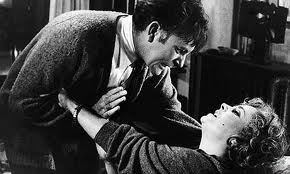
The only thing uttered by the characters in the trailer for Who's Afraid of Virginia Woolf? (1966) is the film's title, a wicked pun repeated and chanted by members of the story's unraveling quartet, originally created for the stage by Edward Albee. “It's easy to talk about it,” the trailer's ever-earnest narrator says of the movie. “It's hard to tell about it.” He then adds that discussion of the film's worth can be summed up by simply mentioning the talent involved, name-dropping Elizabeth Taylor, Richard Burton, and director Mike Nichols with great reverence. As it should be, the trailer is a reflection of the movie itself – a stark snapshot with a tight-lipped veneer that hints at the degradation of decorum. There's no mistaking that something's terribly wrong here, but the preview's refusal to divulge details beyond synopsis basics calls to mind the thin masks George (Burton) and Martha (Taylor) wear in their daily lives.

The first nod to the movie's simmering stew of ugliness comes when Martha finishes her title recitation with a booze-induced choke. In Who's Afraid of Virginia Woolf? nothing's fully  pure, not even the jovial repetition of a pun. The eerie insistence of laughter continues in the trailer, as the narrator tells us that history professor George and wife Martha are “the essence of Ivy League charm to students and friends . . . who don't know them.” In between cackles, the most foreboding of which come from gravelly-voiced Burton, film stills are flashed across the screen, the slideshow looking more and more like a string of crime scene photos (after all, the movie's events could certainly warrant a border of “caution” tape).

“George Segal and Sandy Dennis are the newcomers,” the narrator says, “led by their charming host and hostess to the hell that hides behind those ivy-clad university walls.” The word “hell” is emphasized and followed by a delirious descent. Cigarette in hand, Martha continues to laugh devilishly, then Nick (Segal) gets a turn, then Honey (Dennis) pricelessly lets her giggle transform into a shrill scream of horror. Chilling images of George and Martha in the midst of a struggle are soon topped by a perfect cut to a spinning camera – a sick, twirling dance between Honey and George that hears the two of them chant the title yet again.

It's ironic that a trailer for a work that's so well-written is devoid of any remarkable dialogue. And yet, it's both gracious and appropriate that nearly none of the film's transgressive goodies are revealed. The narration sounds both hasty and deliberate, but were this a modern film, you'd likely know half the plot by the time the clip wrapped, weakening the desire to actually bother seeing the movie. The end of the trailer remains ironic, almost unwittingly so. In order to sell the film, screenwriter Ernest Lehman's work on West Side Story and The Sound of Music is mentioned, as if that could properly prepare anyone for what they'd be getting from Who's Afraid of Virginia Woolf? And the word “Incredible,” tacked on as “the only thing left to say,” reads as an off-key, comically unsure way to close. Not that many people would argue with the sentiment.

R. Kurt Osenlund is the Managing Editor of Slant Magazine's The House Next Door, as well as a film critic & contributor for Slant, South Philly Review, Film Experience, Cineaste, Fandor, ICON, and many other publications.

GREY MATTERS: More Room for Rockstars!

GREY MATTERS: More Room for Rockstars!

null

Sometimes a terrible music movie isn’t such a bad thing.

Good films made by interesting people are mediated creations, in which elements are deleted, themes considered, emphasized, or shaded. From Kevin McAlester’s deft contextualization of the relationship of Roky Erickson's madness to his sublime music in You’re Gonna Miss Me to the balancing act of accomplishment to pitifulness leveled on eternal L.A scenester/DJ Rodney Bingenheimer in The Major of Sunset Strip, there’s all this palpable thinking going on.

No Room for Rockstars (Cinedigm, 2012) isn't hindered by any of that. Whatever it observes about the 2010 Van’s Warped Tour—currently in its 17th year of existence—is just another shiny part of something slick, not terribly stylistically different from, say, an Audi commercial. Touted in the PR as the product of “the team that brought you the highly acclaimed Dogtown and Z-Boys," director Parris Patton’s No Room comes to us with plenty of sheen and literally no idea behind it.

But it’s that very thoughtlessness that allows all manner of cultural stuff to drift to the surface unfiltered, starting with what seems like (and probably is) the Tour’s devolution into absolute, possibly contemptuous, multi-quadrant cynicism, and teetering into issues of class, hyper-capitalism, and the endless, American Idol-style entitlement craze and pathology.

What is Warped? It’s a combination extreme music/sports roadshow started 17 years ago by entrepreneur Kevin Lyman with the sponsorship of skateboard and shoe manufacturer Van’s.

Bikers, skaters, indie labels and zine culture were complemented by left-ish non-profits. From 1993 to 2009, Warped hosted the rocking likes of Andrew W.K., Bring Me the Horizon, Dropkick Murphys, Green Day, NO FX, Parkway Drive, Pennywise and tons more.

The archetypal Warped band was punk and hardcore, but moved on to include metalcore bands like As I Lay Dying, The Devil Wears Prada and the inexplicably ginormous, Warped-playing Asking Alexandria, the rare extreme metal record to reach Billboard’s Top 200 at #9.

But as chronicled in No Room, Lyman—presented here as an distracted enigma wrapped in chinos and a polo shirt—decided in 2010 to expand his tour’s demographic reach to include folkie-emo tweens and R&B-pop teens, and in the process, gladly risk blowing 17 years of alt-culture history for reasons known only to Lyman’s priest, shrink, or accountant. None of Lyman’s many detractors—and they are legion–are represented in the film. Instead we get a guy worshipped by his crew and glimpsed making an apparently legendary bar-B-que. One assumes he signed off on everything in this film. Which means he’s okay with . . . well, let’s look.

The first nu-Warped act we meet is Never Shout Never, the band name of wee Christofer Drew, an adorable 20-year-old acoustic emo troubadour. With his quiff of tousled Bieber-hair and earnest Cat Stevens-esque tunes sure to set tween hearts a-flutter, he’s the film’s artist who falls from innocence.

At first Drew seems too young to buy Gatorade without adult supervision, but a rock star dive from a speaker stack breaks his leg. Immobility leads him to re-think the endless merchandise stands and corporate tie-ins of Warped. He comes to despise how everything—the corporate tie-ins, band tee shirt, belt buckles, jean jacket patches, the endless merch stalls selling boards, drinks, nipple rings, Van’s stuff, Spotify subscriptions, personal style accouterments, and other information and assistance regarding how to officially become an individual—how it’s all become a meaningless, hyper-capitalist shitstorm (I paraphrase). He declares that, after this tour, Warped is dead for him. 

null

Meanwhile, pop/R&B crooner Mike Posner is Drew’s opposite. Posner is . . . well, how to put this?

The arrogant 24 year-old Duke University business grad can’t even thank his fans without smirking. His music is sub-Timberlake Cheez-Whiz performed alone with taped backing tracks to screaming teen girls. His biggest hit is called “Cooler Than Me,” but you know he doesn’t believe such a thing would be possible.

Posner is here to drag an entirely new demographic onto the Warped Tour fairgrounds to buy Monster energy drinks. Posner uses Warped to pimp his record, find new airports from which to jet to LA, guest on The Ellen DeGeneres Show and Live! with Regis and Kelly, and otherwise chill in his luxury bus while ignoring other bands tripled up in stinky buses. Hello, first 1-percent pop star. What a . . . dick.

If Posner and Warped are the film’s Great White sharks, the suckerfish living off their dregs is Forever Came Calling.

A three-piece pop-punk group from Palms, California, Forever follows Warped in a beat-up van, and nags people into buying their demo-CD at every stop. The band has no charisma, and we hear none of their music; all we know about them is their absolute belief that they deserve a slot on the tour because they believe in it, like any other reality show contestant, except this is actually reality. The sad mix of desperation and ego here is often hard to watch.

As children of American Idol culture, Forever is using Warped to leapfrog from obscurity to fame without all the tiresome business of work and music-making. Even as The Team locates the baseless U.S. entitlement hysteria that makes Idol and its variants possible, it decides to turn the Forever story into a mini-Idol narrative itself, compete with a highly dubious finale intended for uplift. The ironies are, of course, lost in the shuffle.

When Suicide Silence actually plays its pummeling "deathcore"—death metal and hardcore mixed—the liveliness of it is almost shocking.

Suicide’s lead screamer is the charming, tatt-covered Mitch Lurker. Lurker has an anxiety disorder that only leaves him when he performs. He’s also got kids and a wife.

In the economic post-apocalypse called the music industry, where big box stores do the Darwin and legal organized crime steals his work (think Spotify, Mog, Pandora), where the only companies who reliably pay you—iTunes and Amazon—do so by the track, as the idea of the album becomes an ancient concept, endless touring is the sole means to solvency.

So I’m glad there’s a Warped for Lurker’s band and family. But at the same time it feels like strivers like Lurker are in the inexorable process of being devalued from stars in the making to something like itinerant day workers.

What Lurker does is singular, special. The Posner type will come and go; Suicide will still be here. Maybe Lyman understood that once, maybe he’s forgotten, clearly this film has no idea. Me, I want more room for rockstars: more is the whole idea, the whole dream.

null

Ian Grey has written, co-written or been a contributor to books on cinema, fine art, fashion, identity politics, music and tragedy. Magazines and newspapers that have his articles include Detroit Metro Times, gothic.net, Icon Magazine, International Musician and Recording World, Lacanian Ink, MusicFilmWeb, New York Post, The Perfect Sound, Salon, Smart Money Magazine, Teeth of the Divine, Venuszine, and Time Out/New York.

SIMON SAYS: Nanni Moretti’s Cinema of Opposition

SIMON SAYS: Nanni Moretti’s Cinema of Opposition

null

The films of Italian writer/director Nanni Moretti primarily revolve around his own ego and then secondarily around questions of moral responsibility, specifically the extent to which we function in society. Moretti himself plays a recurring role in almost all his films: the empathetic and, as he puts it in Dear Diary (1993), "whimsical" skeptic. In I Am Self Sufficient (1978), a single father struggles to come to terms with the fact that his goofy, sub-Brechtian theater troupe isn't really reaching its minuscule audience. And in The Mass is Over (1985), a priest (also Moretti) leaves his sheltered island home to pursue his vocation but finds himself easily distracted and frequently uninterested in his congregants' problems.

I talked with Moretti with the help of an Italian interpreter last week, and my discussion only confirmed what I already knew after watching his films: Moretti is his own best character. Through his characters' various permutations, Moretti, whose new film We Have a Pope (2011) opens at Manhattan's IFC Center this Friday, often wavers between introspective self-seriousness and manic self-parody. In that way, he's a worthy acolyte of poet and filmmaker Pier Paolo Pasolini, whose death Moretti commemorates in Dear Diary when his character takes a long Vespa ride around and beyond Rome's city limits. In films like The Gospel According to St. Matthew (1964) and Hawks and Sparrows (1973), Pasolini questioned whether it was possible to achieve the kind of utopian ideals that intellectual discourse often strives for. The same is true of Moretti's movies, though he often begins by poking fun at himself.

In his movies, Moretti defines himself in opposition to the institutions he is a part of. Even in The Son's Room (2001), a deceptively tranquil family drama that also won the Palme D'Or, Moretti voices frustration with being part of a unit, in this case a nuclear family. Even before Moretti's character’s son abruptly dies, Moretti's character wonders just how involved he can be in his family's collective life. In The Mass is Over, Moretti's stand-in is just as easily uncomfortable with his calling as a priest. He plays soccer with some local children when he doesn't want to listen to a plaintive parishioner and turns up the radio when another congregant tries to confess to him. Moretti often laments that he can't be there for his film's supporting characters. But that semi-comic resistance is a big part of his cinematic persona's charm.

According to Moretti, there's a problematically narcissistic tendency towards self-pity amongst Italians and Italian movies that he parodically embraced when he made Dear Diary. Moretti described Dear Diary to me as his way of spoofing an ongoing trend in contemporary Italian films, where 40 year-old men act like blameless "victims" and lament about being unable to leave behind their difficult jobs, their needy families or their backwards countries. "This feeling of being a victim and not assuming one’s responsibility is a constant in Italians," Moretti told me. "Dear Diary makes fun of that attitude of feeling like a victim for 40 year-olds, for 20 year-olds, for 60 year-olds—it’s still present. It’s a model [of thinking] that still exists and it’s still a problem with the Italian personality. The fault is always someone else’s. If a match is lost, it’s the fault of the referee."

null

Then again, through his films, Moretti expresses his own personal frustrations with being an atheist (in The Mass is Over and We Have a Pope), a Communist (in I Am Self Sufficient and Moretti's 1989 masterpiece, Red Lob), a lover of theater and films (in I am Self Sufficient and Dear Diary), and someone that often finds himself at odds with everyone around him (all of the above). This is funniest whenever Moretti's character despairs over popular contemporary cinema. In I Am Self Sufficient, Moretti works himself up into a frenzy at the thought that Seven Beauties was, upon its original 1975 theatrical release in Italy, hailed as the start of a new kind of Italian cinema. He goes further in Dear Diary, in which he tracks down one of the Italian critics that gushed over the 1986 American serial killer pic Henry: Portrait of a Serial Killer and brings the poor reviewer to tears by reading his laudatory review back to him. Funnily enough, Moretti is reluctant to talk about Henry. When I tried to make an admittedly long-winded parallel between the "psychological simplicity" of characters in both his films and in Henry, Moretti became comically antsy. Even now, there are some films that you simply can't talk to Moretti about, it seems. 

Still, it's not especially surprising to see Moretti act in real-life as one of his characters might in his movies. When asked about how he was preparing for this year's Cannes Film Festival, where he will lead the jury of the festival's main competition, he instinctively responded with a self-deprecating joke. "I’d like to go to Cannes and buy some suits, lose a kilo or two, learn a little English," Moretti said. "I won't be able do do any of these things. The suits, yes, but the English and the weight, no." Moretti went on to tell me at some length what participating in film festivals as a juror has been like for him. But, just like when he jokingly corrected his interpreter, who initially mistranslated "referee" as "coach," Moretti behaved exactly, well, like himself. He's a self-possessed boy philosopher who carries the weight of his world on his shoulders with unabashed gaiety. A victim, he ain't.

null

Simon Abrams is a New York-based freelance arts critic. His film reviews and features have been featured in The Village Voice, Time Out New York, Slant Magazine, The L Magazine, The New York Press and Time Out Chicago. He currently writes TV criticism for The Onion AV Club and is a contributing writer at the Comics Journal. His writings on film are collected at the blog, Extended Cut.

A New Press Play Column: 10/40/70: Melancholia

A New Press Play Column: 10/40/70

This experimental film column began its life at The Rumpus, and we are very excited to see it continue here.  The column freezes the frames of a film at the 10, 40, and 70 minute marks, using these points as the foundations for an essay.null

10 minutes:

The remarkable thing about Melancholia’s early, just married, journey-to-the-castle scenes featuring newlyweds Justine (Kirsten Dunst) and Michael (Alexander Skarsgård) is that, in retrospect, you come to understand that Justine was just play acting. In probably the freshest use and subversion of the Dogme 95 style since The Celebration, these early scenes convey a spontaneity and naturalness (as opposed to the elaborately staged, slow motion prelude) that is highly expressionistic and self-consciously artful. Although the prelude has received the lion’s share of critical attention, it is the scene in and around the limousine, as it maneuvers a sharp turn in the dirt road that leads (presumably from “the Village,” which remains off screen and implied) to the place where Justine’s depression will first express itself. Manuel Alberto Claro, Melancholia’s cinematographer (the film was shot digitally on an Arri Alexa), has said that his “aim is to make images that are in love with the story and not with themselves.”

And so this moment, at the 10 minute mark, we have the tenderness of Justine’s hand on Michael’s cheek, a gesture which seems so genuine but which, in a fine example of delayed decoding, suggests a different meaning, one in which Justine (who will end up having sex, in just a few hours, not with her new husband, but with a young man she is introduced to by her boss at the wedding party). The great English literary historian Ian Watt,, in a study of the works of Joseph Conrad (whose romantic determinism has something in common with von Trier’s), defined delayed decoding as “the forward temporal progression of the mind, as it receives messages from the outside world, with the much slower reflexive process of making out their meaning.” It is, perhaps, only at the end of Melancholia that we remember the early lightness of spirit around the 10-minute mark and wonder: was this all a heroic feat of acting by Justine?null

40 minutes:

Having disappeared from her own wedding reception, Justine is tracked down by her brother-in-law John (Kiefer Sutherland). At the 40-minute mark (which comes during his line “On whether or not we have a deal” from the exchange below), we see him in near silhouette profile, his face filling nearly half the screen:

JOHN: Do you have any idea how much this party cost me? A ballpark figure?

JUSTINE: No, I don’t. Should I?

JOHN: Yes, I think you should. A great deal of money. A huge amount of money. In fact, for most people, an arm and a leg.

JUSTINE: I hope you feel it’s well spent.

JOHN: Well that depends. On whether or not we have a deal.

JUSTINE: A deal?

JOHN: Yes, a deal. That you be happy.

JUSTINE: Yes, of course. Of course we have a deal.

John seems to be speaking not only to Justine here, but to us as well, as the film’s (or any film’s) audience, demanding that we acknowledge “the deal” (the relationship between the film and ourselves) and that we uphold our end of the deal by being “happy.”  In other words, did we get a good “product” for our ticket? (John, as a totalitarian in the realm of feeling, does not instruct Justine merely to act happy, but to be happy.) On one level, John’s instruction is a weird reversal of Jonathan Franzen’s distinction between, in fiction, the Status model and the Contract model. In the Status model, Franzen’s argument goes, the feelings of the average reader simply don’t matter: if readers don’t “get” the book, they are philistines unable to appreciate the complex work of genius. The Contract model, on the other hand, presupposes that “every writer is first a member of a community of readers, and the deepest purpose of reading and writing fiction is to sustain a sense of connectedness, to resist existential loneliness; and so a novel deserves a reader's attention only as long as the author sustains the reader's trust. This is the Contract model. The discourse here is one of pleasure and connection.”

John, from this angle, is von Trier’s sly stand-in for a tyrannical director (“do you have any idea how much this [movie] cost me? A huge amount of money”) who orders his actress [audience?] to “be happy.” And Justine has pretended so well up until now. She flees the set in costume, the ridiculous costume that is her wedding dress, and is cornered in the dark by her dark director.null

70 minutes:

Justine’s sister Claire (Charlotte Gainsbourg) near the beginning of Part 2, on the phone with Claire, who has re-entered the orbit of full-blown depression, a depression which brings her fatally close to Claire. “Hello, darling, how are you?” Claire asks Justine, John hovering and speaking in exasperated whispers (perhaps giving voice to our own “common sense” as viewers, the part of us that resists seeing Justine as the noble, tormented sister who dares to face the truth of extinction, unlike Claire), “Just do as I’ve told you. There’s a taxi down the street, waiting for you. Just open the door and get in. Just get in the cab, darling.” Claire is caught in motion. She passes through frames more swiftly than her sister, as if movement can help her elude the inevitability of the internal catastrophe that is her sister’s fate and her own.

The in-between moment of this frame is un-reckonable, the looming of a vast Disorder.

The Village cannot be reached.

The horses will not cross over.

Nicholas Rombes can be found here. For more entries from the 10/40/70 series, check here.

“Critical Film Studies”: The Hazards of Reference

“Critical Film Studies”: The Hazards of Reference

null

“Critical Film Studies,” the 19th episode of the 2nd season of Community, was probably pretty confusing to most fans of the series when it aired in the Spring of 2011. Heavily promoted by NBC as the show’s full-scale Pulp Fiction parody, the episode turned out instead to be a lengthy and rather muted (by the show’s standards) homage to Louis Malle’s My Dinner With Andre, with only a few Tarantino sight gags tucked neatly away in the periphery. People were understandably disappointed: Community appeared to have traded a spoof of one of the most enduringly popular and widely acclaimed films of the last several decades in a for a more affectionate and high-minded take on a film few in the show’s key demo knew anything at all about. It was, in a sense, an intellectual bait and switch: they promised something familiar but delivered a reference that would prove more substantive, both intellectually and emotionally. 

Though My Dinner With Andre was the toast of the upper-crust New York literati when it was released in 1981, it is now widely regarded by people who haven’t seen it as a movie they’d rather not, ever, lest they become the sort of snobbish intellectuals who regard a film about two guys talking as “interesting” rather than “unendurable”, which they assume it must be. Its reputation has trickled down through pop culture for almost three decades now, and its high-concept setup, of course, has been prime parody real estate for years. One of the advantages of the format is that your audience doesn’t need to be familiar with the film as a whole for the reference click: the novelty lies in recognizing the basic structure–two men meet for dinner and, over the course of an extended discussion or argument, learn more about each other and about themselves–and an un-clever title riff along the lines of “My x With y”. Everything else is context-specific and just sort of writes itself.

A My Dinner With Andre parody is not in and of itself particularly special. Part of the problem is that the format has become a bit of a cliché, but a bigger issue is that lifting the premise of My Dinner With Andre wholesale somehow devalues its content and execution, or at least contributes to the pervading misconception that the film is boring and stuffy and worth remembering only for its setup. My Dinner With Andre is by no means a perfect film, but I’m still immensely fond of it, and it means a lot to me personally for reasons that “Critical Film Studies,” in its own modest way, articulates surprisingly well. It might sound trite (or too typical of a former film student), but I honestly believe that watching My Dinner With Andre for the first time several years ago was something of a life-changing experience, and that it made me, to some extent, a better person.

Before Andre, I felt depleted and vaguely adrift, remote from my friends and from myself. I was living in a run-down student bungalow with four disparate twentysomethings, struggling to care enough about the fifth year of my undergraduate degree to prevent the need for a sixth, and I was one Bukowski book away from drinking myself into utterly cliched oblivion. It was all admittedly pretty juvenile. One night, one of my roommates lent me a copy of My Dinner With Andre, a movie he thought I might enjoy, and, in a bid to avoid schoolwork for a few hours more, I decided to give it a shot. It was a revelation. I mean that: it was though a new world of emotional and intellectual depth had been revealed to me, a world of real conversations and connections and living. My life seemed childish and empty by comparison. Why wasn’t I dining with old friends, sharing a worldview and learning to see things from another person’s perspective? Why was I so reliant on simplistic humor, and on the pop culture that had saturated my life? I suddenly didn’t want to drink too much and quote “Pulp Fiction” and act like a jerk–that wasn’t living, it was acting, and it wasn’t the life of the person I wanted to be.

The next night I brought My Dinner With Andre over to the apartment of some close friends to watch it a second time with them, and then I watched it a third time a week later with another friend. I felt I had to share this feeling with other people. Naturally, I gave into the impulse to call friends from whom I believed I’d drifted apart, and I began dining and talking constantly. It was a strange experience: I was rejecting pop culture in favor of what I perceived to be unmediated experience, but it was a work from pop culture that had inspired me to do it. I didn’t want to rely on movie tropes and references, and yet by imitating Andre I was living an elaborate reference out. I knew this personal sea change had been good for me, but I couldn’t help but worry that my route to being what I felt was a better person was just as steeped in pop culture and cliche as the life I was trying to leave behind.

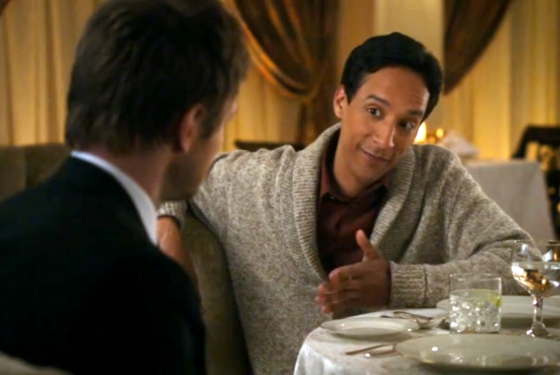
"Critical Film Studies," it turns out, is about exactly this sort of double-bind, about the implications of attempting to reject the influence of pop culture and about the effect of My Dinner With Andre specifically. The episode begins precisely as it needs to: Abed, in the Andre Gregory role, has invited Jeff, his better-looking Wallace Shawn, to meet him for dinner at an uncharacteristically lavish restaurant, which Jeff describes as in an Andre-style voiceover as something he’s not been looking forward to. Abed arrives in a chunky grey sweater, channeling Gregory’s jovial grin, but because Community imitates the forms and conventions of pop culture touchstones as often as its characters explicitly refer to them, it isn’t quite clear if the show is sending up My Dinner With Andre or if Abed is setting it up to look that way deliberately. This ambiguity serves a narrative purpose as well as a thematic one: when a waiter inadvertently brings up My Dinner With Andre and Abed quickly silences him, Jeff begins to realize that he’s been acting out a movie reference without even being aware of it, and a lack of familiarity with the plot and dialogue of My Dinner With Andre is what allows Jeff, as well as the audience, to be fooled by the gag. The writers know the reference will be as much a surprise to most of the show’s viewers as it is to Jeff, and they’re more than okay with that fact–if the episode is in part about a desire to return a state of pop culture innocence, ignorant of references and ready for real conversation, it makes sense that most people watching wouldn’t catch the principal one.

The audience’s assumed lack of awareness is important because it corresponds directly with what Abed’s claims to be afflicted by, which is that his obsession with pop culture has been preventing him from truly living his life and connecting with other people. The point of the dinner, he tells Jeff, is for the two of them to have a meaningful conversation without resorting to shallow pop culture references, which is, of course, what watching My Dinner With Andre has inspired so many of us to go out and do. The problem with following through yourself is that attempting to bond with a friend without pop culture references under the influence of Andre is itself a reference to pop culture, even if it’s a piece of pop culture that’s considered stuffy and obscure. Can a movie inspire you to reject the pervasive influence of other movies? Can a fictional connection drive you to seek out a real one?

Over the course of the dinner, Abed explains a revelation he had while appearing as an extra on the set of ABC’s Cougar Town. As the director calls “action,” Abed realizes that it would be impossible for any character in the fictional world of Cougar Town, even an extra with no lines, to be familiar with Cougar Town the series, because obviously the fiction doesn’t exist in the world of that fiction itself. In order to satisfy his need for authenticity, Abed imagines a fictional persona for himself to pretend to be during his walk-on appearance, but he becomes severely distressed when it occurs to him that this character might have been living a richer and deeper life than his own. It’s the central conceit of almost all fiction: the characters live, actively and with purpose, rather than watching, passively and with disinterest. Like the character in David Foster Wallace’s The Pale King who has an awakening when he hears “you are watching As The World Turns” on TV, Abed is made suddenly and intensely aware of his own relationship to the pop culture he’s been consuming, and being on the passive side is too much to handle. It’s a problem we can all relate to, with one key difference: Abed himself is a character on TV, and we’re watching him discuss his Cougar Town crisis on a show called Community. Fans should be used to the meta impulse on Community, but “Critical Film Studies” takes it a step further–here it’s self-critical.

I sometimes worry about consuming too much pop culture, as I imagine many of us do. Nobody wants to feel shallow, and there’s a constant feeling of obligation to read or watch things that are more serious, or that have more depth. We worry about being the passive spectator, and about coming to be defined by that passivity. For me, “Critical Film Studies” deals with exactly that kind of anxiety, and with how the need to live and connect sometimes seems impossible to take on. There’s no such thing as a totally unmediated dinner, and there can never be a culture-free conversation; even talking openly and honestly with a close friend over dinner becomes a reference to something. Abed tries to reject his dependence on tropes and quotes, hoping instead to have depth, but doing so ultimately proves shallow. Jeff gets indignant when he finds out that’s his been tricked into opening up, but he ultimately learns something. The point isn’t that connection is impossible or that pop culture is toxic, but that we can still have the former while totally subsumed by the latter: sometimes connections cut through all the movie references and surprise us. What “Critical Film Studies” made me realize is that it’s okay to feel weighed down by pop culture, and that’s it natural to struggle fruitlessly against it. It made me realize that the change afforded me by watching My Dinner With Andre could be both shallow and deep, that being inspired by it could be both an elaborate reference and the route to true connections. “It has something to do with living,” Andre says to Wally–and that’s a reference I don’t mind knowingly making.

Calum Marsh is a frequent contributor to Slant Magazine.

TRAILER MIX: House at the End of the Street

TRAILER MIX: House at the End of the Street

null

The trailer for House at the End of the Street goes all Memento on its viewers from the start, beginning at what appears to be the film's climactic chase scene, then winding back, in snippets, to a nasty origin story. Thanks to intermittent rewinds, we can gather that the clip unfolds in eight separate sections, each one stepping a tad further into the past. Though presumably saying little about the film that's represented, this is a rather novel approach to trailer construction, and it's safe to assume that the one-take conceit of similar spookfest Silent House had a certain influence. The trailer demands that you pay attention to its imagery, which is more than can be said of most previews.

When we first see Jennifer Lawrence (whose other film is bound to make this one an instant hit), she's fretting up a storm and climbing into a parked car, where a bottle of chloroform foreshadows her heroine's retaliation. Then we venture back, with the aid of a reversing clock, to see her witness the emergence of a creepy girl, and back again to see her mother (Elisabeth Shue) checking in on her whereabouts. So, that's three sections down, at which point it's clear that her boyfriend (Max Thieriot) is linked to the movie's hauntings. “I want you to leave her alone,” he says of Lawrence's screamer, speaking, we gather, to the ghastly little girl.

It's a bad sign that House at the End of the Street opted to dub its antagonist “Carrie Ann,” a blatant echoing of Carol Anne from Poltergeist. Modern horror ought to do all it can to seem unique, and this doesn't seem the sort of project that will thrive on winking nostalgia. Yet another step backwards in time takes us to a pool party, where Shue and Lawrence's neighborhood newbies are exposed to the local lore, about how Carrie Ann murdered her family in the house we've seen earlier. “That house is the reason we can afford to rent this house,” Shue's concerned mom explains, exposing the family as both relatably un-rich and punishably opportunistic.

It's not every day you get a trailer that delivers its content in reverse, and given the dearth of ingenuity that plagues this micro-medium, any deviation is generally quite welcome. But no one should be fooled by a couple of nifty tricks: beneath the surface, House at the End of the Street still looks as generic as the next girl-on-the-run ghost story.

Finally, the trailer retraces the initial dastardly deed, wherein young Carrie Ann clearly massacred her parents, only to be trapped in her house to haunt it ever more. The always-ominous dripping faucet ushers in the fateful scene, and the (sadly) obligatory parting line has Shue's character assuring her daughter that the home “is going to be really good.” The title then appears, only to disperse into an acronym that makes a handy hashtag (#HATES), revealing a glaring sales priority that trumps strength of form.

R. Kurt Osenlund is the Managing Editor of Slant Magazine's The House Next Door, as well as a film critic & contributor for Slant, South Philly Review, Film Experience, Cineaste, Fandor, ICON, and many other publications.