TRAILER MIX: MAGIC MIKE vs. COYOTE UGLY

TRAILER MIX: MAGIC MIKE vs. COYOTE UGLY

Films that showcase nightlife as a business have a way of settling into their guilt, reminding us that parties have moral consequences despite being the main attraction (think 54, which uses a whole institution to symbolize nightlife's rise and fall). The first trailer for Steven Soderbergh's Magic Mike, a male-stripper story loosely based on lead star Channing Tatum's life, doesn't waste much time owning up to this sub-genre cliché. After kicking things off with a policeman striptease straight out of a million bachelorette parties, and some fancy stage work from Tatum's eponymous gyrating hero, the preview quickly veers to the dreamer's yearning for something more, namely a “respectable” profession and a dollop of love on top. In the process, it wags a disciplinary finger at its own conceit, and reductively promises as many plucked heartstrings as flaunted G-strings.

Conversely, the trailer for 2000's Coyote Ugly masks the reverie respite entirely, making no mention of the songwriting goals of its young lead ingenue (Piper Perabo), and instead exhibiting every sweet sin of the titular New York bar. The B-Side to the Magic Mike clip's tips-in-the-pants atonement (“I am not my lifestyle!” Mike promises his sweetheart), the Coyote Ugly preview sells sex to the last shot, emerging as one of cinema's most misleading acts of marketing. By all evidence, the arc of Magic Mike isn't far off from that of its cowgirl predecessor, which also paired a risqué job with wholesome career ambitions. But while the former felt the need to appease its female target audience with bathos, the latter abandoned its demo completely to rope in live, rude boys, who surely left the film with a mind to murder producer Jerry Bruckheimer.

These two previews are as hypocritical in their respective messages as they are revealing about gender in advertising. Magic Mike's trailer, for all its initial oohs, ahhs, and ab-baring, acts as if its drawing factor isn't a man-candy parade (which also features Matthew McConaughey, Alex Pettyfer, and True Blood's Joe Manganiello), but boilerplate romcom developments. It condescends to women or Tatum fans by assuming they need a snuggly love story, and speaks to the unending taboo of showing too much male skin. Coyote Ugly's clip more or less lies to its audience, consisting primarily of girls on bars and bars on fire, which in fact only account for about 30 percent of the film. It exploited the permitting of female exploitation to pull a thorough bait-and-switch. That  the trailer  worked wonders is really beside the point.

Technically speaking, the Coyote Ugly clip is better by a mile, promising a fun and enticing setting and zipping along with ultra-cool construction, right down to the rough-and-tumble font. Magic Mike's preview has its moments, but only truly hits a groove when Rihanna's “We Found Love” sparks a tonal transition. It's a pity neither of these  trailers could find a pleasant medium, for no one wants a movie merely about flesh on display, but they don’t want such an angle to be shoved under the rug, either. The hot rush of naughty nightlife has a massive, vast appeal—it should neither be used as a ruse nor as a cause for a deceptive wrist slap.

R. Kurt Osenlund is the Managing Editor of Slant Magazine's The House Next Door, as well as a film critic & contributor for Slant, South Philly Review, Film Experience, Cineaste, Fandor, ICON, and many other publications.

GREY MATTERS: PERSON OF INTEREST: A Noir for the New Depression

GREY MATTERS: PERSON OF INTEREST A Noir for the New Depression

null

Person of Interest isn’t the sole new scripted television show in the Top Five because it’s a gold standard procedural mystery. Or because it’s a terrific grown-up look at living with regret that also finds time to explore post 9-11 hot topics of class and morality in the New Depression.

No. Person of Interest is a Top Five show with 13.5 million viewers because it’s figured out a way to use classic noir style while seeming to do something completely of this moment.

Person stars Michael Emerson, much loved for his work in Lost, as Finch, a Manhattan genius billionaire, and creator of a post 9-11 computer system, “a machine that spies on you very hour of every day,” originally designed to predict terrorist attacks.

When Finch became obsessed with the idea that The Machine should predict regular crimes, the government nixed the idea, and so Finch (somehow) took matters—and The Machine—in his own hands, but then realized he needed a partner in pre-crime enforcement.

He settled on an emotionally cauterized ex-CIA operative: "John Reese" (Jim Caviezel, best known as Jesus Christ in Mel Gibson’s gore porn movie about the Gospels). 

Not much is known about Reese aside from his remarkable military skills, detached affect, and preference for $2,000 Hugo Boss-style high couture suits worn, one assumes, out of habit from his spy days at the height of the Cheney years, killing whomever his CIA superiors order for incomprehensible reasons. The result: Reese is a hollow man, he enjoys nothing, indulges no pleasures, and is without family or friends. Caviezel works his three shades of ever-pained grey with aching, Emmy-worthy precision.

Finch favors suits as well, but more stylish numbers that made me think of recent Gucci, all business but with flair and actual color in them, suggesting a past liveliness long extinguished by . . . we don’t know what.

Like the bird whose species he suggests, Finch is wide-eyed and watchful, but thanks to an unspecified past injury, he cannot turn his head, limps, and lives in his library, alone with The Machine. It’s the most curious of pleasures, watching these true two pros feint and parry as their characters test each others’ boundaries. We all know Emerson’s skill with studied strangeness, but Caviezel has the heavier load: he has to both ‘do’ detachment with a dash of rage and occasionally freight it with the driest of drollery, without compromising Reese’s basic deadpan. Kids, don't try this at home.

Anyway, each week The Machine spits out names. They may be victims or they may be perps. Reese does whatever it takes to save or stop that person: surveillance, fighting, killing if necessary.

Eventually, an NYPD Detective named Joss Carter (Taraji P. Henson) joins Finch and Reese in their pre-crime fighting, and voila—it’s the first post-9-11 non-biological family. It takes a while, but as Carter realizes the depths of corruption in her department, she also comes to accept that the man in the striking suits and his friend with the more striking technology are the more effective crime stoppers. The process took time, but Person is all about time.

But so what? Gloomy weirdoes, ex-CIA, mopey cop. How is this really that noir? And why should I care?

The reasons that Person works as noir are intertwined with the reasons you should care. Person limns a version of our world where the shadows are a little deeper, and the debasement of institutions and the people running them are more prevalent.

Another twist is the show’s look, which hop-skips past classic Expressionist chiaroscuro and lands in a New York City Sidney Lumet would recognize, the New York only natives know, which ironically adds a certain exotica to the show. We visit the Queens of kitsch Greek diners, the East Village of fusty Alphabet City coffee shops, of deep Brooklyn storage facilities where you could shoot ten people and nobody would notice for as many days. It’s the opposite of Taxi Driver’s intoxicating filth noir. It’s what's come after Manhattan’s Disney-fication—it’s blah noir.

And corruption festers in the warrens of blah. Corrupt builders, politicians, technocrats, bankers, foster care workers, Wall Street players. An entire section of the NYPD, “the HQ,” is dedicated to facilitating more corruption.

You want mobsters? Person gives you Russian, Hungarian, Polish and Italian post-NAFTA, no-rule-or-regulation mobsters. Arguably worse than them all are the strange, horrible men seen in flashbacks, the monstrous CIA of the Cheney years, who are the source of Reese’s self-loathing and who we see ordering him to commit war crimes like they were going out of business. Which I guess they were. Anyway, the casual, decade-long density of human vileness suggests something James Ellroy would have cooked up.

Even as the show insists on noir’s golden rule—there is no way out—it argues that people have choices, however limited or hard.

In the episode "Cura Te Ipsum," a drug cartel narrative carries us through the soul crisis of a good doctor (Linda Cardellini) going bad. In “Legacy,” a Latina from the projects (April Hernandez-Castillo) trying to escape a lousy past becomes a lawyer representing the wrongfully imprisoned and almost dies for her efforts. Meanwhile, a Ludlum-style spy story powers “Foe,” where a Stasi agent (Alan Dale) who cannot forget ancient slights forces Reese to confront his own bad times. 

Repeatedly, relentlessly, as per noir tradition, episodes hinge as much on the memory of bad things as they do on actual crimes. And it comes as no surprise that the show is the creation of Jonathan Nolan, whose short story "Memento Mori" was adapted by his brother Christopher into the surprise reverse-memory noir hit, Memento (2000).

For me, this memory stuff is pure catnip. As I’ve written here at Press Play, the collision of my face with a bus in 1986 caused sufficient brain damage for me to lose memory of a goodly portion of the 90s.

But seeing as we all exist in the rush of time with only memory on our side, Person has as universal a hook as you could want. And as frenzied as Person’s stories may be, the progress of its protagonists is something best engaged with in the long form offered by television, where a twenty-three episode network order allows vastly more observed and organic character growth.

Reese, on occasion, will now share the ghost of a smile. Finch, on the other hand, is processing something—but what?

We still don’t know the real deal about Finch and his relation to Ingram (Brett Cullen), the close friend with whom he created The Machine. We don’t know if Ingram was killed by the government, by one of the people he tried to save, or any number of scenarios argued about with great relish on Person of Interest fan sites.

What we dread is that Finch killed Ingram and picked Reese because he could relate to his guilt. What we hope is that Finch gained his injuries in an explosion that killed Ingram and is in a process of healing a compromised brain.

Meanwhile, Carter’s been saying she trusts Finch. But she hits that note so hard that one wonders if she’s trying to convince herself more than anyone else. Remember: this is still noir, and trust usually comes with a body count.

At its core, Person of Interest is a noir drama that tries to go beyond noir’s limiting darkness while admitting every week the difficulty of healing and redemption, and how almost anything can screw it up. And how you never know when your number’s up. Nowadays, that’s what will have to pass for optimism.

Maybe people tune in because Person is the rare show they can trust not to lie to them.

Ian Grey has written, co-written or been a contributor to books on cinema, fine art, fashion, identity politics, music and tragedy. Magazines and newspapers that have printed his articles include Detroit Metro Times, gothic.net, Icon Magazine, International Musician and Recording World, Lacanian Ink, MusicFilmWeb, New York Post, The Perfect Sound, Salon, Smart Money Magazine, Teeth of the Divine, Venuszine, and Time Out New York.

SIMON SAYS: Productive Awfulness, or: THE RAVEN Opens This Week

SIMON SAYS: Productive Awfulness, or: THE RAVEN Opens This Week

null

About every month or so, Steve Carlson and I co-host a movie-themed podcast called the Bad Idea Podcast. The podcast’s main conceit, in short: Steve and I are cinephile dumpster divers. We either watch a collection of bad movies or a selection of movies united by a stupid theme (example: movies featuring killer trees in time for the release of Terence Malick's Tree of Life). We do this, as Steve often says, because we're looking for "buried treasure," or, more importantly, a reason "to justify these films' existence."

Fun as this is, I still often wonder if there is such a thing as a productively awful film. We don't think of the films we watch as immediately satisfying but not especially hardy cine-junk food, any more than Solaris is a, uh, cultural vegetable (to be clear: I love Stalker, Solaris and Ivan's Childhood and am fascinated by The Mirror and The Sacrifice, too). So the issue of whether or not there is such a thing as a guilty pleasure film is only tangentially related to our goal for the podcast. Steve and I both acknowledge that we often highlight fundamentally rotten movies, and that, yes, there's something odd about going out of your way to look for the sublime in the awful. But just because a movie is strange does not always mean it's interesting, as we saw during the month when we watched a swath of E.T. ripoffs from around the world. (We watched a German period porno starring a girl in a very bad and very revealing E.T. costume. That was a rough watch.). The kind of film we’re looking for is something that can give us an experience like the one we had while watching Black Devil Doll from Hell, a title we watched for our month dedicated to killer puppets. Black Devil Doll from Hell is insane but it’s insane in a weird, sui generis, avant-garde-meets-blaxtaploitation kind of way. It’s weird in ways that made both Steve and I want to rewind and compare a scene where a woman, while showering, is psychically raped by a sentient puppet to Chris Marker's ground-breaking use of photo-montage in La Jetee. Black Devil Doll from Hell is our kind of movie.

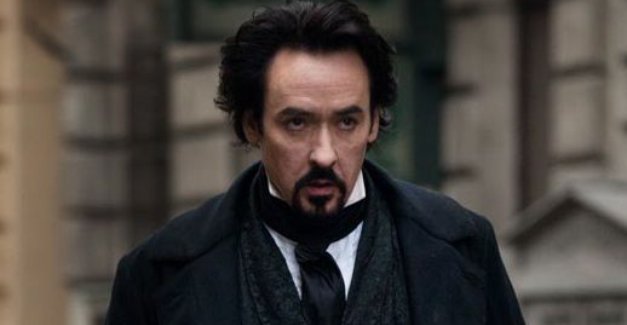
So, it's with little guilt that I express my interest in The Raven, a new thriller in which Edgar Allan Poe runs around trying to catch a serial killer whose murders are all based on gruesome scenes from Poe's stories. The Raven might very well be just a garden variety turd. The plot looks pretty formulaic, and John Cusack looks seriously miscast as Poe (sorry, but Say Anything’s Lloyd Dobler just doesn't have that kind of acting range). But: James McTeigue is directing, which leaves me simultaneously excited and confused.

McTeigue is most well-known as the director of the recent glossy but approachable and not altogether unintelligent adaptation of V for Vendetta. Though that would normally be enough to make me interested, that's not why I'm curious about The Raven. McTeigue also served as 2nd Assistant Director on a number of other Wachowski siblings' related projects: McTeigue worked with the Wachowskis on the Matrix movies, as well as on Speed Racer, as the second unit director. Directing under the influence of the Wachowskis, filmmakers who know how to shoot characters in motion, is not McTeigue’s problem. It's also not really why I'm interested. The single reason for my interest in The Raven is this: McTeigue's last film, the memorably tacky Ninja Assassin.

Ninja Assassin hails from a long tradition of awful movies about ninjas made by white guys. Enter the Ninja, Ninja Terminator, Revenge of the Ninja–all of these films were directed by white guys, and all of them happily exploited the near-mythic image of Nippon's own brutal, stealthy black pajama-clad killers in better Japanese movies (such as Samurai Spy or any of the Lone Wolf and Cub movies). Co-scripted by Matthew Sand and Babylon 5 creator J. Michael Straczynski, Ninja Assassin is pure ninjasploitation. Every narrative cliche is deployed, from the doomed love subplot that teaches Raizo (Korean pop star Rain), our stoic ninja hero, to the domineering but heartless father figure who meaninglessly and firmly urges Raizo to "always remember who you are." The film's action scenes suck because they rely heavily on fountains of computer-generated blood, murky shadows, and goofy action poses to achieve a fairly meager effect. Ninja Assassin's cookie cutter plot has no heart, and its ostentatiously elaborate set pieces have no style. Ninja Assassin is not a diamond in the rough—it's just rough. So why can't I look away?

Something about the expertly executed superficial rotten-ness of his last film gives me hope that with his new movie, McTeigue has taken his propensity for dimwitted melodrama and done something truly flabbergasting. I want to see John Cusack twirl his mustache, drink heavily, and then, who knows, hallucinate that he is a serial killer, or even end up chasing a man-sized blackbird in a trenchcoat. I want to see John Cusack give us a top ten list of pathological clues that point toward the real killer, with a literal bullet punctuating the end of his list. I want to see Edgar Allan Poe get drunk in order to solve crime, just as Jackie Chan’s character gets inebriated in order to fight in the Drunken Master movies. In other words: I want to believe that McTeigue will use the mandate that his big budget and cluelessness as a storyteller have naturally bestowed upon him to make the best damn bad, tasteless movie he can. He has financial power at his fingertips that many other incompetent and flamboyant filmmakers only dream of. I sincerely hope he uses it in a productively awful way.  Because when you watch a fantastically bad film, one that makes you feel like you’re hallucinating while watching it, you’re disarmed. You're reacting purely, without hesitation or rationale. Whatever it is you’re feeling when you watch a spectacularly bad movie, it’s from the gut, and it's icky, and it's strange, and it has to be reckoned with. I want The Raven to be that bad.

Simon Abrams is a New York-based freelance arts critic. His film reviews and features have been featured in the Village Voice, Time Out New York, Slant Magazine, The L Magazine, New York Press and Time Out Chicago. He currently writes TV criticism for The Onion AV Club and is a contributing writer at the Comics Journal. His writings on film are collected at the blog, Extended Cut.

Close Cuts: The Adaptation Process in NO COUNTRY FOR OLD MEN

Close Cuts: The Adaptation Process in NO COUNTRY FOR OLD MEN

null

That No Country For Old Men (2007) constitutes one of Cormac McCarthy’s “lesser” works probably says more about McCarthy’s genius than it does about the book’s individual strengths or weaknesses.  Nearly five years after its release, it stands beside great modern adaptations like One Flew Over the Cuckoo’s Nest and Silence of the Lambs. But the understated greatness of the movie, stemming as it does from the book, must be attributed to the Coen brothers as well, who were able to capture the heart of the book even after shedding some of its most key sections.

Cuts or no cuts, the Coens showed intense loyalty to McCarthy’s work in many ways.  With the exception of about ten scenes, they retained every bit of the book in one form or another, with one broad exception: the larger story of Sheriff Ed Tom Bell (played by Tommy Lee Jones).  The way they altered Sheriff Bell’s dialogue and development is a sterling example of their skillful adaptation of the book, their tightening of McCarthy’s story for the screen.

McCarthy structures the book so that Bell provides its backbone and, in fact, its title. While the movie was marketed around the charismatic characters, the resourceful Llewellyn Moss (Josh Brolin) and the chilling Anton Chigurh (Javier Bardem), Sheriff Bell remains not just the main character, but the very moral compass of the narrative.  McCarthy shows Sheriff Bell’s disillusionment with the world around him through a series of thirteen internal monologues by Bell which open each chapter of the book.  In these monologues, Bell details his unease with life and the pervasive criminal brutality he sees, as well as his back story of painful service in World War II and the dead daughter who haunts him. Bell’s ruminations are long-winded, heavily descriptive, and often dryly monotonous and repetitious; it would probably be fair to say that they make up the weakest collective part of the book, though they remain crucial to McCarthy’s story. Leaving Bell’s monologues out of the movie was likely one of the Coens’ easier decisions.   

The Coens instead synthesized these segments, along with several of Bell’s other scenes, and any mention of his personal story, into three scenes which help the film retain the book’s core: Tommy Lee Jones’s outstanding scenes to open and close the film, and probably the movie’s most mysterious part, near the end, where Sheriff Bell “confronts” the killer Chigurh. 

The Coens solved the problem of how to implement these sections by whittling them down to their bare essence in the opening.  There, Sheriff Bell delivers a short monologue as he discusses his family’s law enforcement lineage, his distress with the crime by a boy he sent to the electric chair, and the larger growing violence of the age.  Constructed with parts of the book’s first, third and fourth chapters and delivered in Tommy Lee Jones’s gravelly, craggy voice as the film pans over the colorful, empty expanse of West Texas, the two minute opening is exquisite, to be watched over and over, and may be the film’s finest sequence.

We hear Sheriff Bell’s winsome, homey, nostalgia become an anxious description of the criminal violence he’s seen, melting into an open, dark despair of the coming storm – embodied seconds later when we see Chigurh viciously strangle a sheriff’s deputy and then shoot down a motorist like cattle.  The film’s ability to effect that difficult transition from McCarthy’s complex prose to the screen while fully retaining the book’s moral direction is a crucial reason for the film’s massive success.

One generally overlooked change the Coens made elsewhere, near the end of the film, further helped streamline the story.  The scene is also fairly mysterious and has vexed many audiences precisely because of how the Coens used it to unpack McCarthy’s text. More than just about any other scene from the book they retained, the Coens altered this scene significantly, and they did this for a central purpose.  They created a more dramatic sequence, yes, but used the scene and Sheriff Bell’s’s imagination to further distill the direction of the cut monologues and show Bell’s breakdown from stalwart veteran sheriff into a conflicted lawman.

The book and the film depict the same basic event in two very different ways, ultimately making the events themselves different. McCarthy’s telling of the scene provides guidance here. After Moss is killed, Sheriff Bell goes back to investigate Moss’s deserted motel room late at night. In the book, Bell approaches and enters the motel room as Chigurh watches him from his truck, driving off before the sheriff can find him. The Coens implemented another sequence.

In the film, Sheriff Bell sits in his cruiser, staring at the police tape and breathing uneasily, before getting out. The camera follows him on each heavy step to the turquoise door.  When Bell creeps up and sees the lock popped out—Chigurh’s calling card of entrance to a closed space via his ever-present cattle gun—he hesitates several times before holstering his gun.

A moment before he does enter, we see Chigurh with his frightening silenced shotgun held tight against his chest, the golden light of the disemboweled lock shaft shining just to his left, the clear intimation being that he is hiding in Moss’s room. A moment after this cutaway, Sheriff Bell pushes open the door, his dark shadow and lowered gun in silhouette against the ugly room. As the audience gasps for his safety, he moves around the room, then, finding no one, he settles on the bed and relaxes before seeing the cover of the vent on the floor, next to several screws and a discarded dime—a tell-tale sign that Chigurh took the case of money out of Moss’s standard hiding place after the police left the crime scene.

This scene begs, where was Chigurh and why didn’t he kill Bell? The answer holds significant implications for the Coens’ adaption.  Based on how we see Chigurh, he appears to be standing, and with light clearly on him, but when Bell enters, Chigurh is neither by the window nor possibly in the open, narrow vent. That leaves one possible hiding space: the door. Here the Coens tease the audience.  When Bell pushes open the door, we can’t see completely behind it, making it just possible that something—or someone—could be there. 

Chigurh may be there behind the door, waiting with his beer can-sized silencer, as the Coens’ clever hint never provides confirmation, but really they don’t have to. From a purely technical standpoint, it’s unlikely that the large killer, holding both his shotgun and the bulky briefcase full of two million dollars could ever fit. Some watchers have stretched to postulate that Chigurh is in the adjacent room.  These views miss the point, based on what the Coens are trying to do with this scene, behind their sleight of hand. 

In the book, Bell approaches and enters the room as Chigurh watches him from his truck, driving off before the sheriff can find him.  While we are led to believe that Chigurh is there, he is also used here as a product of Bell’s imagination, a creature growing out of his fears and revealing of his broader dread, established by the intro and negatively developed. Throughout the course of the movie, Bell has seen Chigurh’s heinous violence as he has murdered people in the coldest blood imaginable. Bell even refers to Chigurh as a ghost right before he goes back to the motel. But while Bell says "it's not that I'm afraid of" the crimes he sees in the opening, he clearly is afraid by the end. This change, developed by McCarthy through his thirteen monologues, is reduced by the Coens to their opening and this scene, where we see Bell relieved that Chigurh isn’t in the room, simultaneously realizing he can no longer serve. The scene leads into Sheriff Bell’s visit to his disabled Uncle Ellis (Barry Corbin), where we learn Bell’s plans to retire.

The final scene, in which Bell reveals two disturbing dreams about his father—and his failure to live up to his legacy—and expresses fear about what is to come, is developed from McCarthy’s thirteenth and final monologue and is as poignant as the first scene is captivating. Interestingly, in an early version of the screenplay, the Coens intended the end of this scene to be given as a voiceover delivered around images of a snowy mountain pass, in much the same way as the beginning was done. Thankfully, they changed their minds, ultimately keeping the camera directly on Bell.  For it is better to see the despair on his haggard face than just to hear it. As he speaks, he is clearly affected and upset by his dreams, and at no point in the film has he looked weaker or more vulnerable than when he finishes and looks to his speechless wife for validation.

Adapting any book, particularly a rich, nuanced one, to screen is an immensely difficult balancing act; the director and screenwriter must create a watchable two-hour product but also can’t cut too much, so as not to risk sacrificing the book’s moral spirit. The Coens perform that balancing act brilliantly, for at that final frame, Tommy Lee Jones captures the soul of McCarthy’s foreboding book and wraps up the Coens’ perfect adaptation.

Mark Greenbaum's work has appeared in The New York Times, Salon, The LA Times, The New Republic, and other publications.

Nicolas Cage is big; it’s the pictures that got small

Nicolas Cage is big; it’s the pictures that got small

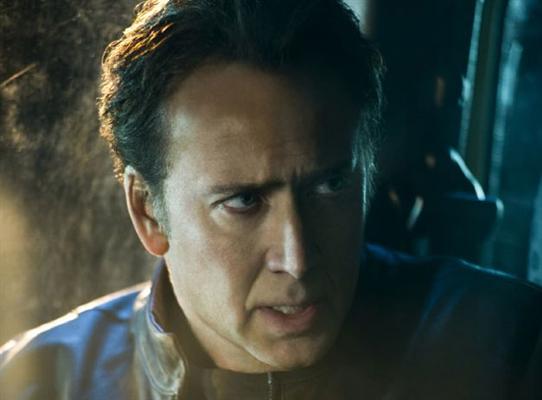
nullThe pictures may have gotten small, but Nicolas Cage is still BIG. More often than not, he acts in CAPS LOCK mode. He HOLLERS and SCREECHES and FLINCHES VIOLENTLY and SHUDDERS LIKE HE'S BEING LOWERED INTO ICY WATER and STARES IN TREMBLING AWE like a guy who just glimpsed a portal into another dimension and is trying to figure out WHAT THE FUCK THOSE CREATURES WITH THE TENTACLES ARE!!!

It took me a while—decades, actually—to accept a couple of facts about Nicolas Cage. One: when he's being subtle, as in National Treasure, It Could Happen To You, Windtalkers and a few other movies, he's good, sometimes affecting, but he tends to lose his special quality; and (2) there's something to be said for a performer whose screen presence is so ridiculously big, and often so knowingly anti-realistic, that it obliterates commonly accepted distinctions between good and bad, believable and unbelievable, and instead becomes an uncanny event, something you evaluate less than you witness. The CAPS LOCK nature of Cage's acting makes him a natural subject for video mash-ups—so much so that my friend Jason Mittell proposed the essay topic "Nicolas Cage as an Axiom of Remix Cinema." Everything Cage does is so vigorously sculpted, underlined, boldfaced and bracketed that you can lift moments from different movies out of context, string them together, and create firecracker-strings of weirdness. And a helluva lot of videos have done just that.

The best, for my money, is Harry Hanrahan's masterpiece "Nicolas Cage Loses His Shit," a symphony of shit-losing backed by a track from Clint Mansell's Requiem for a Dream score. The music track makes it — ties it together like The Dude's rug did his room — because Requiem for a Dream is about junkies being slowly dragged down into a whirlpool of masochistic yet unnervingly romantic agony. It's music fit for a star who can't help doing what he does: a man possessed.

The most troubling Cage mash-ups are the clip reels from Neil LaBute's remake of The Wicker Man. The first one (dated 2007) went viral in a huge way, soon to be held up as proof that the film was poop, its star the worst actor who ever lived. While the out-of-context clips of Cage freaking out are funny enough, they're also unfair to Cage because they shame him for doing something he was specifically hired to do—and does better, or at least more colorfully, than anyone else. I don't think the remake works, exactly, but when you're watching it, there's no doubt that its overheated ludicrousness is intentional: not kitsch, but about style. ("How'd it get burned how'd it get burned HOW'D IT GET BURNED??!!???") Who better than Cage to play a truth-seeker, cycling desperately through fairy tale woods, terrorizing little masked girls and disguising himself in a bear costume? Cage makes as much aesthetic sense in this movie as Gary Cooper did in High Noon. And yet YouTube burned The Wicker Man onto Cage's new calling card and cemented the public notion that he was a rotten actor.

The musical remixes of The Wicker Man were no less problematic, but at least they had a good beat and you could dance to them.

By 2011, the notion of Cage as Crazypants Mega-Ham was so pervasive that Conan O'Brien proposed Nicolas Cage film clips as a replacement for the US government's recently-discontinued "Threat Level" warning system.

Which brings us to Adam Lucas's mash-up "Cage Does Cage." Ostensibly a tribute to avant garde compose John Cage's "4'33" ", wherein musicians do nothing but sit for four minutes and thirty-three seconds, the piece collects snippets of Cage reacting, brooding, etc., without dialogue. Occasionally the actor exhales, sips a drink, or hems and haws while trying to figure out what to say, but for the most part the piece is a hell of a lot quieter than the Cage-mashup norm.

I wouldn't say the video works as a John Cage tribute, because, as Peter Guttmann points, out, the composer's piece "breaks traditional boundaries by shifting attention from the stage to the audience and even beyond the concert hall. You soon become aware of a huge amount of sound, ranging from the mundane to the profound, from the expected to the surprising, from the intimate to the cosmic – shifting in seats, riffling programs to see what in the world is going on, breathing, the air conditioning, a creaking door, passing traffic, an airplane, ringing in your ears, a recaptured memory. This is a deeply personal music, which each witness creates to his/her own reactions to life." Nothing like that happens while you're watching "Cage Does Cage." Let's face it, this video exists because the composer and the actor happen to share a last name. Rather than turn viewers' reactions into the subject of the piece, as "4'33"" does, "Cage Does Cage" keeps the focus on Cage the actor, whose subtlest moments as a listener/reactor/paralyzed spectator are still charged with intimations of future shit-losing. (Indeed, at one point Lucas uses a clip from Vampire's Kiss that was also used in the previously-linked "Nicolas Cage Loses His Shit," but cuts before Cage's pained, fearful expulsion of breath.)

Nevertheless, the video is intriguing, because it's so different from every other Cage mash-up. Its emphasis on reaction and silence casts further doubt on the notion that Cage is a bad actor, as opposed to a performer whose preferred aesthetic doesn't jibe with fashionable definitions of what's good. Even when Cage is being subtle, as he is in many of the clips collected by Lucas, there's an exaggerated (or perhaps "dancer-like") grandness to the way he listens, gathers his nerve, lies down on a floor, or stares out of a train compartment window. It's that silent-film thing again: small viewing window, big actor. But that's not a knock. There's an internal logic to what Cage does and how he does it. You can see this more clearly by observing the quiet Cage than the manic one.

Perhaps the most sensible response to Cage isn't, "What a freak" or "What a bad actor" but "Your mileage may vary." If all acting is small, acting itself becomes small, too; then cinema itself starts to shrink from stylistic risk, for fear of being thought too big, too wild, too "unreal." As Willem Dafoe recently told Press Play columnist Simon Abrams, "I think in many ways, naturalism has ruined movies … I often like understated performances where the actor disappears. I like that a lot. But this imitation-of-life stuff doesn’t always tap into what’s beautiful about the language and the poetry of film."

A critic, journalist and filmmaker, Matt Zoller Seitz is the publisher of Press Play and the TV critic for New York Magazine. His book-length conversation with Wes Anderson about his films, titled The Wes Anderson Collection, will be published in fall, 2012 by Abrams Books.

GREY MATTERS: Cabin in the Woods, Horror in the Dumps

GREY MATTERS: Cabin in the Woods, Horror in the Dumps

null

***SPOILER ALERT: The following piece is one huge spoiler. So, if you haven’t seen this movie yet, consider yourself forewarned.***

If we’re lucky, The Cabin in the Woods will shut down the debased American horror movie machine for a good long while. God knows the damned thing has been creatively moribund for decades and hasn’t had a new idea since Scream, unless you count turning cinemas into torture porn abattoirs as new.

And actually, that was a main reason Joss Whedon co-wrote Cabin with friend and Buffy the Vampire Slayer writer Drew Goddard a few years back: as a protest of Hostel and movies of its ilk.

But Cabin—directed by Goddard—got stalled during MGM’s bankruptcy, and here it is, a dark echo of The Hunger Games, another film about kids trapped in psychotically violent arenas. This one, though, gives equal time to the people behind those funny games.

We know this because, right off, the words “CABIN IN THE WOODS” are hilariously stamped over a freeze frame of said masterminds, a bunch of middle management types in lab coats played by Richard Jenkins (delightfully worn out), Bradley Whitford, and Whedon regular Amy Acker. They joke, place bets, and work as surrogates for anyone grinding another massacre movie out during this period of the genre’s debasement.

Meanwhile, five teens get ready to vacation at the eponymous cabin. There’s Jules (Anna Hutchison), the blond who’s only dumb, it turns out, because her Clairol was secretly doped by agents of the lab (!). And Dana (Kristen Connolly), the “mostly virgin” redhead. And Curt (Chris Hemsworth), the hunk, and Holden (Jesse Williams), who’s the nice guy. And stealing the movie like he stole Whedon’s Dollhouse is Fran Kranz, as Marty the stoner.

As the teens drive “off the grid,” the stations of the Craven/Raimi cross are dully ticked off: road to nowhere. Creepy in-bred dude at gas station. And, finally, the saggy-roof cabin itself, courtesy of Evil Dead.

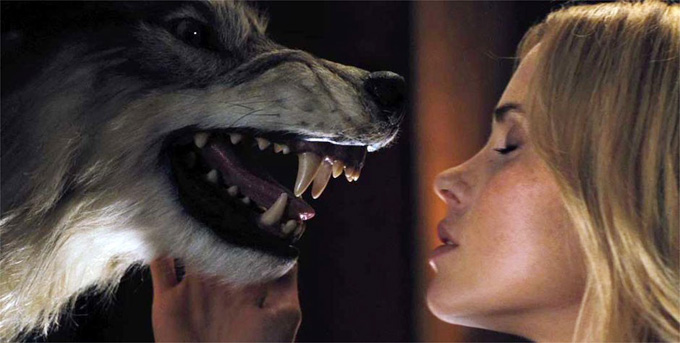
Once inside, Weird Shit happens. Freaky mirrors. Creepy toys. A text written in Latin is read aloud. Zombies rise. And then the violence begins, and we realize that this “cabin” and “woods” were controlled by the lab from the start of the movie, part of a vast underground installation that makes everyone do stupid horror movie stuff ending in sacrificial deaths meant to appease an Entity older than Time, blah blah blah….

Goddard/Whedon stage the first kill with savage efficiency. Three shots: girl gets aroused. Girl shows breasts. Girl gets bloodily skewered. Hip male critics love to excuse this in other films—well, Cabin says, excuse this. (Would the apologists be so enthused if films routinely showed penises being violently, bloodily liberated from their original owners? I know, I know: “Ian, you’re, like, so literal.”)

Generic zombies terrorize and kill in an efficient parody of the prototypical zombie story, which unfortunately drags the film until Marty and Dana break into the installation and find hundreds of Plexiglas cube-cages housing as many monsters for every possible teen kill scenario.

As a black opps cadre confronts Marty and Dana, the latter locates a Staples-style red button that, when pushed, handily opens the cube-cages, and . . . cowabunga! It’s the greatest monster mash in movie history!

It’s as if these beasts flew, crawled and slithered straight out of the last time American horror seethed with invention, due to a cultural cauldron boil of Thriller, the anxieties of Mutually Assured Destruction and AIDS, heavy metal, MTV, MIDI, perms, and a general global urge to out-crazy the next guy. The 80s.

The 80s could cough up an allegory for identity existentialism in the ever-shifting surrealist monster of John Carpenter’s The Thing, or the sexed-up, Lovecraftian latex abstractions from From Beyond, and still have time to create a monster metaphor for AIDS in The Fly. (And because Joss is such an Anglophile, Hellraiser and its Pinhead, the poster boy for S&M perversity in the plague years, are directly riffed on here in the form of another leather/razor creature, named “Fornicus, Lord of Bondage and Pain” in the credits.)

Speaking of politics—and you could—George Romero practically screamed his zombie-metaphor leftism in Day of the Dead while Wes Craven reported Haiti’s long suffering under dictator “Papa Doc” Duvalier in The Serpent and the Rainbow.

All of those movies, plus Gremlins, An American Werewolf in London, A Nightmare on Elm Street, Poltergeist, and dozens more comprise what turned out to be the final flowering of America’s dark imagination, and that’s what’s celebrated in Cabin’s monster mash.

And when all that’s left is a vast pool of blood, it’s like a sanguine sigh, because we all know there’s no room for such lunatic invention in American cinema, not any more.

But I digress.

Cabin ends with a trans-supernatural “Director” urging the campers to use their "free will" to die the way she tells them to. Marty and Dana choose to smoke one last doobie and let the world go to hell. What Whedon asks is: is a species that enjoys watching the graphic rape of a decapitated girl's head and worse in movies like, say, the French High Tension really worth the bother?

Cabin can’t help but be the most slight of Whedon’s efforts, mostly because even a mood master can’t quite negotiate the switches from slaughter to light comedy needed—he’s just not heartless enough. We’re just getting used to the idea that our pitiful heroes might escape, for instance, when one of them motorbikes into what turns out to be a force field that fries him like a gnat in a bug zapper. Cool effect. Which is kind of hilarious. Except then you’re like, "Wait, wasn’t I starting to like this guy?" And yeah, everyone knows Whedon is hoisting us on the petards of our affections—except we never had enough time to really like the zapped biker, so we’re in emotional limbo.

Still, what works is often funny. Goddard directs his first feature with impressive élan, and damned if that monster melee doesn’t inspire: it’s made by people who know that horror cinema can be great art or even awesome trash, carrying out a holy war against what it’s turned into. Plus—if you miss the evil white unicorn, you have nobody to blame but yourself.

But Whedon just can’t hew to the mission statement of creating teen kill archetypes: unable to resist the urge to create characters, he lands somewhere in between sometimes. He can’t even hate the engineers before starting to understand what it would be like having such a soul-killing job. He’s just too humane.

Cabin could, of course, actually fail in its intentions, as it inspires the industry to issue idiot look-alikes about entrapment scenarios that reference other movies, leading us to find, yet again, that nothing can drive a stake in the postmodern monster, because it lives freely on past dreams of the dead, no matter how much you scream.

Ian Grey has written, co-written or been a contributor to books on cinema, fine art, fashion, identity politics, music and tragedy. Magazines and newspapers that have his articles include Detroit Metro Times, gothic.net, Icon Magazine, International Musician and Recording World, Lacanian Ink, MusicFilmWeb, New York Post, The Perfect Sound, Salon, Smart Money Magazine, Teeth of the Divine, Venuszine, and Time Out New York.

Trainwreck Rising, or Jeff, Who Is One with the Universe

Trainwreck Rising, Or Jeff, Who Is One with the Universe

null

A problem—if not the problem—with stoner comedies is that they tend to lack ambition.  That is not simply, ha ha, that content follows topic, though it may be that the target audience is undemanding and easily entertained.  So there is no great mystery as to why potheads are happy to see themselves caricatured as good-natured goobers.  That's not inherently a bad thing.  There is comedic potential aplenty in watching the zonked try to cope with basic tasks, and/or gawping at outlandish situations that would test even the straight of brain.  Jeff, Who Lives At Home, the most recent effort from writer-directors Mark and Jay Duplass, does not entirely break with this tradition.  The shape of what Netflix terms "late night comedies" is to set potheads on a basic task or vague mission and let it spiral out of control as wooly perception and altered cognition yank them through strings of cartoonish absurdities. Now, some of these stories meander more than others, some films have more on their minds than munchies and giggles, but that's the drill, from Up In Smoke (1978) to Dazed and Confused (1993) to Friday (1995) to Smiley Face (2007) to Harold and Kumar Do a Thing (2004/08/11).  For Jeff, Who Lives At Home that means sending its thirty-year-old pothead protagonist out of his mother's basement, ostensibly on an errand  to buy wood glue for a broken shutterbut really in search of something like the meaning of life.  It is in this concern with spiritual yearning that Jeff diverges from the pack: Jeff sees a world beset by mystical signals, and Jason Segel plays him as a big-hearted and hazy-headed Apatosaurus plodding through Baton Rouge on a vision quest.  The illuminated trail of bread crumbs will brush against Jeff's brother, Pat (Ed Helms, in rabid asshole mode), whose shambolic marriage is in mid-collapse, and their mother, Sharon (Susan Sarandon, giving good put-upon), who is feeling, of late, that life has passed her by.

Before we get too far afield, an assessment.  Jeff, Who Lives At Home is fairly begging to be called "sweet," and tends toward pandering, cornball Apatow-esque Within-Every-Slob-a-Heart-of-Gold reassurances.  Whether or not one has use for the Duplass brothers' wobbly, zero-discipline technique, they have stood their ground, trademark unmotivated micro-zooms intact, as they moved from backyard productions The Puffy Chair (2005) and Baghead (2008) to larger-scale pictures boasting bona fide comedy stars and studio distribution.  Appreciate it or find it nauseating, the style, such as it is, sort of works to convey the POV of a blurred mind snapping into occasional focus, particularly in early scenes as Jeff blazes up, and that's not supposed to be a backhanded compliment.  If we indulge in some fuzzy, speculative thinking of our own, consider that, as the independent film boom of the early '90s bloated into the corporate-backed pseudo-indie debauch of the late millennium, the Sundance Picture became the indie equivalent of White Telephone cinema—award-magnetic, pre-sold, and bourgeoisie-approved.  That might make early-'00s mumblecore a scruffy, apolitical analog to Italian neorealism.  If mumblecore might be considered a "movement," it is a one without organization or manifestos in French cinejournals, but one striving for a de-glammed mopey slice-of-life naturalism in subject and form.  What we have here and now, then, is not unlike the encroaching froth and bosomy movie stars that marked the shift to Neorealismo Rosa: the presence of Susan Sarandon heralds the emergence of Pink Mumblecore. (That’s an idea for a Trends In Early 21st Century Cinema paper that you can have for free!)

While the stoner comedy tends towards pointless shaggy dog tales, aesthetic indifference, and, most criminally, frequent un-funniness, they can provide a nice counterpoint to goal-driven Hollywood storytelling.  Cases in point: The Big Lebowski (1998) and Signs (2002). A stoner comedy by default, but so much more, The Big Lebowski does The Long Goodbye (1973) one better or maybe backwards, as Joel and Ethan Coen lovingly satirize Raymond Chandler by ramping up the writer's excessive plot convolutions, widening the menagerie of eccentrics, and suggesting that the ideal detective for such a carnival would be as freewheeling and open-minded as possible: enter The Dude.  As the plot twists, misfortunes and desperate motives of hardboiled fiction pile up, The Dude (another Jeff) shuffles through the maze with a head clouded by mother's-milky vodka, Good Shit, and sunshine.  By the climax, the central kidnapping plot doesn't burn out so much as fade away.  There was no kidnapping, no real ransom, and everyone was faking it but The Dude, whose tumbleweed approach to detective work indeed makes him the man for his time and place.  He tries to focus on the clues, but they go up in smoke.

There is no central mystery in Jeff, Who Lives At Home, either—or there are mysteries, but they are small-scaled and life-sized: Is My Wife Having an Affair? (Pat), Who Is My Secret Admirer? (Sharon), What Is My Purpose In the Cosmic Plan? (Jeff).  Still, Jeff is about clues.  The manner in which these conflicts unfold and entwine depends on how characters divine meaning from the signals they are/aren't picking up.  Thus, Pat spends the day stalking his wife, Linda (Judy Greer, fuming throughout, topped off with a showcase meltdown), with Jeff in tow, tracking her and following leads, and he confronts her pre-tryst, rather than trying to open healthier channels of communication.  Sharon sits in her cubicle at work, feeling lonely, unfulfilled and, in a desperate moment, will say she "hates" her sons.  Sharon is indeed being sent messages—anonymous Instant Messages and sailing paper airplanes containing flirty notes—and tries to sniff out the culprit.  Jeff, meanwhile, sees every object, action and word as laden with portent.  Blame M. Night Shyamalan.

When we meet Jeff, he is alone and giving a reverent monologue about the subtle beauties and comforting philosophy of Shyamalan's alien invasion/family drama/Twilight Zone thriller, Signs.  A problem—if not the problem—with Signs is that it scoops together a mountain of frayed genre clichés and plot contrivances so lazy that they become outrageous, then expects surprise and blown minds from the audience when everything plays out exactly as expected.  Will a priest who has lost his faith manage to find it again when he is splattered with a barrage of miracles?  Gee, I dunno, man.  If everything snaps into place, people are always where they need to be, everything is foreshadowed and no props go unused, is that evidence of God's Plan or does it simply show that God is a hack screenwriter? Signs is reverse-engineered in a way that is either disingenuous or dumb.  As a primo example of how he reads the film, Jeff says his favorite character is the daughter, played by Abigail Breslin, who cannot manage to drink a whole glass of water, thus littering the house with half-full glasses, thus providing the means of destroying the hydrophobic aliens at the end.  Another way to read this might be that a clumsy attempt at characterization by way of cutesy quirk leads to a nonsensical plot point that does not hold up under scrutiny.  Anyhow, Spoiler Alert: Jeff, Who Lives At Home starts by spoiling the end of Signs.

As our hero hits the bong, an infomercial tells him to "pick up the phone" just as it rings.  In Signs-land there are no wrong numbers, so when the belligerent caller asks for Kevin, Jeff follows a trail of Kevins—a basketball jersey, a candy truck—in search of destiny.  Weed is particularly good at fostering this kind of augury-rich vision, at scrubbing the texturing from the Matrix avatars to show the code running the show.  The problem is that weed is not good at spurring one to action, and tends to strip away necessary coping filters (psychedelics, of course, are even better for popping the top off the universe, the cons also magnified in force).  The world's Jeffs might well receive revelation through spliff, television and Pop-Tart, but it has to be carried off the couch, out of Mom's basement, and into the world.

It's like the birds, you see?  Jeff keeps looking at birds flying overhead, squinting serenely at those airborne souls that also rhyme, visually, with the paper plane aimed at his mother's heart, and with a helicopter he will see later.  The film does not directly address the ultimate cheat of Signs, but provides a sort of balance to Shyamalan's sleight-of-hand.  Jeff moves through a chain of coincidence with increasingly dramatic consequences, and in the climax achieves some traditional screen-ready heroism.  His personal motivation may be in sign-hunting, but sometimes causality is completely mundane, and the most important sign read is simply that when there are rescue aircraft in the sky, someone is in trouble.  Regardless of what one has just smoked, or opinions of mumbled-jumbled mysticism, what goes on in a good Tarot reading, dream analysis, or therapy session is not so different.  When the characters in Jeff, Who Lives At Home open themselves to the Signs, their most important work is in making themselves receptive to signals given off by other people, and contemplating an open-ended set of symbols that reflect back on themselves.  When one throws some light on the path, it becomes much easier to stay on track or choose to plot a new course.  Where Shyamalan rubs his characters' faces in incontrovertible predestination, the Duplasses give their cast the freedom to act on such signals as they see fit, and soar or fail based on those choices.

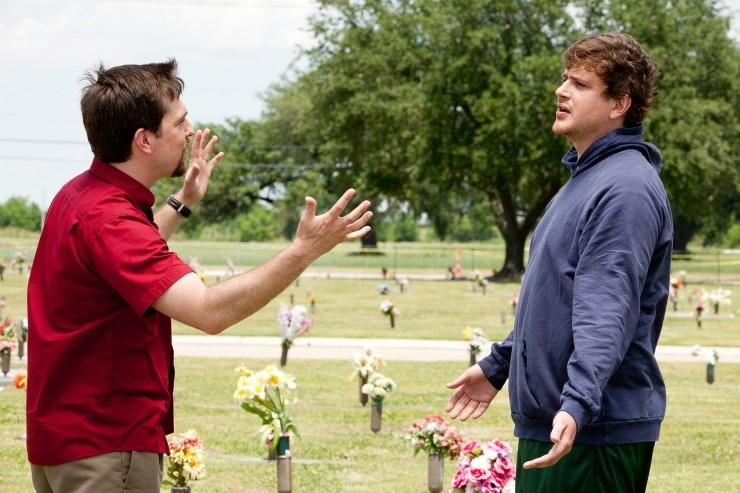
Jeff is looking for a mission, but he seems to be missing the biggest sign.  He already has a mission.  His mother wants him to go to the hardware store.  In a way, his mission is even smaller than Pat's quest to save his marriage, or Sharon's midlife sorta-crisis.  In a scene at the heart of the film, Jeff and Pat stand in the cemetery where their father is buried.  The brothers have had terrible days by any standard.  Pat has crashed the new Porsche that he can't afford; Jeff has been beaten up and mugged.  Both recall dreams in which their dad asks, "What is the greatest day in the history of the world?"  Pat sees this as evidence of a forgotten, shared memory.  Jeff sees synchronicity.  Mysterious either way, no?  They both have an opportunity here to remember the Invisible Father's message: today is the greatest day in the history of the world.

On this greatest of days, Jeff, who lives at home, will haul his ass out of the house, inadvertently heal his family relationships, and more.  But what of the wood glue?  Whether you can—or even want to—read the Signs or not, the Signs don't get any gluing done, no matter how high you are.  The gentle joke of the title itself is that we do, indeed, all live at home.  It's just that sometimes it takes a Jeff to recognize that.  Do not wonder where your place is in the universe.  You are in it right now.

Chris Stangl lives, writes, paints, draws comics, and drinks coffee in Los Angeles. Besides designing the Press Play logo, he has done sundry artwork for Meltdown Comics, The Steve Allen Theater, the Upright Citizen's Brigade Theatre, musician Old Man Charlie, and illustrated the humor book The Explosexuawesome Career Guide. He blogs on film and television at The Exploding Kinetoscope. Like all native Californians, he comes from Iowa.

10/40/70: KAIRO (PULSE)

10/40/70: KAIRO (PULSE)

Context:

Kiyoshi Kurosawa (no relation to Akira Kurosawa) is perhaps best known for Bright Future (2003) and Tokyo Sonata (2008) and although these films bear his visual watermarks—very long takes, slow tracking shots, naturalistic settings, frame compositions that often leave large, impersonal spaces between characters—it is on his metaphysical detective/ghost films that his reputation rests. The most distinctive of these are Cure (1997), Charisma (1999), Pulse, and Doppelganger (2003), all of which, with the exception of Pulse, feature the remarkable, Peter Falk-like Kôji Yakusho as the lead actor. The pacing of these films produces an oddly perverse effect: the slower they are (and they are slow) the more anxiety they produce, as if the executioner’s bullet fired at the prisoner against the wall took two terrible hours to reach her.

Pulse begins with a man and a woman alone on an enormous ship on a dark sea. It becomes clear that they are survivors of some sort of massive, perhaps global, catastrophe. We flash back to Tokyo and the events that lead up to the epidemic of suicides, events that are presented elliptically and without the usual narrative exposition that we expect in apocalyptic films. Details emerge, but they are sketchy and difficult to piece together: it seems that some sort of ghostly presence haunts the Web, a sort of virus that causes people simply kill themselves when exposed to it. The protagonists address this obliquely, through philosophical conversations that center on topics such as loneliness, the possibility of love, and whether we become ghosts in the afterlife. The ending of the movie loops back to the beginning, on the ship.

null

10 minutes:

Michi and Junko are at work at a Tokyo plant wholesaler, still in shock over the death of their friend Taguchi, who recently hung himself. That bare sentence doesn’t convey the cold horror of the scene, for it’s not just that Taguchi hangs himself, but that he does so in a completely unexpected and casual way, moments after the most typical banter imaginable with Michi, who asks him where a disc is, as he casually takes a phone cord out of a box of junk on the floor. When Michi goes over to his desk for the disk, he steps into another room with the cord and hangs himself, off camera. He may have well just stepped into the next room to put some bread in a toaster.

And now, at the 10-minute mark, Michi and her friend find themselves, on the roof of the plant company, surrounded by green, by life. This shot comes during one of the many long takes characterizing Kurosawa’s style, takes in which the sparse but soul-killing violence in his films come at us from the edges and margins of the frame. For all the formal, rigorous, distancing strategy of the film—also evident in Cure and Charisma—there is a healthy dose of quiet and sly humor, as in the fact that these women who work with dirt and plants and water also happen to dress like this. This visual contradiction—a naturalistic, washed-out setting featuring characters whose dress seems out of place—is just one example of how Kurosawa slightly de-familiarizes commonplace settings, rendering them just off-kilter enough to make us uneasy.

null

40 minutes:

Michi, concerned about friend and co-worker Yabe (who has seen what’s on the disk that Taguchi was working on and will also kill himself soon), asks her boss if she can go check on him. This is just one of many shots where characters are framed and reframed on the screen, their bodies appearing behind or in front of a proliferation of rectangles—in this case indicated by the fence frame Michi stands before and the Mondrian-like structure in front of her boss–which only reinforce the film’s relentlessly deterministic sense of alienation. For no matter how these characters try to cope with whatever it is that’s causing the growing plague of suicides, they remain trapped, both individually and collectively, by certain patterns of thinking. Kurosawa uses the mystery/detective genre as a trope to suggest that the criminal is not an individual, or even a human being, but rather a force that is an expression of the collective unconscious of an entire society.

Frame details:

1. The plants, in their sad plastic pots and buckets, straining toward the dim sun.

2. The green water hose the boss is about to wrap into a coil.

3. And also: the fleeting thought that the boss might hang himself with that hose, as Taguchi did with the phone cord.

4. The barbed wire fence, like a cage.

5. Michi’s gaze, as if she has realized something, perhaps the dark knowledge that those plants, incapable of suicide, will outlast her and all the other humans.

In the context of the entire film, this frame from minute 40 constitutes a form of visual terror. Because violence in Pulse, more often than not, occurs unexpectedly and without visual or musical cues, the audience is conditioned to expect it at any moment. Although there’s not real tension between Michi and her boss at this moment, we ourselves bring tension to the scene, noticing for instance, the grip of the boss’s hands on the hose, and the gloves he wears, and the way that the slight tilt of his body and his hat obscure his expression, and the way that Michi keeps her distance from him. The coiling of the hose and the possible uncoiling of his violence. These are possibilities the frame permits.

null

70 minutes:

In an interview regarding Pulse, Kurosawa has said:

Ultimately, the Other—anyone who is not us—remains incomprehensible no matter how much we try to communicate. And we should try to communicate with the Other. This concept is valid because we are surrounded by the Other: the incomprehensible humans and incomprehensible actions human beings take.

Ryosuke (wearing a tee-shirt from Gilley’s bar in Texas, where Urban Cowboy [1980] was filmed) and Harue, university students, are becoming aware that the suicides are not isolated, but something that threatens to wipe out all humankind. The space inside the frame is itself disorienting, as there appears to be a mirror behind the bookshelves to the right of the gray chair. A white curtain hangs on the wall, obscuring what? Ryosuke’s posture is defeated. Harue refuses to look at him.

The frame is from one of many scenes in Pulse where the narrative comes to a nearly complete stop, offering us a chance to experience the reality of what’s happening in much the same way as the characters experience it. What they—and we—gradually come to understand is that, as Kurosawa suggests, the monstrous Other is not outside, but inside. Ryosuke, Harue, and the other characters carry it within themselves. As do we.

Nicholas Rombes can be found here. For more entries from the 10/40/70 series, check here.

TRAILER MIX: LOOPER

TRAILER MIX: LOOPER

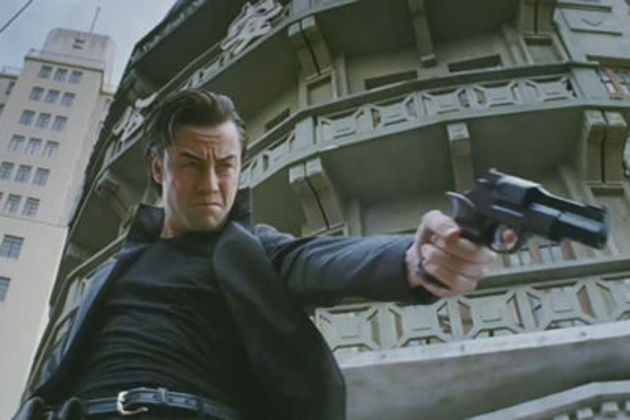
Sometimes a trailer's ability to sell a novel concept can make you forget its otherwise ordinary construction. Such is the case with the trailer for Rian Johnson's Looper, a clip whose pervasive stylish “whoa” factor offsets the reality that, formally, it's all quite familiar. A time-travel actioner, Looper reunites Johnson with Joseph Gordon-Levitt, star of the writer-director's breakthrough cult fave, Brick.  The trailer suggests that the collaborators are steering toward the mainstream and moving away from the impenetrability of Brick's talky mystery, but an interest in noir remains firmly intact, and it yields aesthetic bonuses that also trump the requisite trailer beats.

In voiceover, Gordon-Levitt's assassin (or “Looper”) dishes the dirt about his job: whacking mob casualties from 30 years in the future, where the invention of time travel has allowed gangsters to get rid of bodies by beaming them into the past. It's occasions like these when exposition is given a major pass, and viewer hand-holding is forgiven thanks to heady plot details. Amid the rest of the film's enticing elements (the makeup effects add much to the appeal), hearing Gordon-Levitt's character explain that he's suddenly tasked to off his older self (Bruce Willis) recalls Ellen Page's wide-eyed play-by-play in Inception, which was criticized by many but enthralling nonetheless. Fascination makes explanation go down easy—this is why The Hunger Games plays so well despite an overall lack of nuance.

One might accuse Johnson of taking a page from Christopher Nolan's book if not for the noir-ish blood coursing through this comparatively modest director's work. From the start, this preview doesn't look like it’s touting a film that takes place in the present, but rather in a slick and smoky 1940s milieu, where men grease their hair, eat in diners, and close deals in shady, nonspecific city apartments (in Johnson's view, what is old is continuously new again, as the gangsters of “the future” are shown in Dick Tracy fedoras, and captured in grainy film stock evoking old photos). Aside from fast new cars and live nude girls that promote contempo sex appeal, there's precious little in the trailer to mark events as being in present-day. Gordon-Levitt's Anton-Chigurh-style blaster could be from decades back, and even the Loopers' payments, evidently strapped to the backs of their targets, are good, old-fashioned gold bars.

The trailer closes with a rather unremarkable montage, which is a perfect foil for its parting shot of adrenaline. Houses explode, guns go off, characters fall from great heights, and recognizable side players are given smidgeons of screen time (there's Emily Blunt wielding a shotgun as a presumable love interest, and scruffy clown Jeff Daniels warning of the obligatory quantum-leap side effects). Scored to an upbeat techno track, the nimbly-edited coda is dishearteningly generic, right down to Gordon-Levitt's final point-and-shoot hand gesture. Fortunately, by then the trailer has already cast an arresting spell.

R. Kurt Osenlund is the Managing Editor of Slant Magazine's The House Next Door, as well as a film critic & contributor for Slant, South Philly Review, Film Experience, Cineaste, Fandor, ICON, and many other publications.

GREY MATTERS: One Soul Separated: THE BALLAD OF GENESIS P-ORRIDGE AND LADY JAYE

GREY MATTERS: One Soul Separated: THE BALLAD OF GENESIS P-ORRIDGE AND LADY JAYE

null

Like high romantics everywhere, the lovebirds named Genesis P-Orridge and Lady Jaye felt as if they were really one soul separated into two bodies. Unlike everyone else, they did something about it. After meeting in New York in 1993, the two set about becoming mirror images of one another, first with small things like matching bleached bobs, matching pop and fetish inspired fashion and slashed red anime make-up, before moving on to the hard stuff in 2004: radical, transformative cosmetic surgeries meant to make them look two matching halves of a single "pandrogynous being,"  

And that is how we meet musician/artist P-Orridge (born Neil Megson, 1950) and Lady Jaye (born Jacqueline Breyer, 1969) in Marie Losier’s remarkable new film, with matching hair and fashion styles, breast implants, plumped Restalyne lips, and enhanced cheekbones.

A total break with any music-doc form, The Ballad of Genesis P-Orridge and Lady Jaye also drops any semblance of linear narrative. It opts instead for a jangly non-stop montage of associative images, ideas and sounds to navigate P-Orridge’s five-odd decades of working subcultural fringes—from being an early performance art and industrial music pioneer, to becoming a modern primitive provocateur—and makes it all seem like falling off a log.

But the illusion of effortlessness is just that. Cinema like this, that makes poetic connections entirely on symbolic, suggestive, or subconscious levels, requires a degree of aesthetic focus and rigor you find once every few years, if that.

Losier—a 2006 Whitney Biennialist and collaborator with Guy Maddin on the short film Manuelle Labor (2007)—is up to the task. Like the artist being uncovered, her film is all about a charmingly knockabout faith in strange connections—aesthetic, interdisciplinary and maybe even spiritual.

And so it’s playful and ironically perverse that Losier starts off by disconnecting P-Orridge from his/her exotic strain of fame (damn these pronouns!), limning the artist as just another eccentric expat Brit living in Brooklyn, an arty, eccentric fifty-something guy making dinner in formal drag wear.

But Losier knows she has a secret weapon that will stop audiences fromdismissing P-Orridge as a Quentin Crisp wannabe: his adorable, reserve-melting, total adoration of Lady Jaye.

She’s an ice-blond contradiction, a fetish-styling glam girl who’s also a nurse specializing in the care of kids with incurable disabilities.

P-Orridge recalls staying at a dominatrix friend’s dungeon in the East Village when a door opened, and into the light stepped Jaye, a vision in groovy 60’s style clothes and fetish accoutrements (“my two favorites!”).

Smitten, P-Orridge prayed, “Dear Universe—If you find a way for me to be with this woman, I will sleep with her forever.”

The universe would give one of the worst conditional “yes” answers ever. But P-Orridge didn’t know that, of course.

And then, only after the Genesis/Jaye origins story, does Losier make room for biography, as hercameras roam P-Orridge’s basement. Hundreds of boxes and crates hold thousands of files of newspapers, magazines and ‘zines, while more boxes hold thousands more home, network, pirate and internet video, all of it documenting and critiquing over thirty years worth of performance, music and art-making at the interstices of international fetish, BDSM, industrial, and body modification cultures.

In this blizzard of outlier arts history—post punk, Beat and UK history bits in multiple formats mix and match to becomes mini music videos accompanying P-Orridge’s stream-of-memory narration—but two elements are especially fascinating and essential: a video of P-Orridgein the ‘80s, dressed in hyper-masculine military mufti and practically attacking an admiring crowd. Where, one wonders, did this manned-up Genesis go?

And there is a lot about P-Orridge’s mentor, William S. Burroughs, who in the late 60s went out of his way to land the young and struggling P-Orridge arts funding grants and also introduced Genesis to the cut-up method, wherein linear texts are sliced into impossible-to-predict ‘new’ works.

The cut-up defined P-Orridge’s ‘70s band, Psychic TV, and his ‘80s band, Throbbing Gristle, both way-ahead-of-their-time groups that co-created the industrial genre that led to groups like Nine Inch Nails and provided basic DNA for all electronic dance music genres. But the ultimate cut-up, of course, was the form Genesis and Lady Jaye’s partnership took.

Which most people would think the act of two very disturbed people. And so, in the spirit of cutting folks off at the corner of Freud and Rosebud, Losier and P-Orridge (it’s unclear how closely the two worked on this project for the eight years of production) offer up a video recreation.

A cute sad boy of about twelve years, dressed in British school clothes stands, in front of an institutional edifice, as P-Orridge recalls years of daily bullying, in which he was almost beaten to death.

Cut to:  The real P-Orridge wearing a cacophony of contradictory fashion semiotics—Fascist S&M chic. Red lipstick. A Hitler moustache. Warhol hair. He screams, “I am so sick and tired of being told what I’m supposed to look like! This is not my body!  This is not my name! This is not my personality!

It’s an almost shockingly bare declaration of independence. But what of Lady Jaye?

During the film there’s a sense of mystery about her. She always seems to be finishing something, or leaving somewhere, of in the middle of laughing about something we don’t know about. The film has no special effects, clever editing, or odd framing, but she still seems . . it’s hard to explain . . . spectral in some way.

During a Psychic TV reunion, P-Orridge tells us she’s upset about something, but all I could see was a blur of her moving and, yes, looking pissed, but then we were on to something else.

Then the hammer fell and I wondered about that:

Lady Jaye died in 2007. Cancer. Next to her beloved after making love, or so goes the ballad.

First off, I was glad Losier didn’t cheapen Lady Jaye’s story with talking head treacle that would "explain" her. And P-Orridge, who speaks glowingly about how “we made love” or how “she looked so beautiful,”  wants to keep details about Lady Jaye private and cherished at the same time that he offers her legend as a lasting image and archetype for everything he might consider pure and beautiful.

That some of Losier’s film can be read as myth-creation does not devaluate the far greater parts that are inarguable acts of music history and culturally integrated biography. But the film doesn’t forget to remain true to its title as it evokes another ballad, another musical couple walking in another park, as P-Orridge and Lady Jaye, dressed all in white, stroll through Brooklyn’s Prospect Park.

 “I love you,” says one voice. “I know,” says the other.

Ian Grey has written, co-written or been a contributor to books on cinema, fine art, fashion, identity politics, music and tragedy. Magazines and newspapers that have his articles include Detroit Metro Times, gothic.net, Icon Magazine, International Musician and Recording World, Lacanian Ink, MusicFilmWeb, New York Post, The Perfect Sound, Salon, Smart Money Magazine, Teeth of the Divine, Venuszine, and Time Out/New York.