CRUEL SUMMER: ROBOCOP (1987)

CRUEL SUMMER: ROBOCOP (1987)

The "Cruel Summer" series of articles examines influential movies from the summers of the 1980s. The previous entries in the series have covered THE BLUES BROTHERS (1980), STRIPES (1981), ROCKY III (1982), WARGAMES (1983), PURPLE RAIN (1984), PEE-WEE'S BIG ADVENTURE (1985), and TOP GUN (1986).

The summer of 1987 saw few new ideas in Hollywood. Coming off of summer ‘86’s head-spinning tug-of-war between steroid genre offerings (Cobra, Top Gun) and movies attempting to deconstruct genre conventions (Aliens, The Fly), Hollywood seemed content to make movies that felt more like covers than original compositions. In his review of the requisite Arnold Schwarzenegger actioner Predator, Roger Ebert wrote, “Predator begins like Rambo and ends like Alien, and in today’s Hollywood, that’s creativity.” Elsewhere, Boomer TV favorites were blown up for the big screen, as with Brian DePalma’s surprisingly square The Untouchables, while Dan Aykroyd gave a career performance in the clever Dragnet. There were also John Hughes-inspired teen comedies like Adventures in Babysitting and Summer School. The creatively bankrupt sequels included Superman IV, Jaws: The Revenge, and Beverly Hills Cop II, a movie that was all sound and fury, signifying absolutely nothing. The newfound Top 40 popularity of oldies music tied to the surprise success of Stand By Me led to movies like La Bamba and Dirty Dancing. (Can’t Buy Me Love managed to cross a John Hughes teen comedy with a golden oldie. That’s what’s known as “high concept!”) Even Stanley Kubrick’s remarkable Full Metal Jacket was viewed by some as an also-ran, coming as it did on the heels of Platoon. But there was one movie that combined violence, satire, and humanity so brilliantly that even its most ardent fans didn’t fully realize it was showing a future that was quickly becoming the present.

Paul Verhoeven’s RoboCop is a future shock comedy set in the very near future, which is really a cracked reflection of the present. Unlike, say, Blade Runner, which luxuriates in its beautifully framed images of urban decay, RoboCop has a more lived-in look and feel that gives its story a startling immediacy. Set in Detroit (shot mostly in Dallas, TX), the movie captures the ever-widening disparity between the corporate-political power structure and everyday working citizens. The glass and steel of the numerous looming skyscrapers reflect the fear and need for protection of those in power from a restless citizenry enveloped in crime and madness.

Verhoeven, a Dutch director who had achieved some success with intense art-house offerings like the psychosexual freak-out The Fourth Man, brought a much-needed dose of subversiveness to Hollywood action movies. Directors like Walter Hill, Richard Donner, and Peter Hyams operated in a slightly accelerated classical form. Clean images and pauses in between action set-pieces were the hallmarks of traditional action movies. Verhoeven gleefully took a butcher knife to classical forms and came up with a potent mix of ultraviolence and biting satire. The screenplay by Ed Neumeier and Michael Miner took a perennial 80s action movie—the cop buddy movie—and cranked up the energy to 11. Audiences conditioned by countless cop buddy movies were ready for a movie that went through whiplash tonal shifts. The popularity of this movie, which would typically go from a laugh to a moment of poignancy to a crowd-cheering bit of vigilante violence within the same few minutes, showed that audiences were able to make emotional adjustments at a quicker pace than previous generations of moviegoers. We were all entering a world of speed-up.

As the movie opens Detroit is being overrun by crime while an undermanned police department threatens to go on strike. The city fathers are so desperate for a solution that they partner with the Omni Consumer Products (OCP) corporation, which has created a prototype for a mechanical law enforcement unit called ED-209. The scene where the ED-209 is demonstrated remains one of the greatest scenes in science fiction movies—the machine malfunctions and kills an executive. The humor comes from the sight of a machine following its programming even in the face of utter compliance. (The machines will always come out on top.) When the ED-209 fails to live up to expectations, another eager executive (Miguel Ferrer) says he has a different program that will keep costs down and is guaranteed to work. All he needs is a volunteer.

That’s when Verhoeven introduces us to Murphy (Peter Weller), an earnest police officer partnered with Lewis (Nancy Allen). Weller infuses Murphy with a winning mix of joy and professionalism that tells us he loves being a cop. (The way Murphy practices un-holstering his gun is a nice touch.) He has such an easy rapport with Allen that we’re immediately on their side. (Verhoeven has some perverse fun by making Allen look almost as masculine as Weller by outfitting her with a haircut that’s just painful to look at.) When Murphy and Lewis find themselves in a high-speed chase they work in almost perfect harmony. A problem occurs when they get separated as they pursue a gang of crazed drug-dealing anarchists into an abandoned warehouse. The scene where Murphy is shot to death is so brutal that it puts us on point in wanting to see him get revenge.

Murphy’s body is so ravaged by gunshots that he becomes the perfect candidate for the RoboCop program. In the sequence where he is built, a series of POV shots subtly replaces a human perspective with a computerized one. The images become more square, as if the world were being viewed through a computer monitor. (The shot of a woman giving RoboCop a kiss is curiously moving.) When RoboCop goes out on the street for the first time Verhoeven clearly riffs on the part in every superhero story where the hero puts on his costume for the first time; Verhoeven frequently takes standard situations like a convenient store robbery or a hostage negotiation and gives them a warped comic spin that doesn’t detract from their excitement. I especially like RoboCop’s solution to stopping a rape in progress. (“Madam, you’ve suffered an emotional shock! I will notify a rape counsel center!”)

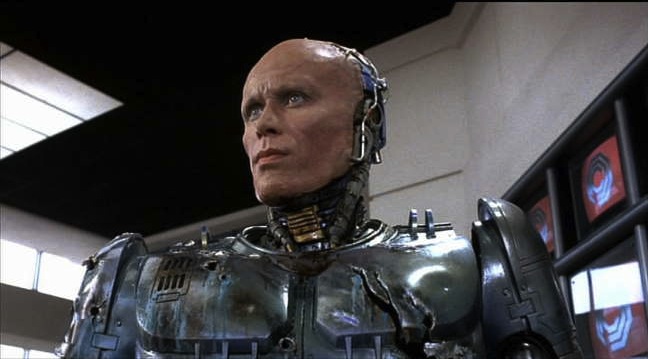
Made in the pre-CGI era, RoboCop is one of the last great practical effects movies. Matte paintings, stop-motion animation, and cutting-edge costumes give everything a tactile quality that’s still thrilling to see. The stop-motion animation of the ED-209 by Phil Tippett is jaw-dropping, especially in a slapstick bit where ED-209 chases RoboCop through the OCP building but is defeated when it can’t navigate a stairwell. Rob Bottin’s make-up effects and costume design remain the best of his career. Coming off his very sticky (and overly painted) effects work on John Carpenter’s The Thing, Bottin’s work here has a more flexible and believable feel. RoboCop’s uniform is like a cross between Japanese comic art work and military chic, turning Murphy into a believable man of steel. (Think a walking Ford Taurus.) Late in the movie, when RoboCop takes off his helmet and we see Murphy’s face for the first time since his death, Bottin’s bald cap prosthetic makes Weller’s already intense blue eyes even more penetrating. RoboCop’s internal struggle with his human instincts is over. Murphy is back.

Verhoeven’s nasty playfulness is constantly popping up throughout the movie. He has an especially kinky preoccupation with the connection between sex and machines. The scene right before Murphy is murdered shows Lewis coming upon one of the more deranged bad guys, Joe (Jesse Goins), taking a leak. When Lewis pauses long enough to glance at his privates, it allows the bad guy to get the upper hand and leads to Murphy’s death. Later, when Lewis and Murphy are reunited, she helps him fix his targeting system by correcting his aim. It’s the closest they will come to consummating their relationship. For Verhoeven, sex is partially mechanical. (Showgirls is all about manufactured sex.) The rousing score by Basil Poledouris uses both orchestration and electronic sounds to highlight the contrast between the organic and mechanical.

Verhoeven’s most daring gambit is the perfectly timed moment of satire. The idea was such brief inserts of humor would lighten the intensity of the action, but instead they just intensify the action, forcing us to be prepared for anything. At various points in the movie the action is interrupted by media newsbreaks (“You give us three minutes, we’ll give you the world!”), that inform us about incidents like American troops aiding Mexican nationals with a raid in Acapulco, or when the U.S. accidentally wipes out Santa BarbAra from outer space. The fake commercials are hysterical, especially a spoof of Electronic Battleship called Nukem. (“Pakistan is threatening my border!”) Of course, the most startling aspect of RoboCop is its depiction of the corporatization of America and the outsourcing of labor for profit. Dick Jones (Ronny Cox), the most ruthless of the OCP execs, spouts rhetoric that at the time sounded like a send-up of Gordon Gekko, but now wouldn’t be out of place on Fox News or a CPAC conference. It’s casually mentioned that OCP has found profitability in industries that had been deemed money losers. These include hospitals, prisons, and space exploration. They now want to take over the Detroit police department and turn it into a moneymaker. In 1987 this sounded like an outrageous satire of the 80s Wall Street culture. Today RoboCop stings, as its vision of the future were all too real. Verhoeven brings it home by staging the final showdown not in the streets of Detroit but in a boardroom.

But RoboCop’s most lasting legacy is RoboCop itself. This film marks the first time moviegoers were made to identify with a machine. Before, machines and aliens in movies were seen as something otherworldly. Even when we were made to feel an attachment to a non-human character like, say, E.T., we saw him through a human perspective. But RoboCop was different because the most human character in the movie was a machine. Every other character in the movie, even the loyal Lewis, was secondary. When RoboCop walks through the now abandoned house where his wife and son lived, we’re made to fill in the emotions he can no longer compute. Movies were now embracing technology and machinery. Everything from Total Recall to Terminator 2 to A.I. to I, Robot to Transformers has showed us machines that are more human than humans. We no longer rage against the machine. We are the machines.

San Antonio-based film critic Aaron Aradillas is a contributor to The House Next Door, a contributor to Moving Image Source, and the host ofBack at Midnight,” an Internet radio program about film and television.

GREY MATTERS: The Horrors of THE INVISIBLE WAR

GREY MATTERS: The Horrors of THE INVISIBLE WAR

null

The American military has largely dealt with the sexual assault of more than 95,000 service members since 2006 by stonewalling, denial, blaming the victims, and worse, according to Kirby Dick’s horrific and essential new film.

I’d had my concerns about Kirby Dick covering this material: his This Film is Not Yet Rated was a snarky swipe at the MPAA that was entirely too in love with itself and its clever graphics.  In this film, save a very occasional lapse into inappropriately cool-looking statistics, Dick’s baser instincts and any unfortunate slide into Michael Moore-like ‘liberal’ self righteousness are utterly consumed by the urgency of the task at hand. 

To the point where we experience a sort of horror-driven vertigo, The Invisible War provides hundreds of ex-service members a place to tell of their defilement by people they’d trusted with their lives. Even as it explores every conceivable reason behind the grotesque failure to address this ultimate crime, the film refuses to go anti-military, mirroring the across-the-board POV of female ex-soldiers who, despite their rape, still respect the uniform.

This is mainly a film of faces, with Dick cutting away only when needed—to courtrooms, clinics, Congress people, and others who won’t help, along with news clips of recent and mostly forgotten military sexual travesties for context. The relative asceticism gives War the apt hush of genocide.

Dick’s assembled a core group of women. There’s Kori, Coast Guard. Jessica, US Air Force. Robin, USAF.  Ariana, Marines. Trina, Navy. Elle, Marines. Hannah, Marines.

Each tells of their love and pride of country and service. Each then describes having that love obliterated and stolen from them by their perpetrator, who most likely goes unpunished.

Dick takes a blowtorch to any notion that rape is anything else but a crime of violence and power by repeatedly focusing on the unspeakably painful physical brutalization of these young peoples’ bodies.

One woman’s spine is broken. Other women have broken bones elsewhere. Kirby focuses on Kori, a short ash blond spitfire whose jaw was crushed in her rape to the point that she can only eat Jell-O, pudding and other soft foods, as a sort of guide through the slow burn hell her perpetrator has turned her life into.

As her jaw problems worsen, the VA offers help with a back condition she doesn’t have. (Catch-22 lives.) Her husband—like all the spouses seen here—does everything humanly possible to help, and as his life is consumed by that endless job, the rapist claims another victim by proxy.

We meet woman after woman after woman, each with a story of love, service, rape, and betrayal by the military family she thought had her back. Watching these women’s’ faces and voices fuse as they all tell one extended story of incomprehensible soul-rending transgression is like hearing Jung’s collective consciousness screaming J’accuse.

Dick attacks every angle of this rotten story. His talking heads are all high-ranking, no-nonsense ex-military or thought leaders who exude zero-bias competence.  As with other victims who hide behind screens and electronic distortion, unearthed official documents, and military rape advocacy workers, the same story comes out, with the same details, the same narratives, the same outcomes, the same strings of words, even. That such identical details come from such radically different people either suggests that 1) Dick brilliantly coached about 50 non-pros to lie like trained actors or 2) This is the real, 100% true, truth. All it ever does is get worse as things are cleared up.

Who rapes? Often people of higher rank. Who know their victim. Who’ve raped before and will again.

We’re introduced to Brig. General Loree Sulton (Ret.) Psychiatrist, US Army, who’s brisk, friendly and assertive in her complete command of victims' psychology.

She tersely, chillingly asserts that tightly knit military units are nothing less than a “prime, target-rich environment for a predator” and points out the terrible irony that the military’s success at creating alternate families causes rape victims to suffer a far worse constellation of psychological damage after being raped, similar to that of incest. These were her surrogate brothers and fathers, after all, who attacked the victim, who may be lying about her, who are turning their backs on her.

Male predators also rape other males, with 20,000 “buddy-fuck” victims in the last ten years. Experts in multiple fields detach this from gay issues: again, rape is about power, violence and dominance. Rapists don’t care about gender. Just targets.

Kirby deftly alternates between small and large-scale abominations so as to keep the human suffering always at the fore, even when he goes historical. When you see a Marine talk about her agonizing violation, and then a second later we’re watching news footage of a famous rape military spree or court decision that says rape is an acceptable part of being in the military (this is a real thing), suddenly those facts are not distant, or abstractions. They’re real things, and you shudder to imagine how they affected the people you’ve come to care about during this film.

Dick follows one woman’s downward spiral from fighting in Operation Iraqi Freedom, to being raped and devastated by PTSD and ending up homeless and drug addicted, to asking, How did this happen? Why does the service so grievously mistreat some of its warriors?

And the answer Dick offers? Military justice is not American justice. There’s a chain of command deciding things. The chain of command has all manner of reasons for keeping rape cases closed or invisible and does not work according to democratic rules. Commanders with no personal involvement in a case might see a rape accusation as a potential black mark on their own career, sweeping the issue and possible investigation under the rug. Maybe they think the girl was asking for it. Maybe they’ve committed rape themselves.

We meet Captain Greg Rinckey (Ret.) US Army JAG Corps, a fortyish man who seems to still not believe the awfulness of what he has to communicate to the filmmakers. “The problem in the military is, the convening authority, who is not legally trained, makes the final decision.” That "decision" being what happens in a rape case, which defines a woman’s entire life.

As a corrective to the luxury of selective historic amnesia Americans enjoy, Kirby brings up recent scandals, old nightmares.

There’s the Tailhook Scandal in 1991: at least 87 women sexually assaulted by more than 100 U.S. Navy and United States Marine Corps aviation officers. The Aberdeen Scandal in ’96: 30 women raped.  

In the Colorado Springs Air Force Academy sexual assault scandal in 2003, 12% of all graduates claimed they were victims of rape or attempted rape. (The film reminds us that over 80% of victims never report their rape.)

At a certain point, the film crosses the line between objective documentary form and out and out advocacy in the same way Joe Berlinger and Bruce Sinofsky’s coverage of the West Memphis Three in Paradise Lost gave up even a fig leaf of detachment in the film’s two sequels, as the filmmakers realized the depth of the crime they were covering. I suppose some grand, detached style might be more artful, but I really don’t worry about superior grammar and usage when drowning people scream “help.”

Simply seeing The Invisible War won’t end any of the horrors it catalogues. But a movie like this wasn’t made to stop anything, it was made to anger you, to get you to do that first thing that keeps these monsters at bay. Ultimately, it really is up to you whether this film is a success or not.

Ian Grey has written, co-written or been a contributor to books on cinema, fine art, fashion, identity politics, music and tragedy. Magazines and newspapers that have his articles include Detroit Metro Times, gothic.net, Icon Magazine, International Musician and Recording World, Lacanian Ink, MusicFilmWeb, New York Post, The Perfect Sound, Salon, Smart Money Magazine, Teeth of the Divine, Venuszine, and Time Out New York.

Nora Ephron: Star Wars for Girls

Nora Ephron: Star Wars for Girls

null

I don't say this lightly: what Star Wars was for men and boys of a certain era (and believe me, I loved it, too), Ephron was for women and girls of that era.

When I got the premature call saying she had passed, I looked at my husband and said, "There's a disturbance in the Force." The world was less funny.

She was generous, gracious, hilarious and a huge help to those below her on the success and social ladder. She took criticism fairly, grudgingly admitting I might be right that the "Julia" part of her film Julia & Julia was infinitely deeper than the "Julie" part.

And in interviews, she reliably returned questions with a speed and spin that would make Venus Williams jealous. I never understood the reaction from hipster gals and most guys that her movies were slick Hollywood confections. To which I'd answer, "And what was Ernst Lubitsch?"

When the longtime New York Times film critic Vincent Canby cracked that Sleepless in Seattle was the movie you loved the night before and were embarrassed about the morning after, I called him—we didn't have email in 1993—and clucked, "You're just afraid that if you admit you like it, your manhood papers might get revoked." He laughed, saw it again, and admitted, "You know, it works."

The most important thing she taught me is that there's no use investing energy in fighting sexism. She believed the best revenge was putting that energy into your work.

Carrie Rickey is the film critic for the Philadelphia Inquirer.

SIMON SAYS: MAGIC MIKE and the Camera

SIMON SAYS: MAGIC MIKE and the Camera

null

Steven Soderbergh's recent use of digital photography in Contagion (2011) and The Girlfriend Experience (2009) has a painterly quality. With Haywire, he proved that he could effortlessly achieve a nuanced look using the still burgeoning method of video photography. But with Magic Mike, he continues to hone the kind of glassy, flat but simultaneously elaborate aesthetic he's used for his more recent films. The broad beats of Magic Mike's narrative may be contrived, but Soderbergh enriches his usual main theme—of getting what you want by consenting to be exploited—through the film's highly stylized look. Soderbergh’s latest is at its best when its camerawork is most eccentric.

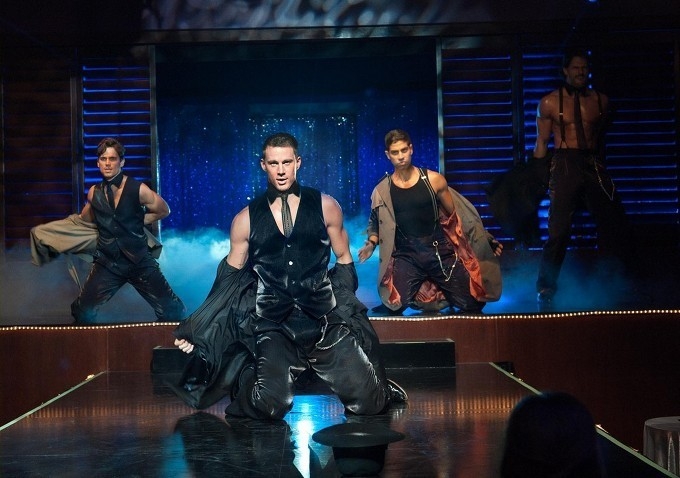
Based loosely on star Channing Tatum's own time as a stripper, Magic Mike is full of sequences designed to subtly disorient or dazzle viewers. Soderbergh constantly calls attention to the artificial nature of his imagery, using lens flares and, in a scene where Tatum raises his voice, unpolished audio to draw attention to his aesthetic and alienate viewers.

Magic Mike's story may not initially seem like it's all about Mike, but that's because it reflects his disillusionment with his job rather than narrating events in his life. At first, Mike thinks he’s an active agent in his life story—but he’s not. He realizes this after recruiting Adam (Alex Pettyfer), a naive, unemployed 19 year-old, to work with him at Xquisite, his strip club. Mike gives up his agency long enough to bond with Adam and develop a crush on Brooke (Cody Horn), Adam's sister.  But predictably, Mike eventually realizes that stripping is only a stopgap solution, and it has actually made it difficult for him to become financially independent. He grows to realize that he's only valuable to Dallas (Matthew McConaughey), the owner of the club Mike dances at, as long as he's doing what Dallas wants him to. 

Mike has contrived, generic reasons for wanting to divorce himself from his scantily clad livelihood. But they're inconsequential; Soderbergh establishes his character's true motivation in a thoughtful, albeit blunt, way. Bear in mind: sophistication is rarely combined with audiovisual elegance in Soderbergh's films. This is apparent in the way Soderbergh uses so much soft focus; his visual compositions all have uniform, flat look backgrounds. Shapes move behind the main figures, but the shapes are relatively indistinct. Additionally, Soderbergh's characters are constantly being projected on. In a crucial scene, Dallas teaches Adam how to dance at the club, posing in front of a wall-sized mirror. We see Adam learn to dance as it happens in the mirror, not directly; this neatly establishes the film's main concern with symmetry and obstacles. When characters want to really see each other, they appear to be positioned symmetrically. But the more out of sync with each other the characters get, the more visually different Soderbergh’s camerawork makes them appear, and hence the harder it is for audiences to actually see Mike and his friends (Brooke pointedly admonishes Adam by telling him, "I can fucking see you"). 

For example, Mike and Adam immediately form a shaky bond. The camera cuts back and forth between the two men as Mike drives Adam in his car for the first time. The men occupy separate spaces, but there is total symmetry to the shot-reverse shot visual structure of their conversations in the scene. The second time, Mike drives Adam home and, if you look hard enough, you can see that Adam is slightly better lit than Mike, that his head's not as close to the right side of the frame as Mike's is to the left side. The two have imperceptibly begun to drift apart. But in the third drive, Soderbergh shows the full-blown divide between the two men by creating a visibly rippling effect, suggesting that Mike and Adam are an outburst away from literally exploding at each other.

Soderbergh's visual flourishes establish Magic Mike’s concerns better than anything his characters say. In one blunt but effective juxtaposition, Soderbergh first shows a rain-streaked window pane and then transitions to a shot of a bust Dallas has made of himself. Another thoughtful visual cue is when Soderbergh literally shows us the barriers between Brooke and Mike disappearing through a tracking shot. As the shot continues, fewer objects clutter the image's foreground, leaving just Brooke and Mike, alone. Ironically, Magic Mike is probably dullest when most focused on its subject: when Mike and his colleagues strip on-stage, Soderbergh's approach is at its most basic.

Simon Abrams is a New York-based freelance arts critic. His film reviews and features have been featured in The Village Voice, Time Out New York, Slant Magazine, The L Magazine, The New York Press and Time Out Chicago. He currently writes TV criticism for The Onion AV Club and is a contributing writer at the Comics Journal. His writings on film are collected at the blog, Extended Cut.

CRUEL SUMMER: TOP GUN (1986)

CRUEL SUMMER: TOP GUN (1986)

The "Cruel Summer" series of articles examines influential movies from the summers of the 1980s. The previous entries in the series have covered THE BLUES BROTHERS (1980), STRIPES (1981), ROCKY III (1982), WARGAMES (1983), PURPLE RAIN (1984), and PEE-WEE'S BIG ADVENTURE (1985).

The 1980s saw Hollywood going to war. America’s defeat in Vietnam instilled a sense of hopelessness that ran throughout the 1970s. The Vietnam movies of the late ‘70s (The Boys in Company C, Coming Home, The Deer Hunter, Apocalypse Now) were all about mourning and the tentative first steps necessary for the country to move on. Then, with the election of a former Hollywood star as President, Hollywood decided to re-up with the military and make movies that were the equivalent of Reagan’s military intervention policies. The distrust of the government and the military during the ‘70s was now giving way to a cinematic flexing of American might. All that was needed to build up morale was a few easy wins, and after that, the Vietnam disaster would hopefully seem like a bad dream.

From the softening of basic training in movies like Private Benjamin, Stripes, and An Officer and a Gentleman to re-staging Vietnam in men-on-a-mission action dramas like Missing in Action and Uncommon Valor,Hollywood saw it was better for business if America came out on the winning side. (The first Rambo movie, First Blood, would be the rare movie during this time that tapped into the rage and marginalization of returning Vietnam veterans. Its sequel, Rambo: First Blood Part II, would turn that rage into comic-book fury, complete with the crowd-baiting question, “Do we get to win this time?”) Vietnam cast a shadow over movies that weren’t even explicitly about the war. Vietnam became a shortcut to character development. Sylvester Stallone’s character in Nighthawks was a pacifist because of his experiences in Nam, while Roy Scheider’s pilot in Blue Thunder suffered from “stress” due to his tours of duty. Movies as varied as The Exterminator to Commando to the first Lethal Weapon all used Vietnam to heighten the audience’s identification with the lead character. All of this cinematic stockpiling of goodwill came to a head in 1986 with the release of a movie that turned Hollywood’s restaging of Vietnam as a winnable war into an advertisement for America’s outsized belief in its own exceptionalism.

Tony Scott’s Top Gun is a visual and aural assault, a full-throttle “ride” that doesn’t stop for pesky things like story. The story goes that the pitch for Miami Vice was “MTV cops.” The pitch for Top Gun could have easily been “MTV pilots.” Scott, along with his older brother Ridley, Adrian Lyne, and Alan Parker, was at the forefront of a group of British TV commercial directors. These directors made advertisements cinematic. When they got their shot at making movies, they infused their movies with a powerful visual sense. Ridley Scott made rust and dirt and grime look authentic and cool in movies like The Duelists and Alien. Parker gave everything an artificial beauty, even a Turkish prison in Midnight Express. Lyne’s use of backlighting throughout Flashdance would become a mainstay on MTV. But Tony Scott was the bad boy of the bunch. He could do everything they could do but he didn’t have any pretensions about subject matter or critical response. Pauline Kael described Top Gun as a “…recruiting poster that isn’t concerned with recruiting but with being a poster.” As it turned out that’s exactly what audiences liked about it. Advertising was now a legitimate form of storytelling.

The story of Top Gun is so simplistic that it’s almost child-like. Producers Don Simpson and Jerry Bruckheimer helped shape mainstream American movies by specializing in movies that anyone could follow. Movies like Flashdance, Top Gun, Beverly Hills Cop, and Days of Thunder gave viewers such a cocaine-adrenaline rush that you came out of the theater ready to take on the world. They made movies about winning, and in the 1980s that’s what audiences wanted to see. The screenplay (more like a scenario) by Jack Epps, Jr. and Jim Cash may have centered on hotshot Navy pilot Maverick (Tom Cruise) and his training at the Top Gun school but, really, the movie was about you and your dream to be the best at whatever you did. Simpson and Bruckheimer’s movies played like a cross between a rock concert and a motivational seminar.

The movies' pop psychology trappings didn't lessen their entertainment value (who doesn’t like a rush of adrenaline?) The opening credit sequence remains one of the best of the decade. From Harold Faltemeyer’s iconic synth-guitar theme to Jeffrey Kimble’s vivid filtered cinematography to the eroticized, slo-mo pans of fighter jets getting ready for a dawn run, the sequence seduces you into wanting to go to war. Even Kenny Loggins’ anthemic “Danger Zone” is part of the quickening of your senses and making you not question the sheer manipulativeness of what you are seeing. (“Revvin’ up your engine/Listen to her howl and roar”…) There aren’t really any scenes in Top Gun, just set-pieces. There aren’t really characters, either. Any nuance or shading in the characters is due to the characters' personalities, not the writing. The characters’ names do most of the work of characterization. When a character named Viper is described as the finest fighter pilot in the world (and he’s played by the sturdy Tom Skerritt), more than half the job is done.

The movie gives us a comic-book version of masculinity. Vulnerability is kept to a minimum. This leads to a good dose of (unintended?) homoeroticism. The verbal showdowns between Maverick and his chief rival Iceman (Val Kilmer) are kind of wonderful in the way the actors play the scenes totally straight. (They’re like the scenes between Charlton Heston and Stephen Boyd in Ben-Hur, except the actors in Top Gun don’t know their secret.) The locker room scenes have a PG level of jocular aggression, while the famous volleyball sequence is meant to appeal to the girls in the audience, but it’s clear Scott knew it would also appeal to men. (The use of Loggins’ awkwardly titled “Playing with the Boys” pretty much seals the deal.)

The aerial photography is still some of the best of its decade, if not in film history. The five major flight sequences help distinguish Top Gun as a superior action movie. Most flyboy fighter pilot movies relied heavily on “realistic” footage but rarely bothered to inform the viewer to what exactly was happening. Scott’s insistence on pre-planning the maneuvers and choreographing the flight sequences allowed him to display a sense of scale that recalls the Death Star run in Star Wars. (Lucas uses CGI the way Scott uses practical and model effects.) We genuinely feel like we’re in the cockpit of one these fighter jets. There’s a palpable feeling of exhilaration during takeoff or when one of the jets has to spin in order to avoid being shot down. There’s also genuine terror, especially when Maverick’s jet goes into a flat spin and he and his co-pilot Goose (Anthony Edwards) are forced to eject.

When Top Gun is in the air, it’s terrific popcorn entertainment. It’s the scenes on the ground that are more problematic. Unlike the non-musical sequences in Purple Rain, where the characters’ interactions were kept direct and intense, the scenes in-between flight sequences have a workman-like pacing that exposes just how thin the story really is. The best performance is by Edwards, who uses humor and sincerity to get us to love him. His death in the movie genuinely hurts. Kelly McGillis is the movie’s biggest weakness. SHE displays none of the confidence that made her so memorable in Witness, her previous movie. She has zero chemistry with Cruise, or more accurately she has just enough to get by. Compared with Cruise’s erotic connection with Rebecca DeMornay in Risky Business or McGillis’ passionate embrace of Harrison Ford in Witness, their scenes together are pretty tame. The one scene between them that works is when they’re sitting on her porch and listening to Otis Redding’s “Sittin’ on the Dock of the Bay.” The movie constantly tells us that they’re in love. (The gorgeous Berlin theme “Take My Breath Away” goes a long way in convincing us they’re a couple.)

Cruise’s chemistry with McGillis doesn’t really matter anyway. What matters is his chemistry with the audience. Cruise’s all-American image is so integral to the success of Top Gun that audiences and critics didn’t fully grasp that it takes a rare kind of acting skill to make what he does look effortless. In Risky Business, he used his baby-faced wholesomeness to get us on his side, even if he was playing a junior pimp. From his somewhat slight frame to his little-boy voice, Cruise, at first glance, wouldn’t seem to have the makings of one of the biggest movies stars in the world. But Cruise’s fabled work ethic is transmuted into his characters’ winning cockiness and we can’t help but be on his side, be it in The Color of Money or A Few Good Men or Magnolia or Mission Impossible: Ghost Protocol. In Top Gun, Tom Cruise became a star by embodying America’s belief in overcoming adversity in order to come out on top.

(NOTE: Oliver Stone would commit a courageous act of star vandalism by casting Cruise in Born on the Fourth of July. Cruise’s Ron Kovic is Maverick, humbled by the ugly reality of war, only to come out a winner on his own terms.)

Is Top Gun a good movie? That’s a tricky question. It’s certainly a watchable one that has managed to stick around long after other, more respectable movies have faded from memory. However, of all the movies surveyed in this series of articles it’s the one that has very little resonance today. The release of Stone’s Platoon at the end of ’86 effectively killed Hollywood’s un-ironic love affair with war. (The release of Robocop the following summer would usher in Hollywood’s long-standing romance with technology and machinery.) Top Gun’s influence can been seen in movies like The Rock, a mostly humorless “ride” that forgot to add the rock ‘n’ roll. (The Rock director Michael Bay is like Tony Scott’s ugly stepson. He’s the father of Chaos Cinema.) Top Gun is an artifact, like bellbottoms or the bob hairdo, from a seemingly more innocent time. It represents a coarsening of summer entertainment, a moment when advertising became a part of the storytelling. Who knew what was once considered crass marketing would now look restrained and old-fashioned?

San Antonio-based film critic Aaron Aradillas is a contributor to The House Next Door, a contributor to Moving Image Source, and the host ofBack at Midnight,” an Internet radio program about film and television.

GREY MATTERS: The Haunted Suburban World of TEEN WOLF

GREY MATTERS: The Haunted Suburban World of TEEN WOLF

Anyone comparing Teen Wolf’s second season to Buffy either isn’t paying attention to the dark gem Jeff Davis’s show has become or doesn’t understand what Joss Whedon’s show used to be.  Think instead of this reboot of the silly Michael J. Fox '80s film as fully on par with Ronald Moore’s remake of Glen A. Larson’s way-'70s Battlestar Galactica. It’s that good. And now, it's that grim.

Gone are even the small gestures toward even nominal teen melodrama normality season one made, mostly courtesy a sound-weave that was already more Lynch than CW, more Cocteau-dream-time-floaty than let’s-sell-some-alterna-pop catchy.

From the credits onwards, the second season announces a visual sensibility that suggests Lars von Trier pace Melancholia in a suburb called Beacon Hills, where McMansions literally sit next to rotting poverty homes. Where there is never anyone on the streets, or any place of business open but the ER, the police department, and a 24-hour veterinarian’s office (Teen Wolf may be grim but it's not without humor.)

The last time I wrote about the show, I mentioned an across-the-board ache, a sense that everyone of parenting age had failed, leaving a generation of children trying to reassure the adults that everything would be okay.

That ache has metastasized into distance, malevolence and violence. The show’s teen werewolf, Scott McCall (Tyler Posey), now keeps a certain distance from Mom since a telepathic bond with her revealed her endless well of erotic loneliness.

Scott’s best friend Stiles (Dylan O’Brien) has a father (Linden Ashby) so humiliated by his drunken confession of broken marriage anguish that he can barely face his son anymore.

And Scott’s beloved, Allison (Crystal Reed), has learned that the worst thing in the world isn’t her morally compromised father (JR Bourne), but her morally psychotic grandfather, played with scene-eating intensity by <i>Battlestar’s</i>Michael Hogan, this season’s very bad, big bad, wolf.

All of this is mirrored in the visual poetry of Teen Wolf, most often conveyed in pairs of shots that tersely convey discrete information, the cinematic version of haiku. Cinematographer Jonathan Hall—best known for The Walking Dead—somehow conveys darkness even in his day-lit school hallway scenes.

Oh. Right. Werewolves. Or as I like to say, “weres”, because it’s shorter and makes things sound as un-lame as the show Davis—best known as creator of Criminal Minds—has gifted us with.

Davis still uses his moneymaker moon howlers, but mainly as bearers of metaphor. But since I want you to fall for this show, I’ll run some Wolf basics by you before getting lost in those thickets.

When we first met Scott McCall, he was a golly, gee-whiz teen lacrosse player in love with the lovely Allison. Scott’s pal Styles was a knockabout, but not a pop-culture-spouting one.

Then Scott got clawed in the night and became a were, which, downside, meant turning halfway into a wolf, but upside, meant super-enhanced strength, night vision, speed, healing abilities, and so on. Sure, there was the whole thing with murdering people and eating their flesh, but a little forethought and some chains and locks could take care of that.

Unfortunately, Scott quickly gained the attention of longtime were Derek Hale (Tyler Lee Hoechlin).  Like the zombies hanging around the mall they loved when they were alive in Dawn of the Dead, Derek can’t stop himself from hanging at his burned down, old American dream house.

Last season, Allison not only learned of her family’s avocation—hunting down and killing weres—but saw her sadistic, morally insane aunt killed by the sadistic, morally insane ‘Alpha’—a sort of ultimate werewolf who may or may not lead the pack of weres.

Also, everyone knows that Scott’s a were when his attempts to gain some privacy with Allison at last year’s winter formal only lead to Chris, the werewolf hunter, accidentally finding him while in wolf form.

This season finds the Argent family closing ranks and forcing Allison to break up with Scott. (Of course, the two work out a complex system of signals and signs for meeting up in secret.)

Then Hell comes to town in the form of cruel, killing-‘em-old-school Gerard, who loves the sound of a young homeless were’s screams, cut off when he cuts him in two with a special sword.

Gerard believes in killing all weres, shows zero tolerance of Others, and has a pungent Tea Party vibe to him that, in an election year, one assumes, must be intended.

Then Allison finds out that she must train to take her aunt’s place and become a were killer. As Valentines to nuclear families go, this one isn’t winning anyone’s favor.

The alternative isn’t kittens and roses either. Derek is trying to create an alternative family based on the pain of others, to repel the Argent menace.

There’s Boyd (Friday Night Lights’s Sinqua Walls), a black kid bussed to Beacon Hills, where he’s forced to do menial work, who chooses Derek’s bite to gain power over a core-rotten school system. And Isaac (Daniel Sharman), a white kid whose abuse at his father’s hands reverberates horribly in a post-Penn State context. And an unnamed student (played by the awesomely-named Gage Golightly) ruined by uncontrollable, humiliating seizures is more than happy to give up a known awful life for a life living like Derek looks.

For whatever reason, because the show works under the disguise of genre, because everyone isn’t putting every word uttered under a critical electron microscope, because the show is free to use metaphor freely, Teen Wolf is free to delve deep into topics whose existence a show like Girls might deny.  

And were the show not called Teen Wolf, its to-be-continueds would surely be the stuff of virtual water cooler conversations. Breaking Bad, now there’s some word play for adults. But Teen Wolf, seriously? Next you’ll be saying Battlestar Galactica, or Buffy the Vampire Slayer or . . . Oh.

Take the battle for the soul of Jackson Whittemore (Colton Haynes). Everything that’s remarkable about Jackson—his steely good looks, his bottomless checking account, his classic Porsche—only remind him how much he didn’t earn them. And so what good there is in him is eclipsed by a need to act out his self-loathing. Worse, Jackson is aware of this extra dynamic, which makes him truly tragic. We never hate him.

And now he wants Derek to turn him into a were as well. To give him a power that comes from his body, not his Chase Titanium card. If something gay happens, well, whatever.

In direct opposition to Whedon’s wonderful alternative families, the Buffy, Firefly or Avengers crews, Teen Wolf is a dire warning against socialization, especially for Scott: if he enjoys Allison, his mom may be getting killed by Gerard. If he’s with his mom, how can he protect Stiles and Allison?

This is horror for times of terrifying scarcity. It’s why Allison hangs on to Scott and vice versa, and it doesn’t feel clingy or retrograde, and it's why Stiles will save even Derek when a new monster comes to town. In lean times where the family is verklempt due to ideology, bad breaks or character flaws, they’re all they’ve got.

Ian Grey has written, co-written or been a contributor to books on cinema, fine art, fashion, identity politics, music and tragedy. Magazines and newspapers that have his articles include Detroit Metro Times, gothic.net, Icon Magazine, International Musician and Recording World, Lacanian Ink, MusicFilmWeb, New York Post, The Perfect Sound, Salon, Smart Money Magazine, Teeth of the Divine, Venuszine, and Time Out/New York.

REMEMBERING ANDREW SARRIS, 1928-2012

REMEMBERING ANDREW SARRIS, 1928-2012

 
Aaron Aradillas
 

There is no single review or article by Andrew Sarris that I can turn to at this moment to illustrate his impact in shaping my critical mind. For me, Mr. Sarris was part of a wave of movie critics who came before me—before all of us—who forced me, through his writing and constantly evolving thinking, to challenge myself as to why I responded to movies the way I do. Pauline Kael’s specialty was conveying her immediate, heightened response to a movie. Mr. Sarris would also do that, but then would investigate how exactly a director or an actor went about in provoking a response, good or bad, from the viewer.

Of course, Mr. Sarris’ The American Cinema is one of the cornerstones of any self-respecting critic’s approach to writing and criticism. It doesn’t even matter if you agree with the auteur theory as put forth by Mr. Sarris. What matters is the way it provides an organizing theory that attempts to put certain filmmakers’ bodies of work in a larger context. Mr. Sarris dared to offer the kind of serious consideration of movies that had been afforded to musicians, painters, playwrights, and poets. Even those who rejected the auteur theory as silly or dry or too academic (most famously Ms. Kael) would go on to practice their own form of it. (See Ms. Kael’s writing on DePalma.)

It is impossible to write about Mr. Sarris without mentioning his partner Molly Haskell, a powerful critical voice in her own right. Ms. Haskell, with soothing Southern voice and disarming yet firm demeanor, was a perfect counterpoint to Mr. Sarris’ veteran college prof easiness. Her From Reverence to Rape remains a provocative and essential examination of the portrayals of women in the movies, while Love and Other Infectious Diseases is both a harrowing and moving chronicle of Mr. Sarris’ extended stay in the hospital in 1984.

I met them once at the Museum of the Moving Image’s workshop for film critics. They were like the John & Yoko of movie critics, rarely separated and in perfect harmony. (If you want to see just how good they were together, then check out their back-and-forth discussion on the Criterion DVD of Ernst Lubitsch’s Heaven Can Wait.) They were generous with their time and genuinely curious about online criticism, as most of us there wrote mostly for online outlets. When it was decided that the conversation would continue over dinner, Mr. Sarris chose to be driven to the restaurant while Mrs. Haskell opted to walk. Being visually impaired, I asked if I could walk with her. She said yes and adapted to guiding me without a problem. I would speak to both of them separately on later occasions by phone. I remember one conversation with Mr. Sarris where we got into a discussion about the movies of Steven Soderbergh. He was mixed on his most recent work. After I finished a five minute dissertation on his body of work, Mr. Sarris said something to the effect of, “You seem to have thought about this. Maybe I’ll think about it.” And that’s what I take away from Mr. Sarris: the desire, the need to constantly think about why I love the things I love.

San Antonio-based film critic Aaron Aradillas is a contributor to The House Next Door, a contributor to Moving Image Source, and the host of “Back at Midnight,” an Internet radio program about film and television.

 
Miriam Bale
 
The first thing I remember about meeting Andrew Sarris is the twinkle in his eye when he discussed cinematic crushes, ever-evolving ones like Jennifer Jones, and the old standbys like Margaret Sullavan, for whom he reserved not just a twinkle but a beatific, reverent grin. It was then that I realized that, as much as we are taught to think of Kael and Sarris in separate camps, both critics introduced the most definable aspect of American criticism, a criticism based on personal, unreasonable love. The next time I saw that twinkle and grin, Andrew was talking about Jennifer Jones at a Film Society Screening, but he was looking at his wife Molly, the woman who both embodied and shared his love of the great sirens of cinema. It was a playful spirit of flirtation and passion that kept his love for cinema always fresh; he was constantly watching new things, constantly revising old opinions. And it was this same  flirtation and passion that fueled one of the greatest collaborations in cinema, that between he and his wife and co-presenter Molly Haskell. Andrew had enough a deep enough lust for cinema to spark all the work-based-on-love that we critics are continuing now.
 

Miriam Bale is a film programmer and critic based in New York.


Steven Boone

Andrew Sarris made a name for himself as a film critic. That's an amazing feat in a world where critics are rated somewhere between accident lawyers and executioners in popular appeal. To do that, you must either hold a set of opinions so bold, idiosyncratic and gorgeously worded that they stand out like an outlandish hat in rush hour (like his rival Pauline Kael) or introduce an original concept that was actually always there, waiting to be named. Mr. Sarris did the latter. Importing from the French, he named the film director as the true author of a film, at a time in America when they were thought of as Hollywood's assembly line foremen. Would an entire generation of maverick American directors have stepped out so boldly in the 1970's if they were still regarded as anonymous, interchangeable employees of moguls?

Another great thing he did was fearlessly brush against the grain when the grain simply chafed. He is famous for his stirring, spiritually astute readings of masterpieces like Au Hasard Balthazar and Lola Montes, but my favorite review of his is a cranky pan of the beloved Southern Gothic classic To Kill A Mockingbird. Practically anticipating Phil Ochs' bitterly ironic song "Love Me, I'm a Liberal" and James Baldwin's Hollywood essays in The Devil Finds Work, he described the film's happy ending thusly: "This is a heartwarming resolution of the novel and the film. Yet somehow the moral arithmetic fails to come out even. One innocent Negro and one murderous red-neck hardly cancel each other out. How neat and painless it is for the good people of Maycomb to find a bothersome victim in one grave and a convenient scapegoat in the other. When all is said and done, Southerners are People Like Us, some good and some bad. So what? No one who has read the last letters of the German troops trapped in Stalingrad can easily believe in a nation of monsters, but the millions of corpses are an objective fact. At some point, a social system is too evil and too unjust for personal ethics to carry any weight. It is too early to tell, but it is too late for the Negro to act as moral litmus paper for the white conscience. The Negro is not a mockingbird."

Sarris wrote with the understanding that movies are not mockingbirds, giving us song to help pass the time and feel a little better about things. By most reliable accounts, he laughed easily and often but never forgot that movies are a matter of life and death.

Steven Boone is a critic and filmmaker, the publisher of Big Media Vandalism, and a regular contributor to Capital New York.


Godfrey Cheshire

In 1968, as a 17-year-old high school senior, I published my first film reviews in the school paper. As I recall, the first hailed Richard Fleischer’s The Boston Strangler while the second registered my fervent but not terribly articulate enthusiasm for Stanley Kubrick’s 2001: A Space Odyssey. The same year, I discovered Andrew Sarris’ reviews in the Village Voice, and Sarris published his magnum opus, The American Cinema: Directors and Directions, 1929-1968. Looking back, I can’t say which came first: my reading of Sarris or the commencement of my own film reviewing. What I can say is that no film critic meant more to me, then or later, and that no other writer’s example was a greater influence on my eventual decision to try writing film criticism professionally.

During college, attending the campus film societies’ screenings and debating Sarris’ and other critics’ reviews were intertwined obsessions that, though extra-curricular, actually seemed to add up to the foundations of a real education in cinema for myself and a small corps of cinephile friends. When asked later what made Sarris so crucial to this era, I usually point to two things. First, while he was known for importing the auteur theory from France (and “theory” was always a misnomer; the French were right to call it a “policy”), the key idea that undergirded it was that film was an art, one uniquely capable of reaching from the grossest of lowbrow slapstick to the chilly peaks of high modernism. It’s hard to believe now perhaps, but until the auteurist floodgates opened in the ‘60s, most reviewers (people rarely spoke of “film critics”) regarded movies, good or bad, as entertainment ground out by big studios for an unsophisticated mass audience. In introducing the director as artist-auteur, Sarris helped us see the work of studio hands like Alfred Hitchcock and John Ford as beacons of personal vision no less than the more determinedly individualistic and idiosyncratic work of new directors like Bergman, Antonioni, Godard, Kurosawa, Fellini, and Truffaut. And his eloquent, probing reviews elucidated the films of both sets of artists in terms not just of cinema history but of other trends in art, politics and society.

The second reason for Sarris’ importance was simple: he gave us a map. In ranking directors in a hierarchy from “The Pantheon” (Chaplin, Welles, Ford, Hawks, Renoir, et al.) down to the lowliest of genre hacks, The American Cinema provided an evaluative overview of the whole history of Hollywood cinema that had no parallel in film criticism. For a college-age film nut in the early ‘70s, it was at once wildly entertaining, wittily challenging and endlessly instructive. Of course one could (and did) disagree with some of Sarris’ predilections and aversions: that was part of the fun. But on the whole, he was a remarkably generous and authoritative guide; there was simply no better way to get a sense of the whole amazing expanse of American cinema, to begin making one’s own evaluations, and to learn which classic films needed to be seen for an assiduous cinephile’s education to be considered adequate if not complete.

To flash forward a couple of decades, I ended up in New York in the early ‘90s and had the great pleasure of getting to know Andrew and his wife Molly Haskell, a Southerner like myself. Encountering the man, happily, involved very little in the way of surprises. He was in person just as he was on the page: charming, engaged, funny, warm, curious, articulate, gracious, sharp-witted and kind. If cinephile means “lover of film,” Sarris will always represent to me the consummate cinephile, because his love of cinema was so passionate, prescient and precise that it kindled and shaped that same love in myself and many others. I feel a tremendous gratitude for all he taught me. Thank you, Andrew.

Formerly the film critic of New York Press, Godfrey Cheshire is a New York-based filmmaker who directed the documentary Moving Midway

null
 
James Grissom
 
Andrew Sarris and I shared a birthday—Halloween—and a deep admiration for Molly Haskell, his wife and one of my first Southern-born friends when I moved to Manhattan. My parents did not feel I would be safe and well in New York City until I was surrounded by people with Southern sensibilities, and  Virginia-born Molly met their qualifications. I introduced myself to Molly in Grace’s Marketplace—over chocolate, as I remember—and my memories of her and Andrew are always around food and talk and laughter.
 
Andrew was proud to defend the films and the actors he loved, and his passion was infectious: Very few people cared about, studied, and shared as fulsomely as he did. As much as he loved films, he loved words, and he could toss them about with great alacrity until they fell into perfect placement. Andrew was happy to do this with another writer’s words as well, and they always came into sharper focus, grew leaner and tighter and stronger. I think Andrew thought it a particularly severe sin to not clearly convey what a film or a book or a person or a sensation had meant to you: He was very much aware of being a witness to things, and he felt an obligation to share whatever he had learned or felt.
 
I took for granted the idea that I would always have a dinner with Andrew and Molly; that they would listen to my ideas and share their own with me; that we would sit in their apartment, watching the sun set or the moon rise over the Guggenheim, and sort things out. As painful as it is for me to consider that Andrew is gone, it is far worse for me to realize that I did not appreciate, until now, how lucky I have been to have known him, to learn from him, and to be able to love—with his approval—Molly Haskell.
 
James Grissom is the author of Follies of God, a book about his five-day visit with Tennessee Williams, which is scheduled to be published in 2013 by Alfred A. Knopf.


Margaret Hames

An A+ Gent

It was my privilege to be Andrew Sarris’ teaching assistant at Columbia University’s film school in 1998. Sarris taught a large, very popular World Cinema class that admitted both undergrads and grad students. His class was a bit on the loosey-goosey side, as Andrew would sit at the front of the class and talk about his favorite films of that particular week, discussing up-and-coming directors he admired, and young actors he thought showed promise. I remember he had very high hopes for “Rennie” Zellweger, and once when an undergrad asked a particularly pretentious “look how smart I am” question, Sarris answered, “I’d rather talk about Rennie Zellweger.”

I was also Sarris’ student in a combined undergrad/grad class on writing film criticism, hands-down one of the best, most inspiring classes I took at Columbia. Once, Sarris called me out for being a bit dismissive in that “smart-ass critic” way regarding John Frankenheimer’s Ronin. Sarris reminded me that John Frankenheimer had certainly more than earned a wee bit of respect in this world. And that goes a long way to understanding Sarris. He had the long view. He had seen so much—good and bad—you’d think he’d have seen enough; but “enough” never came. He was quick to call out the over-praised empty suits, but just as quick to stand up for those directors who had earned their stripes, whose work deserved careful consideration and respect because they were (among other things) auteurs. Oh yes—that word that Sarris introduced into the English language is pretty much taken for granted now. Would anyone question whether a director was (or should be) the true author of a film? He knew it was his greatest legacy and told me so.

Sarris was never dismissive. Visiting over the years, I saw him take up a cane to help him walk, then two canes. The last time I saw him, Columbia was awarding the first annual Andrew Sarris Prize. He kissed my hand, which he often did to female students, one of the only people in the world who could get away with such a gesture. Columbia grades their film students on a pass/fail model. But since I took Sarris in a seminar that included undergrads, he was forced to give me a letter grade. He gave me an A+. So on my Columbia transcript, there’s a whole bunch of passes and one gleaming A+, which is precisely the grade I give to him.

Margaret Hames is the publisher of Media Darlings

Kevin B. Lee

To my knowledge, the above video essay, produced last month for Press Play and Sight & Sound features the last recording of Andrew Sarris' voice. We recorded it one afternoon in Sarris and Molly Haskell's chic apartment filled with books, paintings and grand windows overlooking the Upper East Side; walking into it was like walking into a film critic's loftiest lifestyle aspirations. "We bought it 30 years ago, otherwise we could never afford it," Molly shrugged.

With Andrew's potential for participation limited by poor health, he occupied himself in the dining room with a sandwich while we recorded Molly in the living room. Nonetheless, Molly procured Andrew's original Village Voice review of the film and read from it. She really wanted his voice to be included, and the video is all the better for it. The selected passage, with its discussion of cinema as the beguiling dynamic between surfaces and essences, also gets at something about the relationship between film criticism and its subject, the mad pursuit of conveying the essence of one medium through another. The video is as much a tribute to the essence of Sarris' approach to cinema as it is to Rohmer's. And for all the talk of Sarris being the anti-Kael, there's something about his articulation of ideas that's every bit as sensual and sexy in its own way as what Kael was famous for.

In the midst of the recording, Andrew walked in and eased into a sofa, quietly listening to the conversation. But at one moment, in response to the discussion of scenes involving the touching of Claire's knee, he interjects with a hearty, satisfied chuckle and a soft mumble. I've gotten emails asking what he says, and all I can do is wonder what thoughts went through his mind as the image of that knee flashed across the screen of his memory. But as far as conveying an essence of a lifelong love of the movies, this final sound of his laughter may suffice.

Kevin B. Lee is Editor in Chief of Press Play.

Craig D. Lindsey

I never paid much attention to the whole Kael vs. Sarris debate. I always thought it was two writers engaging in a good ol’ pissing contest. They were two film writers with two wholly unique perspectives on film criticism—end of goddamn story.

I say that to say this: What I enjoyed about Andrew Sarris was how, in his later years, he served as the sensible, introspective yin to Rex Reed’s catty, oversensitive yang in the pages of the New York Observer. Both writers had their own separate columns in the salmon-covered weekly. Since Reed’s column (titled “On the Town with Rex Reed”) dealt with movies, theater, cabaret shows, etc., it wasn’t as intense a film column as Sarris’s. However, on many an occasion, you’d see both men review the same movie in the same issue—and this is where things got fun.

Here’s a sample of what Sarris wrote about The Dark Knight:

“What is most unprecedented about the narrative, however, is its largely unsympathetic treatment of the yapping and yowling citizens of Gotham City, a gloomy echo of ourselves, at the gas pumps and grocery stores, still looking for easy answers from the highest bidders for our votes. In this respect, Ledger’s Joker brilliantly incarnates the devil in all our miserable souls as we contemplate a world seemingly without hope.”

Now, here’s Reed’s take:

The Dark Knight is preposterous, unnecessary and a far, far cry from the old DC Comics of my youth created by Bob Kane. But before the hate mail pours in, let me confess I’m a fool for this stuff, and if “logic” is a word you cannot apply to this movie, neither is “boring.” Compared with the summer’s other action potboilers, it’s a Coney Island roller coaster ride with some of the rails missing.”

This isn’t to say one style of criticism is better or worse than the other. However, you did get an immediate sense of how both men looked at movies. Sarris = well-mannered, pragmatic, detailed, looking at something from all angles before coming to a conclusion. Reed = ornery, hyperbolic, contrarian, getting an idea of what he saw and running with it. If they were a comedy team, Sarris would be the dry-witted straight man, while Reed would be the low-brow clown.

Unfortunately, Sarris was laid off from the Observer in 2009, making Reed the last critic standing there. It’s sad now that not only Sarris has passed, but that fascinating balance will never be replicated again at that paper.

In my opinion, Andrew Sarris will always be seen as a great critic and writer because, quite simply, he knew what he was doing. And whenever you read him, you knew it too.

Craig D. Lindsey is one of the earliest contributors to Press Play.


Matt Zoller Seitz

Andrew Sarris put a frame around cinema itself. He turned the appreciation of movies into an art, but with elements of science. The American Cinema is a taxonomy of directors, arranging them from most to least evolved, most to least artful, most to least memorable. His way of thinking about movies influenced not just film criticism, but pop music and TV criticism and comics criticism, too. Critics of any art form that was previously too young, awkward and humble to dare to define a pantheon were emboldened to try it thanks to Sarris, who insisted that movies could be art as well as entertainment and found the words to explain exactly how that could be so.

I was in the New York Film Critics Circle and National Society of Film Critics for a number of years with him and always looked forward to seeing him at screenings and voting meetings. He was an affable man who seemed to always be taking notes, and he'd been around so long by the time that I got into those groups that he didn't seem to be flustered by anything that happened in the room—though of course by that point, the 1990s, the arguments were pretty mild compared to what I'd heard went on the 60s and 70s. Even when critics were sparring with each other over whether this film or that actress deserved an award, he just grinned, glancing back and forth between the antagonists as if he were sitting courtside at Wimbledon and chuckling a bit.  I went up to his house one time to take his picture for the then-new New York Film Critics Circle Web site, which my brother and I built. I felt as if I were making a pilgrimage. He was charming. While I was taking his picture, his wife Molly Haskell—a giant in her own right—came into the room, introduced herself, then told her husband that he should sit in front of a different window because the light was better there.

Matt Zoller Seitz is the co-founder of Press Play.
 

Oliver Stone

Mr. Sarris was quite generous to me. I was a young screenwriter in New York City.  I remember writing a critical appreciation of Jean-Luc Godard’s Breathless in the early 70s and sending it off. Surprisingly, Mr. Sarris published it in the Village Voice. Meeting him years later, he struck me as a gentle soul, and although over the years his reviews could be tough, I never felt a bone of meanness.

Oliver Stone is the director of Platoon, Born on the Fourth of July, JFK, Natural Born Killers and the upcoming Savages.

Max Winter

Sarris silenced them. By them, I mean the group of people I met and befriended when I started at Columbia University, fresh from Dallas, Texas, in fall 1988. Silenced in what way? Every way. These people didn’t talk like the people I grew up with. They were affectionate at their core, and you could tell that when you talked to them about things they loved, from the Velvet Underground to William Carlos Williams to Bob Dylan to Lorca, but it was buried under several very thick layers of toughness and aggression. It took a while for me to get used to it, but I learned; I remember ending one conversation by overturning a glass of soda on someone’s plate, for no reason I can recall. It seemed to make sense at the time. But Sarris.

Sarris shut them up. We brought the Village Voice to lunch in high-ceilinged John Jay Dining Hall in those days, and every week, the same ritual lionizing of certain names would occur: J. Hoberman. Greil Marcus. Andrew Sarris. When Sarris’s name was mentioned, though, only he got the kind of hands-in-the-air, I-won’t-even-humor-any-other-name response awarded to people deserving of great reverence. He wasn’t a “tough guy,” but his mind was tough, and that brought all the aggression to a halt. There was no question: when one of his pieces appeared in the Voice, that was a treat. The dense, surprising, literary prose seemed to me far more stimulating than anything I was reading in class, in an academic structure seemingly designed to encourage distraction. And it silenced students in a generation which viewed everything from classroom lectures to poetry readings to the level of service at a diner as an opportunity for review, of some kind.

Sarris’s death feels symbolic, a sign of the erosion of a tendency. Towards what? Towards more courage in criticism, towards engagement, towards saying something that might seriously dismantle a reader if there was a thought it might change their thinking. Think Lester Bangs! When Psychotic Reactions and Carburetor Dung came in for review at the Columbia Spectator, everyone was on it. Who would attract that kind of interest now? Our premier critics are plenty sassy these days; they know what they like, and they know what they can’t tolerate, but they don’t necessarily have the erudition necessary to put weight behind their punches. Sarris taught at Columbia when I was a student there, as did Martin Scorsese, Alain Robbe-Grillet, and Milos Forman, and as with many people I admired, I stayed away. I wanted to preserve my reverence. I did hear one lecture, though, almost by accident—and he said something during that lecture which has stuck with me, for years. He told a student, “As a critic, you understand, I can’t make the sun rise. However, I can tell you it has risen.” Who knows if that was original with him, or if he said it once a year and I was the last to know, I still feel sorry I didn’t see more of those lectures; that kind of sunrise I could have seen over and over.

Max Winter is the Managing Editor of Press Play.


SIMON SAYS: The Roberto Benigni Problem

SIMON SAYS: The Roberto Benigni Problem

null

The imminent release of To Rome with Love, the latest movie directed and written by Woody Allen, should have you wondering the following: what exactly do people see in Roberto Benigni, and why has his career sustained itself for as long as it has?

In Allen's new movie, Benigni plays a man whose actions are scrutinized publicly and in minute detail on TV. He plays an overnight reality TV celebrity, which is especially funny since the image that Benigni has projected of himself is completely divorced from his comedies before Life is Beautiful. While they used to screen all the time on IFC, dumb but satisfying lowbrow comedies like The Monster (1994) and Johnny Stecchino (1991) are Out of Print on DVD. You can't even get the original Italian language version of Benigni's Pinocchio (2003) here in the States: the film's original language version had a limited theatrical run in the US, but now, Netflix only carries the English-language cut. Incidentally, Pinocchio was originally supposed to be co-helmed by Federico Fellini, who worked with Benigni while making his final film, The Voice of the Moon (1990). But even that movie is (legally) unavailable anywhere with English subtitles.

In Italy, the only other popular comedian who has also sustained himself in terms of popularity, but not consistency, is Carlo Verdone. Verdone’s and Benigni's careers are roughly contemporaneous and while Benigni cranked out a number of films as a director and actor in the '70s and '80s, Verdone, a fellow comedian-turned-filmmaker, has managed to remain very popular. And yet, with the exception of the bitingly self-loathing 2004 divorce comedy Love is Eternal While it Lasts, Verdone is pretty much washed-up. He directs a film every two or three years, featuring Italy's hottest young pop stars, and he appears in about one film per year.

By contrast, Benigni is equally popular, but his output has become far more inconsistent. After Benigni's awful 2005 tragicomedy The Tiger and the Snow got a 2006 US release, Benigni came to America in 2008 and 2009 for limited English-language theatrical playdates for TuttoDante. In Benigni's live, semi-improvised routine, he extemporaneously recites The Divine Comedy and talks about the puissance of Dante Alighieri's language, even relating the poet's words to contemporary events, including some anti-Berlusconi gags. Bear in mind: Benigni is also the recipient of a whopping nine honorary collegiate degrees from around the world. He has honorary PhDs in Modern Philology, Philosophy, Letters and Communication Arts. Five of these degrees are from Italian institutions. So, unlike Verdone, who seems to have stopped challenging himself a decade ago, Benigni is still sometimes as impressive as he'd like to appear to be. It's just that American audiences don't get to see that side of his persona very often.

Because the difficulty of seeing many of Benigni's more eccentric projects, I'm forced to talk about the Benigni we know, rather than the Benigni we don't know. I've elected to ignore the image Benigni projects of himself in Jim Jarmusch's films, because those films are either not an authoritative means of understanding the calcified Benigni persona as we now know it (Down by Law, Night on Earth) or are just riffs on a previously-established persona (Coffee and Cigarettes). And that's really the ultra-serious question: Benigni has worked with a couple of great filmmakers. He's a hit in his home country, or was (the budget for Pinocchio was estimated at about $45 million, the biggest budget for an Italian film until then). So how is it that he's been able to be so irreducibly annoying for this long?

For most American viewers, Benigni is the guy who pulled a Johnny Weismuller and made like Tarzan when he accepted an Oscar for a mediocre Holocaust movie. The Tiger and the Snow confirms Benigni's self-identification as a hyper-caffeinated, bleeding-heart eccentric. To quote Jennifer Beals' description of Nanni Moretti in Dear Diary, Benigni doesn't present as "crazy;" in fact, he's "harmless" and "whimsical." But his current sense of whimsy stinks, mostly because it's dishearteningly anti-intellectual, as well as simultaneously manic and flat-footed.

Still, Benigni's two recent movies are governed by a shallow and manipulative, but sincere, ethos. This is a guy who, as he explains in The Tiger and the Snow, looks down his nose at abstract metaphors in poetry and art. If he wants to show his affection for something, he will not hide it in veiled metaphors or, y'know, complex ideas, but rather through effusive, hackneyed images. This retroactively explains why Benigni chose the Holocaust as the setting for Life is Beautiful. To make a pat, pseudo-empowering statement about how beautiful life can be, Benigni needed an event that would immediately bring to mind the worst of humanity, an inciting incident both simple and direct. So he chose the concentration camps and the loss of one's parents. 

(Spoiler!) Similarly, The Tiger and the Snow is about a man who fantasizes about winning his wife back, so he heroically rescues her from Baghdad during the Second Gulf War. Tiger is a sort of fuddy-duddy artistic manifesto in that way. Benigni plays Attillio, a poetry professor who laughs at the notion that we have to dream or write poetry about what we want with complex metaphors. Attilio, a scatter-brained romantic, dreams of marrying the same woman every night. His colleague scoffs at this as being "primitive," suggesting that Freud's psychoanalytic theories demand that Attilio imagine this woman as an animal, not directly as a person. But therein lies the charm or lack thereof of Benigni's recent films: they are blunt and proud of it.

If Benigni's character faces a problem, he will not give up until he has begged, cajoled and demanded aid from everyone within the immediate vicinity. Case in point: the woman of Attilio's dreams flees to Baghdad. He follows her there, only to find her being treated for a terminal illness. He takes it upon himself to save her, against all odds, and consequently runs around war-torn Baghdad looking for a cure. This means he has to insert himself into madcap situations, and he winds up being confused for an Iraqi insurgent. How is this the same guy that knows Dante's work by heart? Is Benigni's attitude really just a matter of, as Attilio says, encouraging aspiring poets to acknowledge their limitations and not try to be as lofty in their artistic goals as the author of Inferno? If so, then Benigni's comically jumpy persona really isn't merely self-deprecatingly modest, but rather that of a con-man who’s pandering to a crowd he's not sure is all that smart in the first place.

Benigni's filmmaking and his personality as an extension would be fairly inoffensive if he weren't so strident about being, well, a fuddy-duddy. His films wouldn't, in other words, be so bad if he didn't take acting goofily so seriously. Today, Benigni looks like the constipated King of the Manchildren; he's a self-fashioned populist, a guy who wants us to think he's both a poet and a regular guy. Abstraction in poetry is poopooed outright in The Tiger and the Snow for the same reason that the Holocaust is the subject of Life is Beautiful: because a film whose bathetic message uses the most gut-wrenching context can be understood by anyone. Somewhere along the way, Benigni has somehow confused importance with self-seriousness, and he’s become a popular artist that only people that really want to buy what he's selling can stomach. He's not, in other words, a monster because he's a narcissist, but rather because the version of himself he's in love with is insufferable.

But a lot of people like Benigni almost as much as he does. His fans enjoy his manboy schtick, which is understandable since he makes such great displays of his sincerity as a humanist comedian in the Chaplin mode. He's perfected his slapsticky public persona to the point where his recent ideas make him look more like a juvenile intellectual than a facial-tic-ridden anti-intellectual reactionary. So it's simultaneously fitting and rather strange to think that Benigni is also the guy whose most versatile comedic performances—that American audiences have had the privilege of seeing—are probably in The Monster and Johnny Stecchino, comedies where his protagonist is respectively confused for a rapist and a gangster. If anything, what's most refreshing about Benigni is that he's still trying to figure out who he wants to be. If only he took himself less seriously while doing it.

Simon Abrams is a New York-based freelance arts critic. His film reviews and features have been featured in The Village Voice, Time Out New York, Slant Magazine, The L Magazine, The New York Press and Time Out Chicago. He currently writes TV criticism for The Onion AV Club and is a contributing writer at the Comics Journal. His writings on film are collected at the blog, Extended Cut.

CRUEL SUMMER: PEE-WEE’S BIG ADVENTURE (1985)

CRUEL SUMMER: PEE-WEE’S BIG ADVENTURE (1985)

The "Cruel Summer" series of articles examines influential movies from the summers of the 1980s. The previous entries in the series have covered THE BLUES BROTHERS (1980), STRIPES (1981), ROCKY III (1982), WARGAMES (1983), and PURPLE RAIN (1984).

The summer of 1985 was, quite simply, the worst summer of the 1980s. I should qualify that statement by saying it was just impossible for that summer’s crop of movies to live up to the pop ecstasy of summer ’84. The inmates-running-the-asylum aesthetic of such movies as Indiana Jones and the Temple of Doom, Gremlins, Top Secret!, Purple Rain, and The Adventures of Buckaroo Banzai was now being replaced by a safer, more conservative one. Ronald Reagan had been re-elected and it seemed as if order was being restored. Of course there is no evidence for a correlation between Reagan’s re-election and the conservative, retro tone of the movies from summer ’85 (most of the movies were in production when Reagan was elected), but it sure felt like there was one. Rambo: First Blood Part II, A View to a Kill, Fletch, Brewster’s Millions, Pale Rider, Silverado, Mad Max Beyond the Thunderdome, D.A.R.Y.L., Cocoon, Day of the Dead, Explorers, The Black Cauldron, and European Vacation all had a haven’t-I-seen-this-before feeling about them. Spielberg, who had taken a critical lashing for the intensity of Temple of Doom and was in the middle of making his first bid at “adult” filmmaking with The Color Purple, gave a peace offering by producing the junior Indiana Jones romp The Goonies and the Eisenhower-meets-Reagan time travel comedy Back to the Future. (I should stress that some of these cinematic reruns were quite entertaining, particularly the Rambo sequel and the two Spielbergs.)

Then, near the end of the summer, a spate of movies came out that, rather than rehashing worn-out movie trends, attempted to both deconstruct and comment on certain genre conventions. Tom Holland’s Fright Night used comedy and eroticism (and gory special effects) to rebut all those witless slasher movies, while Dan O’Bannon’s The Return of the Living Dead was a much needed antidote to George Romero’s heavy-handed zombie movies. And Martha Coolidge’s Real Genius was like a teen raunch comedy written by Albert Einstein. But one movie seemingly came out of nowhere and signaled a change in mainstream American movies.

Tim Burton’s Pee-Wee’s Big Adventure is a candy-colored toy box of a movie. A series of sight gags, non-sequiturs, and flights of invention, the movie has a mad, on-the-fly structure, built with the insane logic of a children’s story. The story, as much as there is one, is about a boy and his dog, or in this case, a boy and his bike. There’s such an elemental purity to Pee-wee’s attachment to his bike, that when it’s stolen, we totally identify with his anger and feeling of helplessness and are willing to follow him anywhere in order to be reunited with his bike, even if that means going to Texas!

At the center of everything is Pee-wee Herman, a man-child who looks like a cross between 50s kids' show host Pinky Lee and a mime. As embodied by Paul Reubens, Pee-wee’s initial appeal was the way his child-like innocence allowed him to get away with making sexually-tinged remarks. The sexual innuendo and physical comedy of, say, the famous 1981 HBO special The Pee-Wee Herman Show was startling in the way it made us recognize the countless inappropriate moments that make up our childhood. And Pee-wee’s speaking voice was like a cross between a guttural snort and a high-pitched whine. Depending on your tolerance of adolescent humor, Pee-wee Herman was either the most obnoxious character since Tony Clifton or a cross between Harold Lloyd and a child star.

Burton's training as an artist and animator allows him to stretch the boundaries of movie frame. (It was his animated shorts Vincent and especially Frankenweenie, with its story of a boy re-animating his dead dog, that led to him getting the job of directing Pee-wee's Big Adventure.) He brings an animator's sensibilty to the live-action form. The cinematography by Victor J. Kemper (Dog Day Afternoon, Cloak & Dagger) has a tactile Pop Art look, as if the color processing was done by Crayola. (Red and grAy never looked so shiny.) The production design by David L. Snyder makes everything look like a pop-up book come to life. Pee-wee’s kitchen is one big impractical Rube Goldberg breakfast machine, A kid’s idea of efficiency. (The joke of this contraption is that it goes off without a hitch.) Of course, Pee-Wee’s Big Adventure is most remembered for Danny Elfman’s first collaboration with Burton. Reminiscent of Jerry Goldsmith’s ragtime Gremlins theme, Elfman’s score is a cross between Saturday morning cartoon themes and the music you hear upon arriving at the circus. Elfman has fun adapting the main musical theme for the movie’s many environments. (I especially like how the music gets a slight Mariachi flavor when Pee-wee visits Texas.) Elfman’s scores of late have been rather routine in their eccentricity, but his early collaborations with Burton (not to mention his scores for Midnight Run and the first Mission: Impossible) gave the telegraphing emotionalism of movie scores by guys like David Grusin and John Wlliams a much needed injection of playfulness.

The adventures that Pee-wee has are so disjointed that their unpredictability keeps you in a delightful state of anticipation. The screenplay by Reubens, Phil Hartman, and Michael Varhol keeps sequences brief, almost like extended sketches. (Reubens and Hartman got their start at The Groundlings.) It’s as if the vignettes are a kid’s idea of what places they’ve never been to are like. When Pee-wee attempts to hitchhike across the country, there’s no real danger because we know he can handle himself, even when he’s picked up by an escaped convict. (Curiously, this sequence contains the only moment of sexuality as Pee-wee helps the fugitive Mickey (Judd Omen) evade capture by pretending to be his wife. After they’re clear of the authorities, Mickey gives Pee-wee a fleeting once-over. The rest of the movie is devoid of Pee-wee’s trademark sexual innuendo.) A biker bar is like something out of a Looney Tunes cartoon, while all of Pee-wee’s fears are visualized through stop-motion animation, especially Large Marge. The highlight of the movie is when Pee-wee goes on a tour of the Alamo in hopes of locating his bike in the basement. Jan Hooks’ performance as the perky, gum-chewing tour guide is a little masterpiece of comic timing. (“Do we have any Mexican-Americans with us?”) As a native of San Antonio, I found this sequence almost cathartic as it deflated the unquestioned reverence towards the Alamo.

The climax of the movie is like a mini It’s a Mad, Mad, Mad, Mad World, as Pee-wee finds his bike on the Warner Brothers studio lot and cycles though several adventures in the span of ten minutes. Pee-wee makes appearances in everything from a Japanese monster movie to a Twisted Sister video all the while enjoying every moment of it. The mash-up of movie genres and sleight-of-hand visual gags is dizzying. Burton’s most subversive joke comes after Pee-wee has caused all manner of destruction, when the execs at Warners want to make his story into a movie.  Little did anyone know just how telling this twist would be as the studio’s co-opting of Pee-wee’s adventure would foretell Hollywood’s growing awareness of the audience’s desire to claim a movie (or, more accurately, a movie’s sensibility) as theirs. Studios may not have fully understood Burton’s funhouse mix of 50s horror and deadpan humor, but they could see that audiences were connecting with it. Studios quickly learned it was good business to allow directors with just enough rebel-outsider “vision” to helm their big-ticket projects as a way to entice audiences growing ever more skeptical of being “sold” a movie. Everyone from the Coen brothers to Wes Anderson to Peter Jackson to J. J. Abrams to Guillermo Del Toro to Joss Whedon have done a brilliant job of maintaining their cult figure status while shaping mainstream audiences’ tastes. With Pee-wee’s Big Adventure, both Tim Burton and Pee-wee Herman showed that you could find success in being different.

San Antonio-based film critic Aaron Aradillas is a contributor to The House Next Door, a contributor to Moving Image Source, and the host ofBack at Midnight,” an Internet radio program about film and television.

GREY MATTERS: Vidal Sassoon: In the Salon, In the Movies, In Life

GREY MATTERS: Vidal Sassoon: In the Salon, In the Movies, In Life

Vidal Sassoon did nothing less in his astonishing life than co-engineering the design and mindset of desire and freedom in fashion, cinema, and feminism—in ways that echo to this day.

nullIn the mid-60s, his radical, Bauhaus-inspired cuts for Twiggy and Terrence Stamp in Joseph Losey’s Modesty Blaise defined a Mod brand of cool reemerging again today in everyone from Karen O to Ladytron to Lady Gaga; the pixie cut he crafted for Mia Farrow in Rosemary’s Baby made that film all the more effective and is now being rediscovered by Michelle Williams, Ginnifer Goodwin, and Mia Wasikowska, among others; the feathered cut he crafted for Farrah Fawcett in Charlies’s Angels gave the 70s Sexual Revolution a go-to style that, when shortened, also worked for men.

By creating “wash and wear haircuts” that freed women from the tyranny of elaborate post-war styling, Sassoon caused a side effect that was his greatest effect. Women of the early 60s who got Sassoon cuts were no longer spending a huge portion of their discretionary earnings and spare time on the salon, and so, simply in terms of dollars, cents, and time, feminism became that much more logistically possible.

And so I feel as if this amazing history is in danger of being lost when I realize that when people think of Sassoon, they think of superior hair products. In fairness, though, he also created that industry.

Me, I first “met” Sassoon entirely by accident of need.

When Lizzie E. came up to me at high school’s end and asked how I was going to support myself until my band got signed, I was like,  “I have no idea.” When she asked if I wanted to go to beauty school, I said,  “Sure. Why not?”

But beauty school was lame, all boring rudimentary cuts, color, curling iron work, and such. Until The Twins showed up.

The Twins: two impossibly suave young Latino men in Armani suits with hair like Al Pacino in Serpico. They may have had names, but I never learned them. They didn’t talk much. They cut.

The Twins had been to Vidal Sassoon Academy. This was the late 70s. Everyone knew all about Vidal: he was a living media presence in the process of creating that idea, too. Think Tim Gunn but younger, ludicrously cool in his Pierre Cardin suits, and also a mensch.

nullAnyway, at school, students lined up daily as the Twins executed precise Sassoon-style versions of a Ziggy cut, a Bryan Ferry asymmetrical, a pixie, and the Master’s other contribution, the bob.

Everyone came out of a Twin session changed. Happier. More confident. More cool and more themselves at the same time.

I wanted a Twins cut! But I was also only 17 and seething with a crippling sense of how little I deserved such fine things, in part a side effect of the bipolar disorder percolating in my head.

So I just watched.

All very nice, but this is a film blog! Yes, but film and fashion are always absolutely intertwined.  

To explore what I mean by that, you have to ask, and also know: What is a haircut about? You. If you’re in the Marines, for example, it’s about erasing your identity with a buzz cut ten thousand other women and men have, so as to become an interchangeable part of a unit.

A haircut is also code. It’s Audrey Hepburn's hair in Breakfast at Tiffany’s (1961), signaling in streaked hair-color semaphore that she’s a very new sort of girl, an idea and look Gloria Steinem promptly appropriated and repurposed as an act of playful post modernism, whose referencing of Tiffany's was a hidden-in-plain-sight rejection of the top-down, patriarchal conservatism that institution stood for. And all while looking devastatingly chic.

This is all because of an irrefutable bottom line: hair is the most telling human visual tag after skin color. It’s the thing people remember. And that's why when profiling a perp, after race, a cop will ask what color hair, what style, how long, etc. Because everyone remembers that. It’s probably a tribal thing, engrained on a DNA level.

Until Sassoon, post-war America conservatism recognized the threats inherent in hairstyle—sexuality, individualism, personal agency—and quashed them.

A salon visit—and you sometimes needed multiple ones per week—meant enduring having your hair chemically burned with harsh, primitive perm, bleach and color concoctions, then soaked in gum, methylparaben, gelatin, cornstarch-based based adherents, before being wrapped in scalp-tearing curlers. The client was then stuck under burning hot driers for hours on end before having the hair—now decimated tissue resembling burnt wire—tortured into halo-like shapes held together by industrial-strength lacquers.

nullAt this time, the ‘50s and early 60s, nobody looked at hair and thought: Bone structure! Bauhaus! Geometry!

Nobody asked: How can I enhance the way this woman naturally is, instead of warping her into something she’ll never be?

Sassoon did.

Sassoon, who was born in 1928 into such dire poverty that his single mother was forced to send him to a Jewish orphanage, who later joined the Israeli Defense Forces to fight in the 1948 Arab Israeli War, who then, at his mum’s insistence, got in the hair trade, ran a regular salon for a while until he just had it with things as they were, the sheer cruel, ugly oldness of it all.

He threw out the hair driers, the perms, the chemicals, everything but his trusty sheers.

Word spread like wildfire. Some madman was cutting hair based on bone structure, and geometry, and then letting women just leave the salon! No setting! No lacquer. Just beautiful, healthy, shiny hair. Hair he encouraged women to run their fingers through.

nullHollywood came calling: their new, post-war Chinese sex symbol in the making, Nancy Kwan, needed a look. Vidal created a luscious, cascading bob for Kwan for The World of Suzie Wong (1960). The Beats appropriated it, every present-day hipster girl has had one at least once, and actors like Tilda Swinton, Cate Blanchett and Charlize Theron look especially good with one.

But Sassoon’s eureka moment came in 1964. It was the five-point cut. It was a radical, Bauhaus-inspired design that practically screamed the end of an era and the start of something new.

Craig Teper’s recent gold standard documentary, Vidal Sassoon: The Movie, gets inside the mind of a man who’s known pretty much every way a person can live, and from that experience came a well of empathy that fueled designs that could have been cold or detached or, god forbid, ‘arty’ (and so dismissed.) He could think of hair as a fine artist, as a businessman or, as we’ll see, a method actor. In the film, Sassoon tells his greatest hits in an alternately incarnational/imperious/impish vocal style that’s another pleasure.

nullThere’s the tale of Rosemary’s Baby (1968), where Roman Polanski desperately needed his hero to have a visual signifier of motherhood in crisis that would capitalize on both the rush and anxiety accompanying the first wave of feminism.

He called Vidal. The cut Sassoon delivered for Mia Farrow was short, but feminine. Angular, but not overtly weird. The effect was a triumph of style-based foreshadowing: the idea that this woman would give birth to Satan’s child was totally believable to men—just look at her haircut! American women, ironically enough, wanted to look like Rosemary, and they all flocked to Sassoon-trained stylists.

If I have one complaint with the film, it’s that it’s too humble. Another incredibly important cut, the one worn by Sassoon client Jane Fonda in Alan J. Pakula’s boundary-breaking Klute, is a study in, shall we say, influence. That cut is the missing link between the geometry of the 60s and the flow of the 70s, eventually migrating to the heads of Suzie Quatro and Joan Jett and a good many of the lesbian bars my friend Lizzie E. would hang at.

But his greatest achievement will always be a side effect of the wasted time and money his cuts returned to women. The quarterly perm, the monthly color retouch, the monthly cut, the once, twice, thrice roller/set/comb-out/styling sessions. All of them replaced with one haircut every two or so months.

Without that boon, feminism would have been incalculably harder to pull off.  Or as Vogue’s creative director Grace Coddington, a one-time model who enjoyed the original five-point cut, has said, "He changed the way everyone looked at hair . . . and it liberated everyone."

Me, I never got my hair cut by The Twins. But my band did get a record deal, and the guy who cut my hair was, by incredible good luck, the haircutter for Bryan Ferry, once and future king for all things cool beyond measure.

And, of course, that haircutter trained at Sassoon’s.

null

Ian Grey has written, co-written or been a contributor to books on cinema, fine art, fashion, identity politics, music and tragedy. Magazines and newspapers that have his articles include Detroit Metro Times, gothic.net, Icon Magazine, International Musician and Recording World, Lacanian Ink, MusicFilmWeb, New York Post, The Perfect Sound, Salon, Smart Money Magazine, Teeth of the Divine, Venuszine, and Time Out/New York.