THE DARK KNIGHT RISES, But Not Quite High Enough

THE DARK KNIGHT RISES, But Not Quite High Enough

null

THIS PIECE CONTAINS SPOILERS. IN FACT, IT DEPENDS ON THEM. IF YOU DON'T WANT SPOILERS, DON'T READ THIS PIECE.

Christopher Nolan's selective use of naturalism and realism in his three Bat-films has always been a double-edged sword. His literal-minded representations of the character, complete with declarative speeches that leave no symbol, gesture, or character motivation unexplained, can be maddening. Nolan's films’ biggest successes come from their massive scope. But The Dark Knight Rises is a half-baked success, a finale whose ambitions ultimately exceed the Nolan brothers' abilities.

The Dark Knight Rises begins eight years after the events of The Dark Knight (2008). Bruce Wayne has hung up his cowl as Batman to reinforce the myth that Batman killed "white knight" district attorney Harvey Dent (Aaron Eckhart). The decision to hide the real reasons for Dent's death—he was driven mad after his face was scarred in an explosion, leading him to become the monstrous villain Two Face—supposedly weighs heavily on both Wayne and Commissioner James Gordon (Gary Oldman), but that is something we are more often told than shown (more on this later). Still, this secret is the sticking point for criminal mastermind Bane's (Tom Hardy) plans to discredit Batman and "break" his soul.

Much of The Dark Knight Rises' colossal 168-minute running time is spent watching Bane's plan come to fruition. But The Dark Knight Rises isn't all it aspires to be, because its creators fumble key establishing events, many of which are needed to convincingly establish the film's grand scope. For example, all three of Nolan's films use dialogue excessively to spell out what each character represents. While Batman Begins has a self-serious charm which is smothered by the Nolans' need to psychologically enrich the character through lame, posturing dialogue, The Dark Knight Rises often feels emotionally skimpy.

As has been noted elsewhere, the skill of the actors in Nolan’s films often carries the weight of their emotionally heavy dialogue. In this film, Christian Bale's performance as Batman and Anne Hathaway's as Catwoman are both impressive. However, the most chatty character is Tom Hardy's Bane, a guy who sounds like the descendant of Kenneth Mars's character from Young Frankenstein. Bane's speeches are not only sometimes hard to understand, they're also stilted well past the point of credulity. The scene where he reads Gordon's speech before freeing and arming the inmates of Blackgate Prison, a facility erected with the help of the Harvey Dent-supported, uh, Dent Act, is a dud. It’s a dud for a couple of reasons, chief among them its excessive fixation on the mechanics of what it is trying to convey, to the point where it fails to give good reasons why it’s necessary in the first place. Do Gotham City residents really believe that much in Dent and his heroic image, which Wayne and Gordon helped to establish? If his martyrdom matters so much, Nolan should have slowed down and let the implications of Bane's speech sink in. He doesn't, however, and as a result, a crucial scene has little impact.

Bane's dialogue is flatfooted throughout the film. At one point, he tells Batman that he too was literally raised among the shadows; at another, he enters a room with the line, "Speak of the devil, and he appears." It's impossible, at moments like these, to take him completely seriously. Nolan and his screenwriters have no ear for juicy dialogue, so their villain just sounds like a maniacal windbag missing not only an impressive backstory but also the ability to gloat properly (his most dry taunt line has to be when he compliments the "very lovely" sotto voice of the little boy singing the National Anthem during the stadium scene). 

But again, the Nolans' characterization of Bane and The Dark Knight Rises' other key characters is not, in theory, off-the-mark. The script contains several reverent allusions to the way its characters have previously been portrayed in comic books. Two of the most apparent examples of this can be seen in the way that Selina Kyle traipses around with gal pal Holly Robinson (Juno Temple), a meaningless but cute nod to Frank Miller's portrayal of Kyle in Batman: Year One. But then poor execution makes an ostensibly huge moment such as the one where Bane breaks Batman's back by slamming him down over his knee (as he does in the now infamous Knightfall comic book story) feel weightless. There is no appreciable eye for detail in this scene, no sign that Nolan wants the big, spine-crushing moment of impact to be felt. If this is Bane’s triumphal moment, why does this moment feel so inconsequential? 

I don't just mean to ask why Nolan didn't make Bane scream longer or have Batman’s back crack in slow-motion. Instead, I wonder why he chose to follow this seemingly pivotal scene with one where Bane explains to Wayne that he will continue to break his "soul," lessoning the power of the moment where he destroys his body. Likewise, Wayne's rehabilitation seems more perfunctory than grueling. Nolan should have taken a page from The French Connection II's book and not been so impulsive when fleshing out these pivotal lulls between action scenes. The effectiveness of these little moments and details distinguish an epic narrative from an over-reaching one.

The Nolans fumble in a couple of other small but salient ways, mostly because they don't know how to modulate the pitch of their representation of the character or his world. The Bat, the plane Lucius Fox (Morgan Freeman) creates for Batman, looks like a flying tank. That sounds trivial, given that that's essentially how the Tumbler, Nolan's spin on the Batmobile, has been described. But when it whooshes in out of nowhere to break up a tense standoff between bedraggled policemen and heavily-armed Bane supporters, its clunky appearance really ruins the scene.

The same heavy-handed approach makes it hard to take Miranda Tate's (Marion Cotillard) character seriously. It might seem unfair to complain that Nolan did a poor job of foreshadowing the revelation that Tate is secretly Talia Al Gul, the daughter of eco-terrorist and arch-Bat-foe Ra's Al Gul (played by Liam Neeson in Batman Begins). But Nolan really does do a poor job here, both in foreshadowing the betrayal and conveying its importance. You don't have to be a fanboy to anticipate that Tate is somehow related to Ra's, given that she is initially defined in Rises by her pro-environmental politics, a position that defined Ra's in Batman Begins (2005). Bane is also repeatedly presented as a representative of the League of Shadows, the group Ra's led in Begins, even having Bane go so far as to insist that he "is the League of Shadows."

The obviousness of Tate's real identity is a glaring problem. Nolan likes to get his audience to focus so intently on breadcrumb-sized morsels of information that it's often very easy to lose perspective on what pattern he's establishing as he builds a story. We are meant to be impressed with the complex nature of Rises' narrative but its details, both on a micro- and a macro-level, are frustrating. The scene where Tate cozies up with Wayne by a fire establishes adequately Tate’s significance to Wayne by the time she betrays him. But the scene where she does betray him, by actually thrusting a knife into his back, is emotionally slack. Is Nolan so creatively constipated that he has to make Talia a literal back-stabber?

Or take a look at what Talia symbolizes in the grand scheme of things. The political subtext of Nolan's pseudo-timely Bat-films has always been willfully evasive, which is striking since almost everything else in these films is blatantly spelled-out. But here, Talia tells Wayne point-blank that she is a foreigner in Gotham's midst, an alien who was only posing as a native-born citizen. While surely one can tease out an anti-Obama message from this, what's most striking about this political attack is how incomplete it is. Nolan only seems to point out Talia's foreign-ness and Bane's foreign accent, too, as a means of pointing out that the threat to Gotham has arrived disguised as an ally to Wayne, Gotham's real native son. But again, so what? That kind of weird, self-evident xenophobia does nothing to enrich our understanding of who Wayne is or why Batman is needed as a symbol for Gotham. If the answer is simply that he's not a mean false friend with a chip on his shoulder and a goofy accent, then maybe it's a good thing there won't be a fourth Nolan-directed Batman movie.

Then again, apart from good supporting characters like James Gordon and Joseph-Gordon Levitt's John Blake, the Nolans do get one central character just right:Hathaway's Catwoman is, for the purposes of this last film, mostly well-realized. Her trepidation in her fascination with Wayne is largely believable, and she makes for a decent bad-girl-turned-good. But even this characterization is only relatively successful. The camaraderie that serves as the foundation of the Wayne/Batman and Kyle/Catwoman is more than believable in the scene where Catwoman half-leads Batman and half-struts into Bane's midst at Batman's request. But once Catwoman slinks back into the shadows and lets Bane take control of the scene, her passivity becomes unbelievable. It's hard to believe that a character who later appears to have suffered from serious pangs of guilt would, in that key moment, watch and not even recoil forcefully while she watches the man she just betrayed get his back broken. Even the stuff the Nolans get right in The Dark Knight Rises is frustratingly imperfect. Here's hoping that the creators of the next Bat-tent pole are a little more flexible and a lot more detail-oriented.

Simon Abrams is a New York-based freelance arts critic. His film reviews and features have been featured in The Village Voice, Time Out New York, Slant Magazine, The L Magazine, The New York Press and Time Out Chicago. He currently writes TV criticism for The Onion AV Club and is a contributing writer at the Comics Journal. His writings on film are collected at the blog, Extended Cut.

TEN BAT-TAKES: THE TEN BEST INTERPRETATIONS OF BATMAN

TEN BAT-TAKES: THE TEN BEST INTERPRETATIONS OF BATMAN

“That’s what’s fun about doing this kind of work. All [sic] of it is organic. One idea suggests another, and it does grow.” –Denny O’Neil, Amazing Heroes #50

The concept of maintaining continuity in the representation of a character as simultaneously malleable and iconic as Batman seems like a lost cause, but it’s a noble one. No matter how much Bruce Wayne and his alter-ego have changed over the decades, the character’s various incarnations are all related, in a sense. So there’s no point in complaining that Neal Adams’s “photo-realistic” style, to borrow Bat-guru and writer Grant Morrison’s description, has been aped by a neophyte penciler. In that sense, Batman is a great symbol of modern pastiche. His best creators routinely borrow elements from the stories that have preceded them to create something new, or startling, or both. The evolution of Batman as a character is thus dependent on creative incorporation, repetition and re-invention: it only looks improvised if you don’t know your history.

This list of the best interpretations of Batman is intended to reflect that key aspect of the character. I have my personal preferences, just as anyone else does. If a major name or artistic creator is not on this list, their contributions are most likely discussed within the body of the text. So never fear, there’s a good reason why Christopher Nolan’s The Dark Knight and Frank Miller’s The Dark Knight Returns are not prominently displayed on this list. I’ve also agonized over which stories to highlight for certain creators as sometimes it’s impossible to choose a story representative of a writer or artist’s talents at their peak. In these cases, I have chosen stories or collections which best show what makes that creator unique.

In making this list, I’ve found that that the aspects of the character I prefer are the kind that skew more closely to what Morrison identifies in Supergods, a history of comics, as the more surreal, gothic aspects of the character: “convention has it that Batman’s adventures work best when rooted in a basically realistic world of gritty crime violence […] but from the very start of his career, he was drawn into episodes of the supernatural, uncanny and inexplicable.” This aspect reflects what I like about Batman: the sheer weirdness of seeing a noble hero like Batman protect a city as crime-ridden and routinely besieged by pathological freaks and super-powered monsters. Also, did I mention that the said noble hero is a guy who dresses up as a bat to avenge the death of his parents? Modulation of tone and style is key here because, well, these are stories about a rich guy who fights crime because of a vow he made as a child to spend his adult life avenging his dead parents. If you exaggerate one aspect of the character, you can easily lose sight of that character’s greatest attributes.

Many of the comics I’ve chosen try to make use of established notions of who we think Batman is in order to get a better understanding of what he says to us. I hope you enjoy reading this list as much as I enjoyed making it.

null10) “Going Sane,” written by J.M. DeMatteis and Drawn by Joe Staton and Steve Mitchell

J.M. DeMatteis’s superhero comics are atypical in that they question the validity of solving conflicts through violence. In his most famous Spider-Man story, “Kraven’s Last Hunt,” DeMatteis forces Peter Parker through a draining gauntlet that makes him empathize and even go mad from burrowing so deep into the heads of two super-villains, Vermin and Kraven. “Going Sane” achieves a similar affect but through different means. In it, both Batman and the Joker believe that they’ve defeated each other. DeMatteis’s comic thus assumes that, as is shown in the 1989 Batman movie, the Joker was the man whp killed Bruce Wayne’s parents when he was a boy.

So, thinking that the personified reason for why they respectively fight and commit crime is gone, the Joker and Batman try to lead “normal” lives. Joker settles down, gets a day job, finds a girlfriend and Batman recuperates from his fight with the Joker upstate with the help of a nurse he falls in love with. Both men try to forget their pasts but suffer from recurring nightmares. Because they can’t forget what they mean to each other, they eventually wind up sparring again.

The sincere belief in reform driving DeMatteis’s exploration of this fundamentally goofy “What if” scenario is what makes it such a winner. It’s uniquely surreal to see someone like the Joker, a man we can’t help but consider a freak because of his white face and green hair, trying to lead a normal domestic life. But “Going Sane” is that much more effective for trying to introduce that level of normalcy into these characters’ lives: what if archetypal arch-enemies designed to hate each other tried to change their established personalities completely and forget that they existed?

Along the same lines, novelist Joe R. Lansdale wrote the teleplay for an episode of Batman: The Animated Series called “Perchance to Dream.” In that episode, the Mad Hatter brainwashes Batman into thinking that he’s living a normal life in which he never became Batman and his parents never died. Lansdale and the episode’s two story-writers, Laren Bright and Michael Reaves, come to the same conclusion that DeMatteis does: despite everything, Wayne would find a way to remember his obligation and would not rest until he could. His obsession is just that all-consuming and character-defining (more on this later).

Another thoughtful story that similarly makes light of Batman’s perhaps-myopic need to fight crime first and protect the citizens of Gotham City second is “The Night of Thanks but No Thanks” (Detective Comics #567), a story written by Harlan Ellison in which Batman constantly misreads situations and tries to give help where it’s neither needed nor wanted. In one scene, an old, handicapped woman beats up a mugger by herself, while in another, a car-jacker turns out to have locked his car keys inside his vehicle. As Batman jokes to Alfred at the end of the story, this is “the worst night of [Batman’s] life.”

null9) Batman as drawn by Gene Colan: “Nightmare in Crimson”

Many pencillers have put a definitive stamp on Batman, the prime example being Neal Adams. Morrison aptly describes Adams’s well-known Batman as “grown-up and contemporary:” “Adams combined slick Madison Avenue photorealism with the power of Jack Kirby in a way that made comic-book characters more naturalistic than before.” This added “naturalism,” which emphasizes dramatic poses and the athletic physique of the character, is what makes Adams probably the most influential artist to draw Batman. But Gene Colan, working with inker Klaus Janson, took the foundation of naturalism that Adams established in key stories like “The Demon Lives Again” (Batman #244), and made Batman look more like a character with one foot in a Gothic horror story and another in a modern-day superhero story.

After hyper-popular comics like Tomb of Dracula helped re-establish the prominence of horror in superhero comics, Gene Colan and writer Gerry Conway re-made Batman as a monster-fighting detective. Colan’s version of the Dark Knight certainly looked like Adams’s iteration of the character, complete with pointier ears and a gymnast’s physique. But Conway, Colan and Janson’s take on the character depended far more on the creatures inhabiting the inky shadows and psychedelic zip-a-tone fog of Gotham City at night. Batman not only fought monsters like the Mole and the Man-Bat, the latter of which was an Adams creation—he also became a vampire himself in stories like “Nightmare in Crimson,” featured in Batman #350 (August 1982).

The blurring of the line between Batman and the monsters he fought to keep Gotham safe is weirdly fitting. Since the character’s inception, Wayne’s always affected the look of a monster in order to frighten the criminal element, which co-creator Bob Kane called a “superstitious, cowardly lot.” Or as Morrison puts it in his description of an early Batman story where he fights the Mad Monk, “It was Batman as Dracula, the vampire as hero, preying on the even more unwholesome creatures of the night.” Conway and Colan’s Batman was still a detective and a physical, martial artist-trained crime-fighter. But while their Bruce Wayne had a well-adjusted aspect of melodrama to his life—more believable love interests, the return of now grown-up ward Dick Grayson—their Batman was now more than ever a creature of the night.

Writers and artists have taken many cues from Conway and Colan’s version of the characters. Writer Doug Moench and penciller Kelley Jones would later write a trilogy of stories set in an alternate reality, in which Batman becomes a vampire, stories that were unquestionably influenced by Conway and Colan’s own Bat-vamp stories (Moench began writing Detective Comics soon after Gerry Conway and even collaborated regularly with Colan). Furthermore, writer/penciller/painter Matt Wagner’s revisionist take on the old Mad Monk story, fittingly titled Batman and the Mad Monk, would almost certainly not exist were it not for Colan’s stylishly moody emphasis on monster-men.

null8) Batman in the Justice League International, written by J.M. DeMatteis and Keith Giffen, drawn by Kevin Maguire

It seems illogical to put Batman, a character who preys on the fear of criminals and is universally understood to be a loner, in a team setting. And yet, opposites frequently attract in Batman stories. Take the World’s Finest title that paired Batman together with Superman. In Amazing Heroes #50, quintessential Bat-writer Denny O’Neil described the pairing shrewdly but imperfectly by saying that Batman is the logical left brain to Superman’s can-do right brain (the right brain typically being defined as the center for creativity). Then again, Batman also has a history of teaming-up with just about every superhero in his The Brave and the Bold title; the series featured many incongruous pairings with the likes of WW2 hero Sgt. Rock, super-sleuth Elastic Man and even the Frankensteinian Brother Power the Geek.

So when J.M. DeMatteis and Keith Giffen had Batman lead the newly reformed Justice League in 1987, Batman was already traditionally a team-player. The writing duo’s (now famous) irreverent take on DC’s biggest superhero team franchise made good use of Batman: he was both the voice of experience and pathological reason for the group and the hall monitor for the team’s mix of unruly newbies and aimless veterans. So on the one hand, Batman lead the group in order to keep loose cannons like Guy Gardner, a raging narcissist, and Green Lantern, too, in line, but also to make sure the team functioned as a group until they could find a good leader.

Still, DeMatteis and Giffen were both clever enough to know that Batman is a counter-intuitive choice to lead such a high-profile team. He routinely barks at Guy, and the first time he makes a joke, the Blue Beetle is so shocked that he has to ask his fellow team-mates if they heard it, too. Batman is the group’s stop-gap solution, a character who takes the role as leader until he can appoint someone who’s not only more comfortable in a position of power but also a good fit for this particular team to lead. Martian Manhunter soon took Batman’s place as the group’s leader but for a little while, Batman remained with the group, helping them as best as such an authoritative outlier could. This would not however be the first or last time Batman would lead a team: Mike Barr, the writer who conducted the aforementioned interview with O’Neil in Amazing Heroes #50, gave the Caped Crusader his own team to lead in Batman and the Outsiders.

null7) Tim Burton and Batman Returns

One of the most refreshing things about the two Batman movies that Tim Burton directed is the fact that he was not, before helming either film, a fan of the character or of comics in general. That lack of familiarity gave Burton the confidence he needed to futz around with the character and remake him using Burton’s idiosyncratically macabre sense of humor. Though Burton would become frustrated with mandates imposed on him by studio execs during the making of Batman Returns—he has said many times that he was unhappy with being forced to make the characters more accessory-friendly and thus more marketable for kids’ Happy Meal toys—his second attempt is much more tonally consistent and uniformly brazen in its take on the character.

Which is somewhat ironic, considering that Batman (Michael Keaton) is barely present in Batman Returns. Though he has some compelling scenes where he confronts both the Penguin (Danny DeVito) and Catwoman (Michelle Pfeiffer), he’s only vestigially important to the film’s plot. This is mostly because Batman is, both thematically and narratively, caught in between these two characters, one an outsider who has fooled himself into thinking he wants to be an insider (Penguin runs for Mayor of Gotham City but winds up trying to blow the city up) and the other disgusted with anything vaguely associated with the city’s patriarchial hierarchy.

When the film was initially released, many critics complained about Batman’s reduced status. But that’s part of what makes Batman Returns so exciting: it’s every bit the movie its (then) outré filmmaker wanted to make. It also doesn’t hold uninitiated viewers’ hands too much. Batman Returns is a film whose interests and sense of humor are hyper-specific to its creators: who else would have DeVito bite a man’s nose until he bleeds or have Catwoman grope Batman’s crotch while purring about how his penis is what really defines him? It’s too bad that Burton didn’t get to make a third Bat-film. It seems like both Burton and the Warner Brothers execs were sick of each other by the time it came to realize Burton’s tentatively planned third film. With Batman Returns, it looked like he had really hit his stride and was onto something.

null6) Batman: Year One, written by Frank Miller and Drawn by Dave Mazzuchelli

Batman: Year One’s biggest triumph is establishing the importance of Commissioner James Gordon, then only a Lieutenant—this development is part of what made it a milestone comic book, and one of the major influences on Christopher Nolan’s Batman films. In Miller and Mazzuchelli’s comic, Gordon, a tough, aspiring cop who refuses to be bribed by Gotham City’s corrupt politicians or their hirelings, helps to establish a much-missed human element in Batman’s story. Gordon’s obsession with protecting his pregnant wife Barbara and raising his unborn child in a crime-infested city makes him the personification of what Bruce Wayne returned to Gotham City to. He’s the core of humanity amidst so much squalor, characterized in Year One by pimps, mobsters, bent elected officials and crooked cops. 

Miller and Mazzuchelli’s greatest innovation was establishing Gotham City as being more than just a dense labyrinth for Batman to run around in. That approach would rub off on creators like John Ostrander and Mary Mitchell in Gotham Nights or Paul Dini and Dustin Nguyen in Streets of Gotham, two short-lived titles focusing on the various different people living in Gotham, from rival superheroes to citizen shop-keepers. And it’s telling that “Gotham Noir,” the only time to date that writer/artist duo Ed Brubaker and Sean Phillips have put their film-noir-influenced spin on Batman and his world, centers on Commissioner Gordon. Also, Gotham Central, one of the best Batman-related comics in recent memory, follows the misadventures of a group of cops that just happen to work in the same city as the shadowy Batman.

null5) Grant Morrison and The Return of Bruce Wayne

I’ve singled out The Return of Bruce Wayne as Morrison’s best story so far because it’s simultaneously his most ambitious and accomplished work. In the six-issue mini-series, Morrison has Bruce Wayne re-incarnated six times before he returns to his life in the present-day. Stories like the one where Batman, as a pirate or a witch-hunting pilgrim or even a caveman, retains his moral compass and learns more about himself in the process are inspiring for their simultaneously bugfuck crazy and gratifyingly character-driven spirit. Oh, and did I mention that Batman’s friends are trying to find a way to stop him from being reborn in the present, as he’s been implanted with a futuristic bomb that will blow up when he is reborn one more time? Return really does have something for everyone: romance, time travel and Batman dressed as a Blackbeard-style pirate, complete with fire in his beard.

No comics writer has approached the character of Batman with as much ambition as Grant Morrison. Morrison’s often-psychedelic takes on the character prove just how deeply invested in the character and the world he is: he views Batman as a heroic archetype unto himself. No matter the form, Morrison’s comics insist that Batman will always be a heroic presence. In “Batman R.I.P.,” Morrison creates a villainous group that nearly destroys Batman, causing him to revert to a back-up personality that he created years ago just in case his psyche was ever destroyed by a villain (in these cases, Batman becomes “the Batman of Zur-En-Arrh,” a purple, yellow and red-costumed hero that Morrison repurposed from Silver Age comics where Batman inexplicably visits the alien planet of Zur-En-Arrh). In Batman and Robin, Morrison and penciller Frank Quitely did a nightmarish riff on the Adam West-era Batman stories but, as filtered through, as Morrison put it, a David Lynch-style sensibility. And in Batman Inc., Batman unites with the various different countries’ answers to Batman, including England’s Knight, and Argentina’s El Gaucho.

null4) Bruce Timm’s Batman: Batman: The Animated Series and Batman: Mask of the Phantasm

People often take for granted just how much Bruce Timm, along with his stable of voice actors and writers, did to modernize the character of Batman, as we know him today.Both the multiple Emmy-Award-winning Batman: The Animated Series and its one theatrical incarnation, Batman: Mask of the Phantasm, achieved a tonal balance with the character that no live-action film has ever been able to beat. With show-writers like Alan Burnett and Paul Dini and voice talent like Kevin Conroy (Batman) and Mark Hammill (the Joker), animator and director Bruce Timm found a great middle ground in appeasing both child and adult audiences looking for a good Bat-story. The stories were consistently well-told, juggling Bruce Wayne and Batman’s various and sometimes contradictory character traits. He’s a womanizer, a detective, an athlete, a symbol, and yes, a cartoon character that does things no human man could ever do. Mask of the Phantasm, a film Timm co-directed and co-scripted, is probably the best Batman film to date: its narrative juggles two villains and features a strong love interest for Bruce without ever seeming over-burdened.

Batman creators owe an untold debt to Timm and company for modernizing the Batman and making him both more believable and kid-friendly. He turned a goofy villains like Mr. Freeze into a credible, sympathetic character by giving him a backstory (Freeze now commits crimes to find a cure for his wife, who suffers from a mysterious illness) and modernizing the character’s look. In that way, he also helped to expand the cast of characters that Batman fans would associate with the character to the point where they could not only easily identify a vast “rogues gallery” unique to Batman, but also a regular roster of sidekicks and allies, including two different incarnations of Robin. If any one creator can be credited with helping to build the foundation that has made Batman the most popular superhero film franchise to date, it’s Bruce Timm.

null3) Denny O’Neil and “Venom”

Comics writer Denny O’Neil is probably the most influential writer to ever take on the character. Stories like the now-canonical re-imagining of Batman’s origin story, “There is No Hope in Crime Alley,” and the formally innovative prose story “Death Strikes at Midnight and Three” set the pace for what scads of writers and artists felt they could do with the character. O’Neil’s take was grounded in Wayne’s obsessive nature. Romance, like the one Wayne briefly shares with Talia Al Ghul, was marginal in O’Neil’s Bat-stories because of the character was so mission-oriented. His most formative Bat-stories were written, as O’Neil described them in Amazing Heroes #50, as “pure comic books:” “It never occurred to me to plot social issues into these stories.”

At the same time, O’Neil’s take on Batman was semi-realistic, making his teaming with penciller Neal Adams a good fit. O’Neil treated the character as a real, psychologically understandable character, someone whose actions and world could make sense within a quasi-realistic context. His villains were not as flamboyant as the ones featured in the campy Adam West TV show from the ‘60s, a conscious decision that O’Neil has since expressed regret about (“I think it was also, however, a mistake on my part not to put more colorful, flamboyant villains in more of the stories.”). This is striking since Christopher Nolan similarly was hired to take on the Bat-film franchise because his take stridently opposed everything the two West-era-inspired Joel Schumacher-directed films offered viewers.

 “Venom,” a relatively recent Batman story by O’Neil, is a very good example of what O’Neil could do with the character. In it, O’Neil takes the social-issues-centric, anti-drugs stance that he famously pursued in his Green Lantern/Green Arrow team-up comics and applies them to a rather moving Batman story. After he’s incapable of lifting a piece of debris trapping a small child, Batman resorts to experimental steroids to help make him as physically capable as he is mentally adept. The way O’Neill merges his psychologically rich understanding of the character, as shown in Wayne’s daily setting of the grandfather clock leading to the Bat-Cave to the time of his parents’ death, is remarkable. And more importantly, the plot, which takes Batman to the fictional South American island of Santa Prisca (the island where, in the comics, The Dark Knight Rises’ villain Bane originated), is a good mix of detective story and action-adventure.

null2) The Killing Joke

With The Killing Joke, British New Wave writer Alan Moore and 2000 A.D. artist Brian Bolland put a definitive spin on the Joker as Batman’s mirror image in a story that’s still considered one of Moore’s best stories. Like “Going Sane,” Moore and Bolland’s story starts from the premise that Joker and the Batman can’t stop the cycle of violence that keeps them at each others’ throats. But unlike that later story, The Killing Joke really drives home the psychological violence that drove the Joker to drop out from society and turn to crime. “One bad day,” as the Joker puts it, is all it took to push an otherwise sane man over the edge, turning him into a monster.

Normally, the idea of giving a villain like the Joker a specific origin (in this case, the Joker is a failed comedian who gets involved with gangsters in order to help buy a better life for his pregnant wife) seems tacky. But that’s the crux of what makes Moore and Bolland’s Joker so sympathetic: his madness is a product of his refusal or perhaps inability to stomach the random injustices of life, the kind that made his life determined by a series of circumstances that were well beyond his control. What makes The Killing Joke a great Batman story is its taking advantage of the notion that Batman’s villains are just reflections of his personality, versions of what might have been, had Bruce Wayne’s life been determined by completely different forces.

null1) Steve Englehart and Marshall Rogers’ Batman

No one take on the Batman character and his development as a modern hero is as influential as Steve Englehart and Marshall Rogers’ eight-issue run. The pair left their indelible mark on the character in mystery-oriented stories like “The Laughing Fish,” a story that was the loose basis for Tim Burton’s 1989 Batman movie, and with villains like Hugo Strange, a psychologist who became obsessed with revealing Batman’s identity after trying to recreate the conditions that made Bruce Wayne Batman. With Silver St. Cloud, Englehart and Rogers were the first team to give Batman a memorable independent love interest. And the pair’s treatment of the Joker is equally crucial to the character’s development as a lethal psychopath and the most dangerous of Batman’s villains.

Though O’Neil readily admitted that there are similiarites between Englehart’s and his own vision of the character, he also correctly identified what separated his Batman from Englehart’s: Wayne was a more emotionally well-balanced character under Englehart and Rogers’s stewardship. He was more understandable, too, perhaps because he had functional social relationships and could still be defined by his extra-curricular obsessions as a super-rich, tights-clad vigilante. Here was a recognizably human Batman, one that should be looked on as the Platonic ideal whenever superhero skeptics wonder how a superhero comic can be simultaneously pulpy, thoughtful and character-driven.

Simon Abrams is a New York-based freelance arts critic. His film reviews and features have been featured in The Village Voice, Time Out New York, Slant Magazine, The L Magazine, The New York Press and Time Out Chicago. He currently writes TV criticism for The Onion AV Club and is a contributing writer at the Comics Journal. His writings on film are collected at the blog, Extended Cut.

GREY MATTERS: Show Stopper: The End of the American Theatrical Moviegoing Experience

GREY MATTERS: Show Stopper: The End of the Theatrical Movie-going Experience

null

At some point, no matter how much you love something, you may have to admit it’s ruined beyond repair, that it really is time to let it expire with whatever dignity it has left. That thing, currently, is the American theatrical movie-going experience, may it rest in peace, forever, quickly, soon.

What was just five years ago a slightly unpleasant thing has turned into a Pavlovian act of outright self-harm wherein the exhibitor game’s guiding business model—absolute contempt for overpaying customers—is just the beginning of the worst show in town.

It’s where we submit ourselves to sticky-floored rooms full of texting and chattering teens and, here in New York City, suffer through forty minutes of TV commercials, followed by twenty minutes of film trailers, followed by five minutes of ads for the theater we’re sitting in while choking down $7.50 Cokes (the cheapest hydration available) and maybe a popcorn that eats a ten-spot in an already profoundly slimmed wallet.

One thinks back to the $5 blown on the subway, the $12 an hour on the babysitter, and, of course, that extra $5 the theater is milking you to experience The Avengers in a version of 3D IMAX that’s all murky because the theater is saving money by projecting with lower-amp light while the vaunted THX sound suggests the flatulence of the Gods, due to blown subwoofers.

And art houses? Please. Wherever you are, there tends to be a place with this recurring funky-but-chic design out of a How I Met Your Mother episode about someone’s artsy trustafarian uncle. These theaters let you pay multiplex money to see what your cooler friends are talking about—the current debased definition of being a "cineaste"—while burning through the kids’ allowance to pay for a Certified Organic, shade-grown coffee and lactose-free muffin.  Mmmm, film culture—it’s so yeasty!

Less flippantly: All this is happening because brick and mortar theatrical exhibition is moribund and going down.  According to The Los Angeles Times, movie attendance in 2011 dropped to a 16-year-low as The Motion Picture Association of America (MPAA), the lobby group for all the major studios, registered zero domestic growth for the industry.

Most devastating was another LA Times piece claiming that “total box-office per film” had plummeted 13% in 2011 because people are more inclined to wait for movies to hit DVD, on-demand and other services.

Time magazine paints an industry kept afloat by international markets where 69 percent of overall sales last year came from beyond these shores. And by sucker-punching customers with arbitrarily increased ticket prices garnished by $3 to $5 extra fees for a 3D craze created by the industry itself for the purpose of raising the cost of admission up to and beyond $8 per person no matter where you live, while a one dollar bottle of water skyrockets—it isn’t like you can leave the theater to buy one elsewhere.

The business model here is contempt: as long as a certain amount of people show up who are willing to have their wallets and handbags stripped, it’s all good. That is, until a summer of no business-saving Avatars or Avengers. When it’s all John Carters.

But this isn’t a business known for planning ahead. Or at all.

And yet the abusive audience/exhibitor relationship continues to be championed—by film writers whose experience of it couldn’t be farther removed from that of ordinary citizens, who enjoy perfect prints in cushy screening rooms with plush chairs and high-end sound systems. There are no texting teens, no phones beeping, no snack bags crinkling.

Which might help explain the cognitive dissonance of Salon’s normally insightful Andrew O'Hehir in a new article unreasonably titled, “Does Hollywood hate adults? Bloated with teen-oriented summer spectacles, the ailing film industry may finally look to moviegoers over 30.”

Putting aside the craziness that Hollywood might dislike anyone rich enough to pay for a ticket, what Salon is re-selling here is the common idea that it’s those damned big-budget CG action and superhero movies are ruining American cinema.

Movies like The Hunger Games, The Avengers, and The Amazing Spider-Man. Whose billion-dollar-plus earnings are the only thing keeping the industry afloat in this time of zero growth, thus making it possible to even imagine “indie film” as an incredibly minuscule boutique business.

Of course, Salon is very much in the business of not countenancing the idea that many cannot afford to throw away $72 per person ($12 per ticket here in New York, $15 for a Coke and popcorn, $5 for trans, $40 babysitter) to see a Woody Allen movie on its first run that in 60 days will be on Pay Per View for $4.99.

Yet that’s exactly what the studios, theaters and culture organs like Salon are selling: time and exclusivity. The great water cooler discourse surrounding a new Allen film when it comes out. Except now it’ll be about Game of Thrones or Girls. Because who wants to endure a platform in its final spasms when you can enjoy a Golden Age still being born?

Anyway, Mr. O'Hehir asserts that the lukewarm successes of Moonrise Kingdom, The Best Exotic Marigold Hotel, To Rome With Love, Beasts of the Southern Wild, Ted, and Magic Mike are proof positive that “adults are going to the movies in droves and making a huge statement by doing so.”

Since I cannot imagine just what “statement” connects a magical realist pre-Katrina film with a male stripper morality tale, let’s look at those “droves.”

Beasts has made $800K so far. To Rome, $5M. Moonrise Kingdom, $27M. And so on. If you were to tally the total grosses of every film Mr. O'Hehir lists, you still wouldn’t match the $346,178,697 Spider-Man made in its first weekend.   

And so the real problem with the Salon piece—and ones like it, which run all the time—is that they answer an unsure future with nostalgia and cries to a sort of indie populism that just doesn’t fit the incredibly huge, intractable, and complex international film and entertainment market.

As for traditional exhibition—it’ll stumble along for a while. Teens still need a ritual location to meet, text, and cell-talk. And there are indie theaters that make filmgoing an actual pleasure: the Arclight in LA, Alamo Drafthouse in Austin, the Charles in Baltimore, the Sunshine here in New York. And every so often I’ll be goosed into thinking something is a must-see worth four meals-worth of money to see. 

Then it’ll turn out to be an overhyped world market contender like Prometheus or Battleship, and I’ll appreciate again how lucky I am to live in this low cost, post-movie-theater Golden Age, away from the brick and mortar, and at home in the worlds of Breaking Bad, Alphas, and Mad Men, of Teen Wolf, Fringe, and Longmire, of Parks and Recreation, Doctor Who, and Justified. And like Andrea True sang in another golden age, more, more, more.

As for the shared experience of viewing cinema—hey—do it. Maybe individual people will create neighborhood theaters. Or perhaps we’ll have networked versions of those summer film festivals most major metropolises offer. This could get really interesting—and completely lacking in the designed unpleasantness that’s currently the industry’s trademark.

But the good new days can only be hastened when we agree that hey, it was great while it lasted, but theatrical cinema is dead.

Hallelujah.

Ian Grey has written, co-written or been a contributor to books on cinema, fine art, fashion, identity politics, music and tragedy. Magazines and newspapers that have his articles include Detroit Metro Times, gothic.net, Icon Magazine, International Musician and Recording World, Lacanian Ink, MusicFilmWeb, New York Post, The Perfect Sound, Salon, Smart Money Magazine, Teeth of the Divine, Venuszine, and Time Out New York.

SIMON SAYS: Could TRISHNA Really Be a Michael Winterbottom Film?

SIMON SAYS: Could TRISHNA Really Be a Michael Winterbottom Film?

null

If you sat down to watch Trishna, a modern-day adaptation of Thomas Hardy's Tess of the D'Urbervilles reset in contemporary India, and didn't already know that it was directed by Michael Winterbottom, you probably wouldn't be able to tell. Trishna has none of the finesse, charm, or nuance of Winterbottom's better films about raging narcissists and the supporting characters who love them. That's right, a film that is ostensibly about Trishna is in reality largely defined by the thudding obviousness of Winterbottom's feeble class-warfare-minded social commentary. The one-note characterization of Jay (Riz Ahmed), the wealthy and highly irresponsible young man from the rich part of Mumbai who marries working-class Ossian peasant Trishna (Freida Pinto), typifies the film's weaknesses as both a social critique and a drama. Winterbottom's latest is so alarmingly flat that it's not even an ambitious failure like 9 Songs (2004): it's just unremarkably bad. Which begs the following question: where did the idiosyncratic, calculating young artist go, who helmed both the hilarious Tristram Shandy (2005) and the provocative Code 46 (2003) and also co-directed with Mat Whitecross the rousing Road to Guantanamo (2006)?

In Trishna, class rules everything surrounding the titular heroine, a working-class girl who accepts Jay's offer to work at his father's hotel. The inequality inherent in this relationship is clumsily foreshadowed during the film’s introductory scenes with Jay, a self-absorbed young man who, when hanging out with his airhead friends, rides around in a car blasting a song with hateful lyrics like, “I’m the king and she’s my queen, bitch.” Apparently, Winterbottom thought that telling us through a song cue how being raised with a silver spoon in his mouth affected Jay’s character was a good thing, at one point.

Still, Jay unwittingly broadcasts his own insensitivity throughout the film, even as he gives Trishna a personal tour of the family's hotel's manor estate. Jay doesn't even know how to thank the men that work on the grounds in their native tongue, but that's presumably forgivable at this point since he's still more sheepish and obnoxious than aggressive and obnoxious. That will gradually change, which is realistically where Trishna differs most with Hardy’s source novel. It takes Tess far less time to realize that she doesn’t like the smarmy and rich Alec. But in the beginning at least, Trishna willingly allows herself to be tempted by Jay's offers of financial security for her family and herself. 

The world of the rich is populated by louts of all stripes throughout Trishna. That kind of ham-fisted commentary is the last thing one would expect from Winterbottom, an artist who has over the last decade or so proven just how thoughtful his general understanding of the human condition can be. And yet even Jay's father, a man who bemoans his son's insensitivity and lack of business sense, is obnoxious. Jay's father casually remarks that he can hear pheasants chirping. That casual display of knowledge is meant to drive us to him, especially since Jay petulantly protests that his father couldn't possibly identify birds based only on their unique call. But ultimately, Jay's dad is only endearing insofar as he's the opposite of his son. He disappears from the film's narrative and is never seen again. For that one scene, he serves as a human sandwich board, reflecting in big bold letters what is wrong with Jay's character before those points are only further accentuated through his interactions with Trishna.

Speaking of which: boy, are this movie's sexual politics guileless. How could the director of 9 Songs, a notoriously anti-romantic (but ambitious) drama that used graphic scenes of un-simulated sex to chart the gradual decline of a relationship, have made this film? Trishna has none of that earlier film's sophistication. When Jay dominates Trishna in the bedroom, it's obvious when his domination is a good thing and when it shows his callousness as a character. You always know exactly how you're supposed to feel when you watch Trishna, making the film's first 90 minutes a slow but blatant march towards an unenlightening over-the-top climax. In 9 Songs, Winterbottom tried to get viewers to examine and draw their own conclusions about the minute but telling gestures that define his two lovers. Where the hell did that Winterbottom go?

(Spoiler!) The most immediate example of this film’s weakness can be seen in the scene where Trishna confesses to Jay that she aborted their baby. The scene understandably goes on after Trishna, who at this point still loves and trusts Jay, tells what she did. But it doesn't need to go on for as long as it does. Winterbottom conveys all of the malice the scene needs with the worried and increasingly distant expression on Ahmed's face. And yet, the scene continues to accommodate and needlessly communicate Jay's uncomprehending narcisissm: he's upset with Trishna and wants her to know that she should have involved him in this important decision. Again, we know we're supposed to come down on Trishna's side because of the way that Winterbottom allows Jay to have the final say in this scene, dazedly berating Trishna about how hurt he is that she didn’t consult him. That kind of ceaseless chiding manipulates the viewer into wanting to tsk-tsk the bratty Jay for insisting that his needs supersede Trishna's. But really, the only thing this scene proves is that an obnoxious character who was always obnoxious can get away with being obnoxious for a while because he has a hold over someone as impressionable and disadvantaged as Trishna. Because nothing is done to make Jay more sympathetic, there's nothing more to Trishna than bad histrionics and self-righteous anger. Just as Godzilla fans call the 1998 American version GINO (Godzilla in Name Only), Trishna should henceforth be called Db-WINO: Directed by Winterbottom in Name Only. 

Simon Abrams is a New York-based freelance arts critic. His film reviews and features have been featured in The Village Voice, Time Out New York, Slant Magazine, The L Magazine, The New York Press and Time Out Chicago. He currently writes TV criticism for The Onion AV Club and is a contributing writer at the Comics Journal. His writings on film are collected at the blog, Extended Cut.

BREAKING BAD’s Greatest Scene

BREAKING BAD’s Greatest Scene

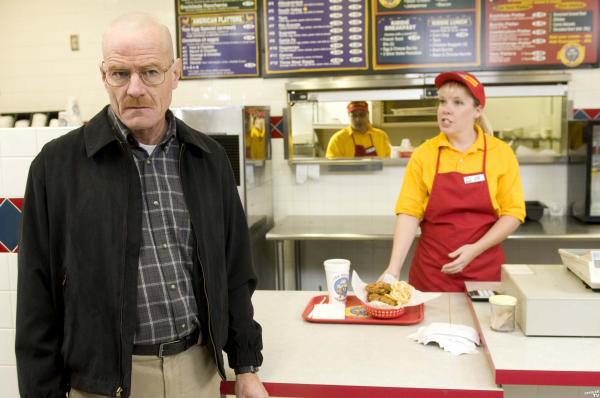
If longtime fans of Breaking Bad were asked to identify the show’s most memorable scene, many would probably point out gems like Walt and Jesse’s standoff with Tuco in the Mexican desert in early Season 3, Hank’s shoot-out with the cousins in mid-Season 3, or Gus’s spectacular demise in last season’s finale. Each is among the great show’s most iconic segments. 

My pick would not be nearly as blood-pumping or blood-spattering.  I would choose the fantastic beginning of Season 3’s ninth episode, a mock commercial for Los Pollos Hermanos that slowly melds into a wordless tour of the massive methamphetamine center lying beneath Gus’s fast food empire. While a seemingly anonymous throwaway with no character dialogue and barely any appearance by Breaking Bad’s stars, the opening is a mesmerizing sequence which captures in one swoop the show’s brilliance, beauty, character debasement, and tension as well as any single scene in the show’s four seasons.

Creator Vince Gilligan takes a unique approach to each episode’s opener, often implementing unexplained teasers, as well as small asides that hold far greater significance than viewers may first surmise.  The Los Pollos opening is a prime example of this style and grows out of Gilligan’s dark sense of humor.  The ad sounds and feels incredibly authentic, making the audience feel as if the commercial break is still in progress; it isn’t entirely clear that the episode has even begun until the smooth-voiced announcer intones the historic lineage of the fictional restaurant. 

Though the commercial’s impressive quality seems like the brain child of some slick Madison Avenue agency, it is instead another clever trick by Gilligan, who loves to toy with his characters—see Walt’s befuddlement at removing the pizza off the roof of his house or his extortion at the hands of Saul Goodman’s vengeful receptionist—as well as his audience, best shown in Gus’s death scene, with the kingpin emerging seemingly indestructible in a neat homage to The Bridge on the River Kwai, and with Gus fixing his tie before keeling over, much as Alec Guinness dusted off his fallen cap before falling dead onto the dynamite plunger.

Beyond merely playing with the audience, the Los Pollos opening is a good expression of the show’s thesis that things are often not as they appear; indeed, the premise of the entire series, that a harmless, nerdy teacher who harbors a boiling rage of resentment, jealously, and cruelty becomes an irredeemable criminal—Mr. Chips becoming Scarface, in Gilligan’s description—revolves around this larger theme.

We quickly see the Los Pollos commercial is not what it purports to be. The sequence then goes one step further by immediately showing how the advertised chicken joint is an elaborate front for the biggest meth distributor in the Southwest. The fairy tale story of the “chicken brothers” and their “zesty chicken . . . slow cooked to perfection”—with delectable-looking brown wings and legs floating in the air—melds into a sprinkling, tinkling rain of turquoise bits of Walt’s blue crystal, as the narcotic is processed by an a small army of drug handlers in surgical garb, hidden in hundreds of tubs of thick gooey fry batter, and packed into trucks headed across the region. The chicken product has, in seconds, become something entirely different and far more deadly than any artery-clogging fat, as the sequence strips away the lies of Gus, just as the longer show methodically reveals more and more of Walt’s underlying callousness. 

The Los Pollos opening gives us our best view yet on the show of the startling, almost comic commoditization of the drug trade that is literally coming off an assembly line like cars from Detroit. In this case, the drug trade has melded figuratively and literally with fast food, and is not much different from greasy grub in its scale of mass production and its ultimately unhealthy after-effects.  If Breaking Bad is in part about the narcotics industry itself, it articulates this exploration no better anywhere in the show’s forty-six episodes than in this sequence.

The scenes also demonstrates the show’s attention to detail as Walt weighs and loads his fresh drug batch onto a dolly where it is wheeled out to numerous destinations. Walt looks tired, half-hearted, and almost bored by the monotony of his job—the drug trade is hardly as exciting as it might appear, or as he naively believed.

This theme recalls two other superb similar sequences from earlier in Season 3, the first where Walt excitedly prepares his brown bag lunch for his first day at the super lab, and the next the extended sequence where he and Gale enjoy their first day “at work” together, making meth, enjoying coffee, playing chess, and discussing poetry to breezy music reminiscent of a Charlie Brown movie.   

These scenes portray the initial fun, exciting side of meth-making, which will be dryly stripped away episodes later in the Los Pollos commercial.  And importantly, the dark side of the trade, the constant threat of extreme violence, lurks in the background as Gus’s henchman Victor opens the meth shipments and menacingly prowls behind the workers—not to mention in the numerous shootings and murders throughout the series.

Furthermore, the opening displays Gilligan’s love of piercing colors and sharp sound effects; here, the glowing red brightness of the sizzling chicken and accompanying spices, the wet clopping cuts of the succulent peppers, the dazzling phosphorescence of the blue meth, the metallic shininess of the super lab, and most of all, the funky, bouncy, strangely compelling music of the scene all remind viewers vividly of Gilligan’s reliance on visually and audibly arresting mediums to catch and hold viewers’ attention in place.

More broadly, the Los Pollos sequence is a textbook example of good filmmaking: a fast, wordless sequence which neatly establishes in minutes an intricate, complex storyline that could be delineated over an entire episode or season. Just as Walt’s bag lunch scene perfectly establishes his professional delusions and personal devolution, the Episode Nine opening explains Gus Fring’s entire organization in around a minute and a half.

At the opening’s finish, as the endless procession of trucks carrying meth across the country moves towards the highway, Gus stands alone, his face hidden by shadow, but his identity clear by his crisp, tucked-in shirt, gleaming rimless eyeglasses, and good posture, He watches in obvious wonderment at the size of his operation, then turns slightly in clear pride at his burgeoning empire. Gus is ultimately a stand-in for Vince Gilligan himself, who crafted this tight sequence which stands as a brilliant summary of his classic show.  He deserves to take that bow too.

Mark Greenbaum's work has appeared in The New York Times, Salon, The LA Times, The New Republic, and other publications.

The Amazing Spider-Mensch

The Amazing Spider-Mensch

null

Spider-Man is great at saving the world, but somebody please save Andrew Garfield from himself—judging from interviews, the poor guy's an ulcer waiting to happen. His quotes page on imdb.com is a minefield of self-deprecation: “I'm very neurotic and self-conscious.” “I think too much.” If I watch myself, then I suddenly have a bunch of things that I'm scared to do. It just upsets me.“ “I'm probably going to be the guy in the movie theater shouting abuse at myself.” “I was genuinely expecting 'You're just a shit actor' instead of 'We want you to [play Spider-Man].'” Where'd this guilt complex come from, Rob Carnevale of IndieLondon asks in an interview? Garfield doesn't mince words: “Being Jewish.”

Yes, Garfield is the first Jewish Spider-Man in movies, a fact that's not gone unkvelled over in publications like The Jewish Journal and the Jerusalem Post. (Naomi Pfefferman sums it up in the former by observing how Garfield “reminded me of the kind of gangly geeky-cute guys you’d develop a crush on at Jewish summer camp.”) While Garfield makes a serviceable action star (his wide-shouldered yoga teacher physique, sleek underneath Cirque du Soleil-designed spandex, certainly sweetens the deal), his best moments in The Amazing Spider-Man could only befit a Nice Jewish Boy—hypochondriacally fretting over his spider bite welt, stammering out his secrets to Gwen Stacy before tangling her up in a kiss, abjectly apologizing after laying waste to an entire subway car because of Spidey-sense jumpiness. He, more than any other Spider-Man—and certainly more than Tobey Maguire—understands the joke-away-the-guilt core of Peter Parker's uneasy being.

As conceived in the early ‘60s by writer Stanley Lieber (known professionally as Stan Lee) and artist Steve Ditko, that part of the character was right there from the beginning. Lee was a New York-born Jew, and Spider-Man was a new breed of superhero  – utterly urban, exiled, neurotic and conflicted, subject to all of the Age of Anxiety's assaults that rolled off the back of less complicated, more assimilated heroes such as Captain America. Also, since Spider-Man had no sidekick, he talked to himself, rendering the reader privy to an inner monologue full of doubt, fear, and insecurity. No wonder he's so full of jokes when he's doing away with bad guys: we laugh to keep from crying. (Lee originally worked on the character with Jack Kirby, a Jewish artist born Jacob Kurtzberg, but grew dissatisfied with Kirby's designs and turned the nebbish-y character over to the non-Jewish Ditko. But it's Kirby's pencils on the cover of Spider-Man's first appearance in Amazing Fantasy #15, swinging across the New York skyline with a rescued man in his arms, a pose we still see as prototypically Spidey.)

That's the thing about Spider-Man: his considerable gifts are only as good as his surroundings. Sure, he can cling to walls and swing on webs, but how impressive is that against the skyline of Omaha or Peoria? Sure, Superman left Smallville because Metropolis offered more opportunity to do good, but he'd still be perfectly superpowered back there. Spider-Man, on the other hand, reaches his full potential only in synergy with the hospitable habitat of the endlessly tall buildings of Manhattan.  He’s not even operating at his peak in his home borough of Queens. How many other superheroes are “bridge-and-tunnel”?

Spider-Man’s story is similar to the great exodus of Jews at the turn of the century, fleeing shtetls to flourish in New York City, a city whose Jewish population is still second only to Tel Aviv. (Israel has its charms, but for many American Jews the real Holy Land is a place where you can find a decent bagel on any corner.) The Jews’ impact on New York's culture and history is so great that Lenny Bruce said it best: “If you live in New York or any other big city, you are Jewish. It doesn't matter even if you're Catholic; if you live in New York, you're Jewish." (Indeed, Peter Parker wears a Ramones t-shirt in his first big fight scene, invoking another game-changing group of Jews from Queens who also besieged Manhattan.)

Judaism reveres the tenet of areivut: the onus of mutual responsibility, spelled out especially in Shavuot 39a:  Kol Yisroel areivim zehl'zeh, translated as “all of Israel (meaning, all Jews) are responsible for one another.”  That concept of “responsibility” is crucial to Spider-Man: it's what accompanies great power, whether you like it or not, a guiding aphorism with much greater moral subtlety than “Hulk SMASH!!”, and near-Talmudic in its grace and simplicity. If Spider-Man's Jewish, then he's looking out for other Jews—and, like Lenny Bruce said, that includes everyone in New York City. Don't worry, five boroughs: Spider-Mensch has your back. His tikkun olam is defeating Doctor Octopus when needed.

An actor can't play Spider-Man without understanding areivut in his gut, without understanding that heady brew of neuroticism, guilt, humor, social responsibility, and a symbiotic love for big cities where reinvented exiles can thrive, swinging free. Even though a UK-raised actor is an unconventional choice for an American icon, Garfield's tribal memory extends deeper than his passport. His Jewish roots inform the truth of Peter Parker, and his portrayal conveys Spider-Man's essence more than any other actor's has previously. In that same IndieLondon interview, Garfield was quoted as saying, “I feel like I have a really big guilt complex, and that if I’m not doing any kind of good then there’s no real reason for being.” Peter Parker would say the same thing. Mazeltov, webslinger. Today you are a Spider-Man.

Thanks to Adiel Levin, Jessica Leshnoff, Ben Korman and Shoshanna Schechter-Shaffin for contributions to this blogpost.

Violet LeVoit is a video producer and editor, film critic, and media educator whose film writing has appeared in many publications in the US and UK. She is the author of the short story collection I Am Genghis Cum (Fungasm Press). She lives in Philadelphia.

CRUEL SUMMER: DIE HARD (1988)

CRUEL SUMMER: DIE HARD (1988)

The "Cruel Summer" series of articles examines influential movies from the summers of the 1980s. The previous entries in the series have covered THE BLUES BROTHERS (1980), STRIPES (1981), ROCKY III (1982), WARGAMES (1983), PURPLE RAIN (1984), PEE-WEE'S BIG ADVENTURE (1985), TOP GUN (1986), and ROBOCOP (1987).

The 1980s were dominated by action movies. Previous decades saw action movies held in more or less proper proportions, with action relegated to war movies, westerns, or the occasional spy thriller. John Wayne, William Holden, Steve McQueen, and Lee Marvin would preside over the action, usually playing men of few words. Then, the 1970s saw a shift towards existential dread as the rise of crime in cities allowed movies to tap into the audience’s fear of social unrest. (The plots of westerns and caper thrillers were too exotic to have any real-world connections. Vietnam had, for the moment, made the gung-ho heroics of war movies seem rather unseemly.) Movies like The French Connection, Dirty Harry, Death Wish, and various blaxploitation offerings gave us vigilante thrills and heroes that restored order in times of civil unrest. Guys like Clint Eastwood and Charles Bronson were older and still men of few words, but they were now providing comfort and safety.

But the ‘80s saw an accumulation of action movies, with a heavy emphasis on the flexing of one’s muscles. Cop buddy movies, urban vigilante movies, POW rescue movies, Chuck Norris karate movies, Death Wish sequels, you name it, dominated the theaters. The existential dread of the Watergate era had been replaced by Reagan-era optimism. Along with Eastwood, who had managed to become an elder statesman of action, Sylvester Stallone and Arnold Schwarzenegger had become pillars of American might. The recurring image in ‘80s action movies was of an obscenely pumped-up one-man fighting machine. (It wasn’t a Stallone or Arnold movie until they were fighting the bad guys while wearing a tight t-shirt that accentuated their forearms.) Movies like Nighthawks, The Terminator, Rambo: First Blood Part II, Commando, Cobra, and The Running Man were outrageously entertaining comic-book depictions of outsized masculinity. But by summer ’88 audiences were starting to feel fatigued by all the car chases, shoot-outs, fistfights, and explosions. We kept going to action movies, but we were rarely surprised. That is, until one movie caught everyone by surprise and forever changed the language of the genre.

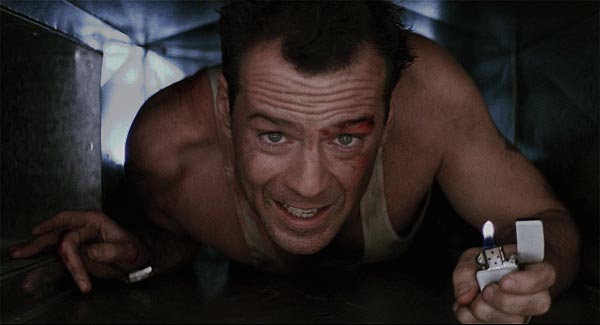
Die Hard was something new, an over-the-top blowout its director made personal by injecting humor and humanity into its incredible action set-pieces. Director John McTiernan staged the action with a you-are-there immediacy that was different from most other action movies. Your perspective was constantly shifting along with the hero’s, as if you yourself were always under the threat of attack. Die Hard was a ‘70s disaster movie crossed with a ‘80s one-man action vehicle, but it played like a witty character study.

And the character of John McClane turned out to be one of the most endearing action heroes in movie history. As played by Bruce Willis, McClane is a screw-up forced into action because bureaucracy and macho posturing are causing inaction. McClane is fully aware that he’s in way over his head. He sees the dark humor of his predicament which gives his one-liners a playful spontaneity. (“Come out to the coast, we’ll get together, have a few laughs!”) The casting of Willis in the lead was a masterstroke. We may now take for granted that TV actors can transition into movies, but back in 1988 it was a rare occurrence. (TV star Mark Harmon made a bid for action superstardom with the summer ’88 buddy thriller The Presidio, but he forgot to bring the humor.) On Moonlighting Willis played a smart-ass cut-up, but what made him instantly likable was the feeling that Willis himself was a smart-ass cut-up. In Blake Edwards’ comedies Blind Date and the criminally underrated Sunset, Willis displayed a knack for light slapstick and farce that, if you weren’t paying attention, could be seen as being one-dimensional. Willis always makes you aware that he knows he’s in the middle of an incredible situation. That’s what makes him such a compelling actor. (It’s also what makes him a star.) We want to see how Willis/John McClane (or Butch Coolidge in Pulp Fiction or Joe Hallenbeck in The Last Boy Scout or David Dunn in Unbreakable) gets out of a sticky situation. In Die Hard, Willis created a new action movie archetype: the everyman superhero.

The reason we root for McClane is because we know just how outmatched he truly is. As the villain Hans Gruber, Alan Rickman ushered in a new golden era of movie villains. With the exception of the Bond villains (who were just as dashing as Bond himself), the bad guys in movies were almost always secondary characters who rarely registered. (Anyone remember the name of Fernando Rey’s character in The French Connection?) The hero was the star, and stars can’t be upstaged. For the most part, memorable villains appeared only in exploitation movies (Vice Squad, 52 Pick-up) or intense psychological dramas (Manhunter, Blue Velvet). But Die Hard changed all that as the filmmakers realized the best way to make the hero look good is to put him up against someone stronger and in complete control. Previously, villains were the ones that sweated. Here, McClane’s undershirt is drenched in fear and desperation. Gruber is the ultimate villain for the 1980s: a sharp-dressed corporate raider who seizes the Nakatomi Corporation during its Christmas party in order to steal $640 million in negotiable bonds. Rickman infuses Gruber with such high comic levels of contempt and self-satisfaction that we’re genuinely startled when he turns violent. It’s a wickedly sinister performance, never more so than when he compliments Nakatomi president Takagi (James Shigeta) on his suit by flatly saying, “Nice suit. John Philips, London. I have two myself. Rumor has it Arafat buys his there.” Rickman makes being bad look good.

Die Hard looked and felt different from most other action movies. Shooting in widescreen allowed McTiernan to fill the frame with extra information about the Nakatomi building’s layout. Over the course of the movie, as McClane crawls through elevator shafts and ventilation ducts, we become familiar with recurring locations throughout the building. (McTiernan displayed a similar mastery of geography with the jungle-set Predator.) The cinematography by Jan de Bont (The Fourth Man) was quite daring for an action movie as he opted to pan on action instead of keeping the camera static. In an early scene, when one of the bad guys slides down a flight of stairs, the camera slides along with him. The many scenes of McClane running through empty offices and hallways have a thrilling sense of movement. By showing the building under construction, McTienran and De Bont could place fluorescent lights in the ground and have half-finished structures in the foreground. In one of my favorite sequences, as the LAPD S.W.A.T. team prepares a rescue attempt, we’re given several perspectives at once. There’s the computer expert Theo (Clarence Gilyard) watching the S.W.A.T. team get into position on a close-circuit monitor, while Hans looks down from an executive office. We also see McClane looking on helplessly as the police walk right into an ambush. (The climax of this sequence is one of the movie’s highlights.) The nearly non-stop score by Michael Kamen gives each set piece its own rhythm. At various points in the score Kamen incorporates Beethoven’s “Ode to Joy,” A playful acknowledgement that all an audience might want from a movie is to be thrilled.

There’s a distrust of authority and upper management running throughout Die Hard. The movie aligns itself with the working-class, be it funky limo driver Argyle (DeVoreaux White) or patrol officer Powell (Reginald VelJohnson). It’s when those in power arrive on the scene (S.W.A.T., the FBI, Deputy Chief Robinson) that ego begins to interfere with getting the job done. Of course McClane is a NYPD officer, but we quickly intuit that he doesn’t follow the rules. (Die Hard with a Vengeance begins with McClane on suspension.) This highlighting of the conflict between individual action and teamwork is really a variation on the ingrained conservative value system of action movies. John McClane is no different from Popeye Doyle, except we now cheer him on without reservation.

This conservative streak allows for some satirical riffing on alpha male action-movie heroics. Unlike his Planet Hollywood partners, Willis isn’t afraid to show a vulnerable side. In a brilliant touch that immediately makes McClane relatable, he spends the entire movie running around in his bare feet. We become acutely aware of the beating McClane is enduring, especially when he has to run across shards of broken glass. This is contrasted with the macho posturing of those in charge like blowhard Chief Robinson (Paul Gleason) and the borderline psychotic FBI agents who take over the negotiations. (During the rooftop climax, when the feds are manning a gunship, an agent exclaims, “Just like fuckin’ Saigon!”) Gruber is amused by alL the futile attempts to outsmart him and his men. At one point he asks McClane, “You know my name but who are you? Just another American who saw too many movies as a child? Another orphan of a bankrupt culture who thinks he’s John Wayne? Rambo? Marshal Dillon?” McClane’s response both mocks and pays respect to old-fashion American heroism.

It’s interesting to note that the summer of 1988 saw established action movie icons attempting to maintain their dominance. Stallone’s Rambo III was so by-the-numbers that even its title was tired. Schwarzenegger tried to make fun of his own image by doing the cop buddy action comedy Red Heat. In a symbolic changing-of-the-guard, Eastwood came out with the final Dirty Harry movie, the surprisingly entertaining The Dead Pool. But Die Hard set the template FOR all future action movies. The most immediate reflection of its impact was Hollywood’S attempt to copy its success with a series of “Die Hard on a …” movies. We got everything from “Die Hard on a submarine” (Under Siege) to “Die Hard on a plane” (Passenger 57) to “Die Hard on an island” (The Rock). (In the best Die Hard clone, Jan de Bont’s spectacular Speed, Keanu Reeves’ Jack Traven is the kind of guy who joined the LAPD because he saw Die Hard in theaters.) The movie’s more lasting impact is shown in the way it presented the hero, foregoing he-man stoicism in favor of intelligence and vulnerability. Die Hard gave us a hero with brains as well as muscles. You can see its influence in characters ranging from Batman to Jack Ryan to Ethan Hunt to Jason Bourne to James Bond (Daniel Craig’s take) to Jack Bauer. One of the movie’s taglines at the time claimed, “It will blow you though the back of the theater!” Boy, did it ever.

San Antonio-based film critic Aaron Aradillas is a contributor to The House Next Door, a contributor to Moving Image Source, and the host ofBack at Midnight,” an Internet radio program about film and television.

GREY MATTERS: MARINA ABRAMOVIC: THE ARTIST IS PRESENT

GREY MATTERS: MARINA ABRAMOVIC: THE ARTIST IS PRESENT

null

There is a hunger out there that cannot be fed by smirks, poses, and irony. In art, in film, hell, in anything. That hunger is why The Metropolitan Museum of Art’s “Alexander McQueen: Savage Beauty” drew Madison Square Garden-sized crowds in 2011 for four months straight. And it’s why believers from around the globe came to New York to mourn the early death and celebrate in a hush the incandescent genius of McQueen, a fashion legend already on his way to art stardom and now definitely a star post mortem.

The tens of thousands lining up on Fifth Avenue revealed an indefinable demographic. Elementary school kids who’d gasped over impossible McQueen women in dresses made of blood red laboratory slides from used library copies of Vogue, Wall Streeters who pored over McQueen videos while their wives and children slept. The Lady Gaga fans who saw his Alien/aqua-woman fusions in “Bad Romance”. As Robert Palmer sang, every kinda people. (The same need explains last year’s Tree of Life mania).

The McQueen phenomena was a stark relief from the last time someone tried to mint a new art star: the Guggenheim’s up-trading of Matthew Barney from Film Forum ur-hipster with “The Cremaster Cycle (1994-2003)” show, way back in 2003.

A collection of semen-toned sculptures surrounding five pop-tchotchke-glutted films that J. Hoberman brilliantly summed up as “narcotized self-satisfaction,” the root of the appeal of Barney’s was their cold, smooth, ironic hipster deadness—the idea of emotional response their anathema.

And so, the McQueen show solidified an appetite for a new art star. Someone personifying a natural disinclination to buy into an exhausted and drained self-cannibalizing post-modernism, for artists with the nerve to make indescribable emotional engagement their goal.

If McQueen was going to hand-apply tens of thousands of feathers to a dress that evoked the madness of Edgar Allan Poe (and not the stories), whoever came next would have to be literally or figuratively dirty. Or both.

If you tuned into HBO Monday, you know who she is: Marina Abramović. While stylistically McQueen’s utter opposite, she feeds the same need for an extreme in inexplicable emotional experience, and Marina Abramović: The Artist Is Present feeds the need in spades. (And sure, she’s been around for decades, and yeah, the actual show took place in 2010, but the film, which is how most people will get to know of Abramović, hits us now, and so this modified timeline.)

Directors Matthew Akers and Jeff Dupre have given us a sharp-eyed film with the affect of ambient music and the feel of a myth progressing in real time that hinges on and riffs off images of The Artist is Present’s endlessly fascinating main event:

It’s Abramović in a brightly lit space in at New York’s Museum of Modern Art, stock still in a series of structured/shapeless robes, sitting in a light-colored wooden chair, confronting one of what will come to be 1,565 strangers in a matching chair, saying nothing so long as those strangers need to say nothing back to her. Each trapped in the other’s gaze.

People of every age, race, creed, and yes, James Franco, take the chair (Lady Gaga came but just watched). Abramović sat motionless for 736 hours and 30 minutes over a period of three months, with no days off.

The people who come to see her—they’re actually called “sitters”—often smile, frown, try to out-stare her (forget it) but just as often, they break into helpless tears. Sometimes, Abramović weeps with them.  

Even as the body-breaking pain of the project—although she eerily looks half that age, Abramović was 63 at the time of this piece—becomes alarming, her dedication grows more heroic. No wonder young people in the audience want to be like her.

Structurally, Akers and Dupre’s film works as a constant interweaving of multiple stories and themes building up to the show itself.

nullThere’s the prepping of the MoMA space: the endless daily maddening minutiae of putting together a show that included approximately fifty works spanning over four decades of video works, installations, photographs, and collaborative performances made with ex-lover Ulay (Uwe Laysiepen).

There’s Abramović decamping to her Hudson Valley home with a troop of young people who will re-enact her pieces within the show.

She puckishly treats them to a Spartan Zen/Marines regime of shock troop performance art training during which they learn how to not move, eat or do anything but exist in the moment for days on end, motionless. (For people still unclear on what performance art is, one talking head brusquely explains that it’s just like painting, except with living bodies.)

I had the sense that Abramović was using the film to re-write her biography, to make a better myth.

The daughter of World War II Serbian partisan heroes, Abramović speaks of being under the influence of her fiercely militaristic mother and paints a life defined by The Work and one Great Love: Ulay, the German performance artist with whom she lived and crafted performance art’s basic syntax.  This love story’s arc packs an incredible emotional gut punch one isn’t prepared for in a film on art. Which, one assumes, is the reason it’s here.

We see and hear of pieces where Abramović invited people to use any of the 72 implements surrounding her body—a whip, scissors, scalpel, gun, etc—on her, and came out of it with thorns in her flesh, death barely averted.

nullOther works involved cutting her flesh, whipping herself, walking the Great Wall of China, and pushing her body to extreme limits of pain and suffocation. The Artist Is Present is eventually about the limits of human giving. If they exist.

She says she recalls each person, communicates with each sitter. And yet the filmmakers never address the 800-pound Christ subtext in the room. Would simple boredom with excess Christian yada-yada explain this aversion? Probably. I wonder what the crying sitters think.

The film does suffer from a couple of crises of courage. It gets jittery at Abramović’s embrace of high-end couture in the 80s. As her art becomes more rapturously theatrical, the film quick-cuts away, as if anxious that more surface-pleasing pieces might somehow be less artful.

Lady Gaga, the artist who most obviously mirrors Abramović in terms of absolute dedication, political engagement/fashion-passion, and near-crazy work ethic (think two full CDs, five videos and hundreds of live performances in one and a half years) is alluded to, but only in a dippy Fox News clip that feels like a way to deny the connection, in case Artforum is off Gaga this season.

But that’s small beans. Marina Abramović: The Artist is Present is one of the film events of the year, carrying forward the needed romance of the artist as a creature owned by a mission which is carried out by an incomprehensible extreme work ethic that would literally kill anyone less devoted than she is. Abramović helps us remember that anything less should simply not be acceptable.

Ian Grey has written, co-written or been a contributor to books on cinema, fine art, fashion, identity politics, music and tragedy. Magazines and newspapers that have his articles include Detroit Metro Times, gothic.net, Icon Magazine, International Musician and Recording World, Lacanian Ink, MusicFilmWeb, New York Post, The Perfect Sound, Salon, Smart Money Magazine, Teeth of the Divine, Venuszine, and Time Out New York.

SIMON SAYS: Local Heroes: The New York Asian Film Festival Strikes Again (And Again, And Again)

SIMON SAYS: Local Heroes: The New York Asian Film Festival Strikes Again (And Again, And Again)

null
 
The New York Asian Film Festival, now a pop culture institution unto itself, started eleven years ago. Its movies were first screened at the Anthology Film Archives in the summer of 2002. For a while, the festival was just a colossal labor of love for fest founders Goran Topalovic, Nat Olson, Paul Kazee, Brian Naas and Grady Hendrix. The air conditioning at the Anthology broke a lot during the festival's first few summers, and the programmers paid for much of the festival's expenses with their personal credit cards. Most years, the festival earned just enough to break even, but each following year, they'd come back stronger and more determined than ever to show attendants genre films and arthouse experiments from across Asia. 
 
nullWith raffle drawings before each film, surprise screenings, and a plethora of special guests, the festival has become a staple of adventurous New York cinephiles' annual calendars. So while this year's program may seem like it's filled with familiar titles and faces, that's only because the New York Asian Film Festival (NYAFF) helped those titles and faces to become familiar. Oldboy, the poster child for the short-lived "Asia Extreme" movement of the early aughts, screened this past weekend with star Min-Sik Choi in attendance. And the first two Infernal Affairs movies, the crooked cop/gangster saga that inspired Martin Scorsese's The Departed, will screen this Friday. Which is fitting, since Infernal Affairs previously screened at NYAFF in 2004, while two of Oldboy director Chan-wook Park's films screened at the festival in 2003 and 2007, respectively. These guys don't jump on bandwagons, they get people on them: Park's Joint Security Area screened at NYAFF (before it was officially NYAFF) a year before Oldboy came out in America, and Infernal Affairs played NYAFF a couple of months before it got a miniscule limited theatrical engagement, thanks to the Weinstein brothers. 
 
NYAFF also got Janus Films to dig up Nobuhiko Obayashi's psychedelic House, a film that has gone on to be one of the Criterion Collection's biggest sellers, from their vaults. They've started cults around filmmakers like Katauhito Ishii (The Taste of Tea; Funky Forest: The First Contact), Johnnie To (Exiled; Throw Down) and Ji-Woon Kim (I Saw the Devil; The Good, the Bad and the Weird). These guys may have started from (and with little!) scratch, but they went on to become wildly influential taste-makers.
 
This year, the original NYAFF programmers are not present: Olson and Naas have left the festival, while a couple of other succeeding NYAFF curators have assumed diminished responsibilities. And the festival's venue has changed over the years, too; this will be NYAFF's third year at Lincoln Center's fully air-conditioned Walter Reade. But not much else has changed. The festival continues to show support for the artists they've previously championed, further fostering a sense of community, with high-energy events for each of these screenings. 
 
nullFor example, Hong Kong filmmaker Edmond Pang has had a film screen at the festival before (Pang's Exodus screened in 2009). But this year, NYAFF will screen two of Pang's features and an eclectic shorts program called Pang Ho-Cheung's First Attempt. First Attempt was a one-time-only reprisal of an interactive experience where Pang talked about four of his early short films before, after and while they screened. Pang made these shorts with his mother and two brothers when he was 11, 12 and then 26 years old. The earlier shorts, where Pang improvised slow motion effects and spliced in footage from John Woo films like A Better Tomorrow, were definitely the highlights of what was shown. Their make-do aesthetic has a cockiness to it that makes every boombox song cue and every spliced-in scene of buildings exploding that much more endearing.
 
Better yet, before a screening of Pang's romantic comedy Love in the Buff, Pang and Hendrix re-enacted (with hand puppets!) the events of Love in a Puff, the romcom to which Buff is a sequel, for anyone that hadn't seen it. The NYAFF gang will do anything to make first-time attendants feel welcome, and they do it with such a unique combination of storied grace and aw-shucks charm that it's almost scientifically impossible to not be won over.
 
nullAnd the festival hasn't stopped making new discoveries either. On Sunday, the festival screened The Sword Identity, the directorial debut of Chinese screenwriter/action choreographer Xu Haofeng. Haofeng is the screenwriter of The Grandmasters, Kar-wai Wong's upcoming martial arts epic. Watching The Sword Identity, you can easily see a similarity between Haofeng's interests and Wong's. Haofeng has made a genre film ideologically grounded in the notion that actions reflect character and that physical gestures and techniques always express the essence of things. That's the kind of story that the protagonists of both In the Mood for Love and 2046 dream of writing and the kind that Wong tried to make in Ashes of Time
 
Still, The Sword Identity, which screens again on the 11th, is very much an accomplished self-sufficient work and a compelling festival find. In his Sunday introduction to the film, Hendrix probably overplayed the fact that the film got a blase critical reception at last year's Toronto International Film Festival. But The Sword Identity is now very much a NYAFF find, a film whose vision of heroism perfectly matches the festival's ethos. NYAFF programmers know that, when it comes to screening exciting and innovative films, it's not just the thought that counts. These guys never program in a half-assed manner; they always pull out as many stops as they can. To paraphrase Harlan Ellison, the most important thing about NYAFF is not that they became a great film festival–it's that they've remained a great film festival. Here's to another eleven years of discoveries at the New York Asian Film Festival.
 
Simon Abrams is a New York-based freelance arts critic. His film reviews and features have been featured in The Village Voice, Time Out New York, Slant Magazine, The L Magazine, The New York Press and Time Out Chicago. He currently writes TV criticism for The Onion AV Club and is a contributing writer at the Comics Journal. His writings on film are collected at the blog, Extended Cut.

VIDEO ESSAY: Batman: The Animated Series

VIDEO ESSAY: Batman: The Animated Series

Children of the 80's and 90's remember this series with a fondness bordering on the familial.  The animated series was there for you every day after school, with new episodes on Saturdays.  Watching the episodes again, I realize now it has become a not quite completed work, which is how superhero entertainment functions.  Batman's adventures are never-ending. The last episode, "Judgment Day" wasn't a pay-off to a series long arc but just another adventure.  I think this is part of what makes Batman, and characters like him, an avatar of the collective pop culture unconscious.  For as long as stories are told, Batman will be with us. 

John Keefer is a writer/director of short films working out of Phoenixville, PA. You can view his work here. You can follow him on twitter here.