Is Reggie Watts the Most Important Artist of the Century So Far?

Is Reggie Watts the Most Important Artist of the Century So Far?

null

The
only thing you need to know about “postmodernism” is that it’s over.
Several decades of academics goading us to dig deeper into the roots of all
language, the better to see that we don’t define words or understand others’
speech consistently, have come to a close. That’s largely because the
generation of literary and performance artists coming up now has—without
realizing it—eaten this “postmodernism” for breakfast every day and
grown tired of it long before formal exposure to it in college and grad
school. 

The
harsh reality that language is imperfect is simply old hat. Instead of
dissecting the realities of language, what today’s youngest and most innovative
artists are doing is speaking in the language of reality. They’ve leaped over
both the hundred thousand tomes of boring European literary theory that defined
academic art for decades, as well as the much-discussed sincerity-irony
spectrum that was so important to Gen-X art in the eighties and nineties—think
Bret Easton Ellis and “Reality Bites”—to come to a place in which
what really matters is achieving in art what we all already experience in life:
A sense that we move through so many online and real-time identities in our
lives, and are exposed to so many different types of discussions, and are so
unsure anymore about what is real and what is fiction and what the difference
between the two is, that the only recourse is to live life and make art as if
those identities, discussions, and realities were actually interchangeable.
This, then, is really all you need to know about “metamodernism,” the
place America’s most experimental young artists have taken us in music,
literature, film, and television.

Reggie
Watts, a New York City-based musician, comedian, and slam poet whose routine is
heavy on improvisation and stream-of-consciousness association, is just the
sort of multidimensional artist you need to be watching if you want to know
what experimentation in the literary and performance arts looks like right now.
Instead of academics like Kenneth Goldsmith or Rachel Blau DuPlessis performing
high-concept ideas in art based on European theories about the mind and
language, or young emo boys and girls painting over the gaps in their sincerity
with irony, we’ve now got artists like Watts. His way of making art is much
closer to the way we actually function day-to-day in America—something which,
not that you’d know it, has been a goal of experimental art for at least a
century. 

Back
in the early twentieth century, a number of European literary movements,
including Dadaism, Futurism, and Surrealism, bred young radicals who used
wild-eyed manifestos and ultra-challenging experimental literature to force
workaday men and women to more carefully consider the pitfalls of modern
living. While sometimes this form of social protest included an element of
performance, more commonly it was found in texts that—ironically—only the
Continental intelligentsia were likely to ever come across. The aim of all these
movements was nevertheless an admirable one: To make the conditions under which
art is created and performed every bit as dramatic and complex as the conditions
under which those who don’t make art
are forced to live. Unfortunately, somewhere along the way this ambitious aim
got sidetracked and stifled in the offices and classrooms of
university-dwelling English scholars. Metamodernistic artists like Watts offer
our best hope, now, of once again seeing America’s artist class making art directly
relevant to how we live today.

Perhaps
it’s not surprising, then, that metamodernists like Watts don’t go in for
reductive titles like “filmmaker” or “poet” or “novelist”
or “musician”; today’s most innovative work not only crosses all
boundaries of genre but in fact ignores such boundaries altogether. We see it
as much in poetry as in songwriting, as much in fiction as in comedy. This
metamodernist approach weaves together different planes of reality and modes of
communication to build the sort of uneasy coherence that allows us to survive
them intact. In other words, while it may often seem, in the Internet Age, that
a stable self-identity is a luxury few of us can access or afford, what
metamodernism offers us—all of us—is a way to locate an authentic self even
in the midst of contemporary America’s chaotic, social media-driven culture.

Watts’s
tenth multimedia production, the short film “Why Shit So Crazy?”, is now
available for streaming download from Netflix. It’s cobbled together from
various clips of the performer’s bizarre stage routine, a fact which itself
suggests more than one level of reality: the reality experienced by the people
who attended the shows we see excerpted in the video, and the new reality Watts
creates by foregrounding his short film as a highly-manipulated sequencing of
things that actually happened. Some of the effects in the video are
“merely” stylistic—for instance, psychedelic visual echoes, or
inexplicable slow-motion shots, all of which remind us we’re not in Kansas
anymore. But most, including countless conspicuous jump-cuts, are deliberate
and force us to consider the things we do and don’t count as “real”
in both art and life.

More
commonly, Watts is engaging in several manipulations of language that reveal
the metamodernistic life we now live. Sometimes, what Watts is doing is making
activities we’d normally consider secondary to a live performance the primary
focus of his act, much like tooling around on the Internet has become a way of
life for America’s youth rather than merely something to pass the time. Watts
at one point spends two minutes adjusting his microphone; later, he takes that
same microphone off-stage to have a brief yet convincing argument with his
girlfriend. On other occasions, common verbal tics become the entire substance
of Watts’s routine. And in one particularly memorable bit, Watts performs a
masterful and detailed mimicry of the whispered conversations of audience
members disrupting his performance. 

Often,
Watts leaves his audience wondering what the baseline of his act is—in other
words, who Watts himself really “is”—by switching without warning
between different accents, foreign languages, timbres, and volumes. He
sometimes even speaks in gibberish, though it’s gibberish so convincing in its
rhythm and timbre that it seems merely a reasonable continuation of the
monologue that preceded it. Many of Watts’s thoughts go unfinished, but in a
way that mimics ADD or ADHD rather than seeming coy or ironic. Other remarks
seem wise but also empty of content, like this one: “I’ve learned
throughout the years, living here in New York, that unless you keep realistic,
there’s no way you can survive. You have to make sure that things make sense every
day
.” Okay, that seems clear enough; wait a minute, what?

These
purposeful eccentricities emphasize just how much of the language we come
into contact with daily is noise that nevertheless feels essential and true.
For instance, sometimes Watts will sing his lyrics
“incorrectly”—offering a word that’s other than the one we might
have expected—though as the entire routine is improvised, it’s up for grabs in
this type of performance what’s “correct” or in error. Elsewhere
Watts seems to bare his heart with a searing sincerity, though as it’s in the
context of an improvised Jamaican pop-song scat, who knows: “I’ve been in
love so many times before, it’s hard to count. And when I fall in love again, I
won’t know if it’s really love because I can’t remember what it was the first
time I fell in love. Because it’s a construct of your memory. But it’s a
feeling nonetheless, and I’ve got to respect that in the process. And everyone
knows, everyone feels inside: that’s Life.” Some, all, or none of
this may be autobiographical, but it’s undeniably catchy as a sung lyric. It’s
also wise, yet it’s presented in just the sort of frivolous package we’d expect
to find nonsense in. That’s how the Internet Age feels sometimes, and Watts
knows it. The same can be said of his use of “call-and-response”
techniques. Usually, the sound that echoes back to him on stage is quite
different from the sound he requested from the audience, demonstrating for us
that even when we want to be in concert with one another, it’s impossible.

Watts
also goes into sudden diversions of thought and manipulations of fact that
frustrate even our most modest expectations. For instance, he tells a story
about his Montana childhood, and then he casually mentions an incident that
happened to him as a youth in the 1950s (which is impossible; Watts just turned
forty last year). Later, he details the history of the venue he’s performing in
with great authority, then subtly changes major facts the second time he
repeats them. More broadly, “Why Shit So Crazy?” slides seamlessly
from one topic or genre of performance to another, as when Watts moves from
miming to narrative to scat to hip-hop without pausing, or fills his improvised
songs with “plain speech” no one would ever set to music.

Yet
even Watts’s “plain speech” is quite a bit more—that is to say,
quite a bit less—than it at first
appears. At one point Watts speaks of how men and women “are” without
ever completing a thought or making a coherent observation. Women think and do
things, Watts explains, speaking as if he’s exposing a fundamental truth of
great import, and men also sometimes do and say things. And this, Watts
concludes, “explains” the situation in Palestine as well as the on-again,
off-again military conflict in Kashmir. It doesn’t, of course, explain either
of these things, but Watts nevertheless ends each sentence of his mini-lecture
with the words, “know what I mean?” Another of Watts’s songs is
comprised entirely of gorgeously sung profanities coupled with a recitation of
the parts of speech in English (e.g., noun, adjective, adverb). Still
another reproduces the compelling non-narratives of everyday gossip using a
string of sung pronouns: “I’ve got you, and you’ve got him, and he’s got
her, and she’s got she; he’s got he and we got them. We is them too when we go
there–well, no, I don’t know.”

It
helps that Watts is an excellent singer, lays down some of the best beats
you’ll ever hear, has impeccable comic timing, and can improvise narrative better
than even the most talented slam poet. Which is exactly what this new mode of
art calls for: Excellence in multiple types of language—and in the realities
those languages create for us—rather than specializing in obscure theories
about how individual parcels of language sometimes operate. It’s like today’s
young innovators are looking upward, toward the many different realities
layered atop our everyday one, whereas yesterday’s aging innovators are forever
looking down, trying to see how many angels (or European scholars) they can fit
on the head of a pin (or in scholarly treatises no one reads). 

We’re
seeing this same sort of emphasis on “super-consciousness”—that is,
on how realities collide and accumulate in the lives of real Americans—not only
in stage performances like Watts’s, but on the page, too, in the poetry and
fiction of young literary artists who live and write in multi-genre
communities. Increasingly, these literary artists are found in graduate fine
arts programs across the nation, even as they experience social networking
phenomena on a daily basis like the rest of us. If the previous generation of
artistic experimenters was fascinated by basic Internet-Age technology like
search engines and “uncreative writing” (the idea that you can take a
text that already exists and pretend it’s “poetry”), the younger
generation Watts is a member of is more interested in having fifty tabs open in
a web browser all at once and moving seamlessly between them as through a
single “reality.” Sure, it was interesting and instructive when John
Cage recorded his “4’33″” in 1952—a “song” that’s
simply four minutes and thirty-three seconds of silence—and Kenneth Goldsmith
intrigued many younger artists when he typed up an edition of The New York Times in 2003 and called it
a book of poetry (Day), but neither
teaching us to appreciate background noise nor challenging what sorts of
material can be used to make a poem resonate in 2013 the way they once did. If
anything, today’s young people are so suffused in noise and so bored at the way
language is constantly being thrown at them in tiny, marketing-savvy packets
that what they’re looking for is something entirely different: A way out of the
nation’s gummed-up language matrix that makes them feel more human rather than less.

We’ve
become accustomed to thinking that America’s poets and novelists don’t write
much if anything of relevance to today’s youth. But with more and more young
artists sticking with their artistic ambitions through college and graduate
school, we’re more commonly seeing young American creators who are eccentric
but not, importantly, separated out from their peers like the solitary geniuses
of America’s literary past. The result is a generation comprised of young poets
and novelists—and musicians, comedians, and genre-bending performers of all
types—who seem like the sort of people you’d want to get a beer with, and who,
however strange and distinct their performances or modes of writing, are
somehow capturing what it means to be in your twenties or thirties or even
forties in the Internet Age. The list of such artists includes poets like
Donald Dunbar, Chelsey Minnis, and Sampson Starkweather; musicians like Lady
Gaga and Bo Burnham; filmmakers like Joss Whedon, Shane Carruth, and Terrence
Malick; and multi-genre performers like Sarah Silverman and, of course, Reggie Watts.
Ultimately, these men and women are among the most successful experimental
artists in the United States not because they’re boring and obscure, but
because they’re exhilarating and only obscure in the way modern living
sometimes feels obscure. It’s all right to be confused and frustrated by the
simultaneous identities and realities our technologies force on us, but Watts
and other young artists in the metamodernistic mold teach us that it’s okay to
laugh at and embrace and combine these conflicting realities, too.

Seth Abramson is the author of three collections of poetry, most recently Thievery (University of Akron Press, 2013). He has published work in numerous magazines and anthologies, including Best New Poets, American Poetry Review, Boston Review, New American Writing, Colorado Review, Denver Quarterly, and The Southern Review.
A graduate of Dartmouth College, Harvard Law School, and the Iowa
Writers’ Workshop, he was a public defender from 2001 to 2007 and is
presently a doctoral candidate in English Literature at University of
Wisconsin-Madison. He runs a contemporary poetry review series for
The Huffington Post and has covered graduate creative writing programs for Poets & Writers magazine since 2008.

Cracking the Mold? Melissa McCarthy’s Position in 21st Century Female Comedy

Cracking the Mold? Melissa McCarthy’s Position in 21st Century Female Comedy

null

The idea that a comedy centering on the lives and
experiences of women cannot be a moneymaker has all but faded away after Bridesmaids’ release back in 2011, but
the debate over whether or not women, as a gender, are as funny as their male
counterparts is still being actively debated today. In many ways, this is
rather strange. After all, we have no shortage of funny women performing standup
and starring in various roles on TV and in the movies. Of course, humor is
highly subjective and culturally loaded. The things we find funny are a
combination of personal preference and social constructs. Melissa
McCarthy’s success as a comedian and status as the “new face” of female comedy
is likewise a combination of fierce talent and the
media’s willingness to give her support.

The support that McCarthy, and other female comedians,
receive tends to be tremendously ambivalent, a buttressing that continuously
comes back to the idea that funny women are rare and unusual. Female comedians are still perceived as
subversive, even though women like McCarthy have been performing comedy for
years.

All of this points to the fact that
our heightened awareness of sexism doesn’t necessarily stop it from occurring.
Two years ago I ran into a male acquaintance who I hadn’t seen for some time.
We caught up about career and relationship things, and then he mentioned that
the woman he was seeing was a few years younger than himself, a ripe old 27.

“I really prefer dating younger
women,” he told me earnestly. “After all, once a woman is my age—the late
twenties—she starts having certain expectations. It must be sad that, as a
woman, you have so much less time to explore and be young, what with your
biological clock and all.”

This was said one part in earnest, one
part as a playful jab, one part in an almost endearing attempt to talk to me about what it
was like to be a woman, but it hit me like a brick and left me feeling
exhausted and angry. I felt the same way when a male friend told me that he
could gain as much weight as he liked without bearing any social consequences
because that was just a women’s issue. Both women and men have stated
unflinchingly that women just don’t age well, period. Comments like these are
not intended to engage me in a dialogue about pressing gender concerns, nor are
they attempts to think critically about an inherently sexist system. Instead,
comments like these, which position gender stereotypes as stark, unchanging
facts, are intended to keep women in a position of vulnerability and
learned helplessness.

I keep being reminded of these
types of comments as I consider the recent hubbub about McCarthy, whose
tremendous success in TV shows (SNL,
Gilmore Girls, Mike and Molly
) and films (Bridesmaids and, most recently, The
Heat
) has inspired women and fueled further debate about whether women are
funny or not.  The debate, which is a
recurrent one, seems to boil down to the issue of whether or not female
comedians are as funny as male comedians. You can find such esteemed
thinkers as Jerry Lewis, Christopher Hitchens and Adam Carolla considering it
from various vantage points of subjectivity. Their comparisons always imply
that women, rather than being seen as individuals who either possess or lack a capacity for
humor, are instead seen as being somehow representative of all womankind.nullWhile McCarthy is talented and incredibly likeable, she is also not
the first female comedian to do physical comedy (Lucille Ball did that way back
in the 50s, when stuffing chocolate into her bra, or contorting her face when
crying, or falling over or into things when dancing). Nor is she the first to
wear her weight proudly (Roseanne Barr did that throughout Roseanne in the 80s and 90s). She is also not the first to be
raunchy and in-your-face (fortunately or not Joan Rivers still does that now). I don’t say this to downgrade McCarthy’s
accomplishments or to criticize her work. However, I do find it strange that women
are still perceived as being unusual when they are talented at any and all of
these things. If McCarthy has broken out of a mold, she has broken out of a
mold that many, many female comedians have already cracked.

The female comic, like the female
writer, the female artist, the female filmmaker or the female public
intellectual, is always seen as representative of a female experience, not a
human one. True, female comedians today are allowed to play with a greater
number of facades than they used to. There are “sexy” comedians like Chelsea
Handler, Whitney Cummings and Sarah Silverman, who are each perceived as pretty
first and funny second; “quirky” comedians (my favorite brand) like Tig Notaro,
Aubrey Plaza and Kristen Schaal, whose dedication to awkwardness is thoroughly
genderless; and “self deprecating” comedians like Tina Fey, Janeane Garofalo
and Roseanne Barr, who willingly put themselves down for the sake of a few
laughs. While each of these women individually brings great, unique talent to
the industry, female comedians, more so than their male counterparts, are pigeonholed
into certain set personas.

nullOf course, this is seen outside of
Hollywood as well. It may be a function of our Internet age as much as
run-of-the-mill sexism. I’ve been alternately thrilled and dismayed at the way online
magazines like Slate and The Atlantic feature women’s issues sections—which serve the
dual function of bringing women’s issues to attention and ghetto-izing them. It
certainly is helpful to have all of my feminist commentary in one handy section
of a magazine, but these publications, condescengingly enough, clearly don’t consider
issues that affect women to be “news.” Issues pertaining to gender in general
are presented as loftier lifestyle-oriented pieces. Bridesmaids was marketed as a game changer and seen as subversive
because it featured an all-female cast, but it was also only one of a long line
of female-centered films about getting married. While Bridesmaids was innovative in that it placed women in situations
more rough and raunchy than was previously deemed appropriate or acceptable, Bridesmaids’ success did not reinvent
Hollywood. as many feminists hoped it would. It simply paved the way for a new
female brand, one which Melissa McCarthy has become the poster child for: the
rough and raunchy female comic.

The
Heat
, McCarthy’s latest film, is effective and funny, but it is also hardly
revolutionary in its approach to comedy. Its appeal to both genders is really
based on the fact that the buddy cop comedy genre has been a historically male-oriented
one. In determining a film’s importance, we still mainly worry about whether or
not that film is going to appeal to men. Perhaps my cynicism sounds a bit
world-weary. After all, The Heat does
pass the Bechdel test, which posits that a movie’s gender equity can be gauged
by whether or not we encounter two or more women in a film who talk about
something other than a man. It highlights a positive and affirming
female-friendship that seems genuinely affectionate and is not based around
relationships with men.  That said, I am coming to a point as a feminist critic where watching two women who
don’t seem pathetic, or boring, or insular, or don’t make me feel like I want
to shoot myself in the head is not enough for me anymore. The summer months are
still a sea of bromances, as well as male-centered action and superhero movies,
and I don’t feel grateful when I see women “allowed” to engage in the same
vulgar and offensive humor that men have been playing at for years.

When writing this piece, I talked
it over with a friend, who tried playing devil’s advocate with me. My friend
said that all the female comics of the past 60 years were courageous game changers.
They have worked hard to help women break into the comedy world. But while I
agree that the socially-minded commentary of women like Margaret Cho, Wanda
Sykes and Roseanne Barr have been tremendously inspiring and empowering, it is
clear that the comedy circuit is still incredibly hostile to women. Our culture
itself is hostile to women, skeptical of their successes, unwilling
to see women’s accomplishments as anything more than a special interest work.
The recent and prolonged debate about whether or not it is okay to joke about
rape is often derailed by critics and comedians alike. Big headliners like
Daniel Tosh often claim impunity when confronted by angry critics, highlighting
how comedy can only be successful when there is complete freedom of speech. Unfortunately,
the sheer ubiquity of these types of jokes reinforces the idea that women’s
needs—for safety, consideration and respect—are simply not important, and that
women’s needs are actually counter to the goals of comedy as a whole.

nullThe trend of creating a kind of
false gender discourse as a means of actually reinstating the status quo is not
unique to the comedy circuit. In the past month blogger,
researcher and artist Nickolay Lamm tried his hand at transforming Barbie so that her
measurements would reflect the height, size and shape of an “average” American
woman, rather than the obviously out-of-proportion measurements of the much worshipped
and maligned traditional Barbie doll. In the pictures of this version of Barbie,
you can see a shorter, slightly thicker Barbie, with a rounder chin and ass.

I’m not sure what I am supposed to
feel about these kinds of projects. Most likely the same kind of gratitude I am
expected to feel when women are given the main billing in a comedy. Are these
new Barbies intended to help us recognize that the unattainable images we
constantly see are, in fact, unattainable? That a short lived dialogue
surrounding a trendy new meme will promote some kind of tangible change? The
reality is very different. Every few years someone else comes along with a new
reason for why the original Barbie is bad and how a more realistically shaped
Barbie would help girls learn to feel good about themselves. And we all know that
Barbie isn’t going anywhere. Little girls are not going to be fighting over
these new Barbie models. If Barbie sells
a bill of lies to girls and young women, “average” Barbie sells an even bigger such bill:
that continuing a dialogue around a problematic image will help heal us. In
reality, Barbie’s ubiquity is strengthened by clichés. These clichés surround
her very existence, which is a part of America’s cultural fabric.

Our current view of female
comedians reduces them to dolls. By this I don’t mean to suggest that we don’t
laugh at the jokes female comedians make or listen to them when they talk about
their experiences. What I mean is that we still reduce female comedians to
their gender. Perhaps this is a problem of consumerism, as well as sexism.
After all, we have just as many ridiculous and offensive stereotypes about
masculinity being marketed to us today ( the idea that men are buffoons who can’t
take care of children, for example, is a staple in sitcoms and commercials
alike,) and the culture of masculinity is not one that most of us are trained
to think critically about. At the end of the day, we buy the bill of goods we
are sold, which is why PSAs about how unrealistic photoshopping is are doing
nothing to help women (and men) feel better about themselves.

I enjoy laughing more than I enjoy
criticizing things. In researching this piece, I loved having the opportunity
to watch a lot of really wonderful and talented female comedians at their best.
But the longer I kept researching, the angrier I got. Our world pretends to
offer women a tremendous array of options, only to continuously remind women
that we should be thankful for getting anything at all.

Anger, of course, often comes from
a feeling of being out-of-control or helpless, and that is truly how I often
feel when I talk about these issues. I know I have seen them constantly, every day,
since I was a little girl. I know that there are a lot of compassionate and
concerned thinkers, male and female, who really want to improve these issues. I
also know, however, that real, permanent, far-reaching change won’t come from
simply allowing women a greater number of stereotypes to play into. What we don’t need is another a parade of
Barbies. It doesn’t matter if we accept all shapes, sizes, colors and any
number of interesting and evocative outfits. At the end of the day, funny,
talented women notwithstanding, the cultural machine is still just interested
in churning out plastic.


Arielle Bernstein is a writer living in Washington, DC. She teaches
writing at George Washington University and American University and also
freelances. Her work has been published in
The Millions, The Rumpus, St. Petersburg Review, and South Loop Review, and she has twice been listed as a finalist in Glimmertrain‘s Family Matters Short Story Contests. She is Associate Book Reviews Editor at The Nervous Breakdown.

Rehabbing Tonto: THE LONE RANGER as Picaresque Tale

Rehabbing Tonto: THE LONE RANGER as Picaresque Tale

null

As The Lone Ranger
shifts from the point of view of its hero, John Reid (Armie Hammer), to the
first-person narrative of his Indian sidekick Tonto (Johnny Depp), the tired
pulp story becomes a postmodern picaresque. A type of story with a long
literary tradition but seldom seen on film, a picaresque is usually episodic in
nature, a fact that contributes to what many perceive is the messiness of The Lone Ranger. Tonto exemplifies the
typical picaresque hero (or picaro), noble in intentions but misguided and
perhaps even unreliable in his perception of the events in which he is usually at
the center. Like Arthur Penn’s Little Big Man, this film begins with a
rather decrepit Indian as a dubious storyteller, spinning a yarn full of
non-sequiturs and magical realism that both uncomfortably overlap with heinous
atrocities in order to subvert the typical white victor’s perspective of the
American western. The first appearance of Depp, made up to look a hundred-odd years
old, is itself a metatextual reference to Little
Big Man
’s protagonist, Jack Crabb (Dustin Hoffman). Crabb is a white man
raised by the Cheyenne who encounters famous figures like Wild Bill Hickok and
George Armstrong Custer (who, in The Lone
Ranger
, finds his own visual parallel in a cavalry officer played by Barry
Pepper), just before their grand, untimely ends. 

Tonto’s pseudo-mysticism is one exaggeration highlighted in his narration,
later revealed to Reid by his sidekick’s own people as the mad ravings of a
fool. But Tonto’s skewed imaginings serve to leaven the social commentary with
humor as is typical in other picaresques like Don Quixote. A dark flashback showing the extermination of Tonto’s
tribe by plundering strip-miners backs up against a hallucinatory image of the
Lone Ranger’s horse Silver standing comfortably at the tip of a branch of a
tall tree. “There’s something very wrong with that horse,” says Tonto, an odd
laugh line at that point of his story. But isn’t it also a bit of humor meant
to both mitigate the horror that precedes it as well as heighten it in sharp
relief? It certainly inspires Reid to take the role Tonto has bestowed on him
more seriously than he does initially, if for no other reason than he fears the
crackpot may not be up to the task.

Still, Reid is more of a milquetoast here than in any previous iteration of
the Lone Ranger character. Consequently, Tonto becomes a tragic hero looking
for redemption. He is indirectly responsible for the genocide of his own
people, but he strives to make amends by stymieing the advance of the railroad
(and attendant whites) into Indian lands, ultimately with no success. This the
film makes clear even before the story proper starts. Our introduction to the
wizened, old Tonto is in a travelling circus sideshow display behind a racially
charged nameplate that reads “The Noble Savage.” Even Tonto’s name,
as alluded to when Reid asks him if he knows what it means in Spanish, befits
that of the typical picaro. “Tonto” is Spanish for “idiot,” an
apt description for other picaresque heroes such as Redmond Barry Lyndon or
Forrest Gump.

Much of the gleeful critical piling-on directed at The Lone Ranger is
conflated with politically correct hand-wringing, involving Hollywood’s
depiction of Indians and the casting of Depp to play the Masked Man’s Indian
sidekick, Tonto. One camp is offended by the very existence of Tonto, a
mishmash of Hollywood’s stereotypes of indigenous people. Of Depp’s
performance, Mark Dujsik
says, “…speaking in broken English and gratuitously mugging for the
camera—perhaps it’s for the best that a Native American actor has been spared
the indignity of the role…” Another sillier group’s outrage seems to stem from
nostalgia for the television Tonto they grew up with. Badass
Digest
’s Devin Faraci says “… The Lone Ranger is a movie that seems
to be embarrassed of its own source material…. Unwilling to just degrade The Lone
Ranger himself by making him a buffoon, the movie also makes Tonto a gibbering
lunatic.…”

Critics are insulted that Depp, whose claims of Indian ancestry are remote
if not entirely questionable, was cast as a quite evidently made-up Indian icon.
However, before the previous 1981 disaster, only one Indian actor had ever played Tonto, TV’s Jay Silverheels (a Canadian
Mohawk whose real name was Harold J. Smith). Silverheels did his best to imbue
a character that was basically an expository soundboard with elements of his
own heritage in order to position the character as a hero his people could look
up to. But at his foundation, Tonto is still a thin character. Being upset that
the mutable Depp is playing Tonto is like feeling insulted that British
chameleon Peter Sellers played the faux-French Inspector Clouseau.

Depp’s performance as Tonto is a memorable tragicomic creation, made
perfectly viable by the framing device utilized by director Gore Verbinski to
tell the movie’s story. Indeed, when seen as a picaresque told by an
anti-establishment fool, it becomes clearer that Depp and Verbinski are not only
not denigrating the Indians; by
rehabilitating the subservient character of Tonto, they are elevating the
Indian people to their rightful place as the central figures of the story of
the American West. As if to bear out this idea, Verbinski offers us, as the
final credits roll, an elegiac, silent crane shot of Depp’s aged Tonto
shuffling off into the sunset, not in his stereotypical buckskin but his titular
partner’s now-threadbare black outfit. He has become the hero of his own tale.

Atlanta-based freelance writer Tony Dayoub writes about film and
television for his blog,
Cinema Viewfinder. His criticism has also been
featured in Slant’s The House Next Door blog,
Wide Screen, Opposing
Views and Blogcritics.org. Follow him on Twitter.

Are the Belchers of BOB’S BURGERS the New All-American Family?

Are the Belchers of BOB’S BURGERS the New All-American Family?

null

The conceit that made The Simpsons the
longest-running animated series and sitcom in U.S. television history was
simple enough: Focus attention on a working-class family whose members are all
of above-average intelligence relative to their age—with the notable exception
of the breadwinner—and let hilarity ensue. Most of the resultant humor
focused, in the early seasons, on Bart’s ready ability to outsmart his elders;
in later seasons, Homer’s tendency to win the day without any know-how or even really
trying stole the show. Here and there, toddler Maggie’s age-inappropriate
intelligence, Lisa’s nerdy maturity, and Marge’s throwback do-gooderism offered
a spoonful of additional comic relief.
 

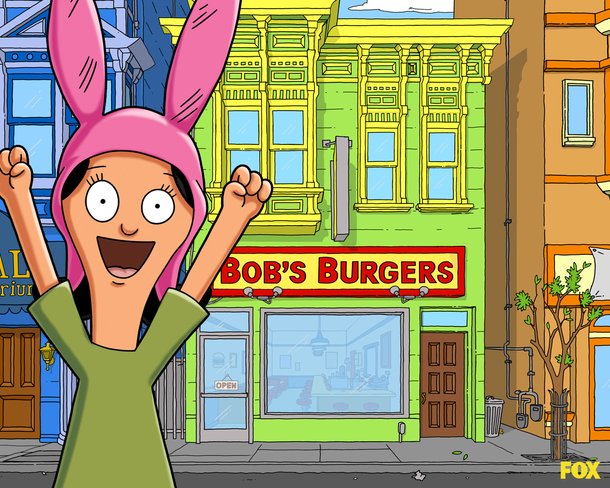
The premise behind Bob’s Burgers is altogether
different. Instead of being across-the-board shrewder and more insightful than
their peers, the Belcher kids are defined by the type of their intellects rather than their magnitudes: Louise is
strategic, Tina self-conscious, and Gene unpredictable. More broadly, and far
more importantly, all three seem to suffer from significant mental and
emotional disabilities. Louise, the youngest Belcher, wears bunny ears at all
times, relishes violence and conflict, and only rarely shows even a hint of
emotional attachment to her parents and siblings; Tina, the eldest, is a
depressed and anxious pre-teen whose creepy obsession with sex is made all the
more unsettling by the fact that she speaks in a boyish monotone; Gene, the
only son and middle child, alternates between making insightful observations
and farting uncontrollably, between an attention span measured in seconds and
being willing to eat or say or do absolutely anything if asked. The upshot of
all this is that viewers can smell the dysfunction a mile away—even if they
lack the clinical terminology to diagnose it.
 

nullBy comparison, Bob and Linda Belcher, the show’s Baby Boomer
parents, are refreshingly normal-seeming. Linda is on occasion overbearing and
melodramatic, and her voice and physical mannerisms undoubtedly grating, but
she’s reasonably intelligent and loves her children ferociously. Bob’s not a
particularly good father, in part owing to his fixation on an ailing small
business and in part due to his garden-variety egotism—which has, over the
years, made him less attentive to his offspring. Viewers therefore get to
witness all at once two common fears about Baby Boomers: either that they’ve
grown up to become squares like their parents (as with Linda), or that their
narcissism and baseline immaturity has doomed them and their families to a
diminished quality of life (as with Bob). Meanwhile, their kids stand in for
not one but two generations of overdiagnosed and overtreated younger Americans,
though in Bob’s Burgers there’s a notable twist on even that (somewhat
tired) form of social satire: The Belcher kids’ presumptive diagnoses would probably turn out
to be perfectly well-founded.
 

A few of the show’s peripheral characters are interesting as
well—there’s erstwhile burger-joint patron Teddy, a middle-aged bachelor who’s
chatty, “local,” and unsophisticated; the mysterious Calvin
Fischoeder, Bob’s landlord and a likely grifter; and Mort, a white-bread
funeral home director with no social circle—but most of the show’s extras are
simply foils for its ingeniously zany plotlines. More important is that, unlike
Bob and Linda, who have at least a dollop of parental instinct, the Belcher
children live in a borderless world, one in which kids are free to give vocal
and dramatic expression to their every neurosis.

nullAs middle-school-aged children on the cusp of young
adulthood, the looming question for the Belcher brood is, “Will they stay
like this into adulthood? Is this what the next generation of Americans looks
like, in crude caricature?” Of course this has been the chief fear of
red-blooded middle-class Americans for years: That soft, upper middle-class
living, marked by self-indulgent lawlessness, will become standard in the
United States. Thus Louise’s instinctive unwillingness to be feminized by her
father, mother, or school; Tina’s androgyny and repressed sexual deviance; and
Gene’s perpetual infancy. These same phenomena likewise encapsulate two fears
long endemic to the nation’s eldest two generations: That women will refuse to
or forget how to “act like women,” and that boys will never evolve
into “real men” capable of fighting and winning wars and running the
economy. Implied in all of this is that Bob, and perhaps America, would meet
with greater economic success if a lid were finally put on such first-world
eccentricities as the Belcher children display.

And yet, never has an animated show exhibited such
light-hearted contempt for average men, women, and children. To call Louise,
Tina, and Gene’s middle-school classmates drooling idiots is to merely describe
their appearance, demeanor, and intelligence with precision. Some of them
actually do drool, and all are imbeciles for whom two-dimensionality would be
an improvement on their characters. What few neighborhood adults populate the
Belchers’ highly-circumscribed little world are conspicuously underwhelming.
All of which encourages the view that, while the Belcher kids are indeed
suffering from emotional and (as to Tina and Gene, if not Louise) intellectual
degeneration, at least they’re not flatliners like everyone else. This celebration
of eccentricity would be a tad
unsettling if it wasn’t also so uniquely American. What others abroad might
term antisocialism is, in the United States, individualism at the level of the
individual and patriotism at the level of the nation. 

Ultimately, what makes Bob’s Burgers perhaps the funniest
animated series ever aired on U.S. television—and adorably escapist, rather
than arch-conservatively dystopic–is the sitcom format, which ensures that
borderlessness does not, ultimately, lead to chaos. True, the humor of the
series is often predicated on every joke or snippet of dialogue going two or
three steps farther than one normally might be comfortable with, but the
emphasis is finally not on American family life permanently jumping the rails
but on the ways modern living lets families ride their own nonsense to its farthest
waystations. So it is that when Tina threatens to punch a female classmate if
she ever gossips about her, the violent threat is issued not merely once or
twice but ten times. In the same episode, Gene confronts mild, harmless,
intermittent bullying at school with severe, persistent, physically threatening
bullying of his own. Louise, meanwhile, makes manifest her anger at her
father’s shifting affections by literally attacking a gift her father gets for
her brother with a sharp object. In other words, the overstimulated Belcher
kids habitually pass on their over-stimulation in the form of overreaction, or
else honor the ways they’re emotionally and intellectually underdeveloped with
gross under-reaction—much like, many would say, American culture tends
to do. These days, any crank will tell you, no public nuisance fails to produce
a public outcry, no private slight fails to become an occasion for a public
meltdown, and no grotesque facet of American culture is so harrowing that the
nation’s children can’t gradually become desensitized to it.

nullThe Belchers’ five-booth diner may require a re-opening
after its initial opening (and a re-re-opening after that, and a
re-re-re-opening after that; ephemeral disasters seem to follow this family),
but open for good it finally does, and if it makes virtually no money at all—a
fact uncomfortably remarked upon by Bob in most episodes—it also never quite
goes bankrupt, either. The message is implicit: With a younger generation like
this, and with parents like these, America’s middle class may never prosper,
but it’ll somehow eke by. If this throughline seems identical to the one
popularized by The Simpsons in the 1990s, it’s because, while the
Belchers are certainly not the Simpsons, they’re still, at base, an
all-American family whose members are perfect avatars for an empire in decline.
Only in a nation unmoved by its own excesses and turgid economy can simply
treading water as small businesses come and go—the opening of each episode of Bob’s Burgers features at least one
local storefront that won’t make it to the next episode—be considered good
enough.

It’s nearly impossible to find an animated television family
designed to be lifelike, so it’s not reasonable to expect animated art to
mirror actual life. But for all that, there’s a sense in which—at the level of
metaphor, and with an eye towards an entire nation rather than just one nuclear
family—the Belchers are as representative an American family as we’ve seen on
TV in a very, very long time.

Seth Abramson is the author of three collections of poetry, most recently Thievery (University of Akron Press, 2013). He has published work in numerous magazines and anthologies, including Best New Poets, American Poetry Review, Boston Review, New American Writing, Colorado Review, Denver Quarterly, and The Southern Review.
A graduate of Dartmouth College, Harvard Law School, and the Iowa
Writers’ Workshop, he was a public defender from 2001 to 2007 and is
presently a doctoral candidate in English Literature at University of
Wisconsin-Madison. He runs a contemporary poetry review series for
The Huffington Post and has covered graduate creative writing programs for Poets & Writers magazine since 2008.

STAR TREK Into Remission: Gene Roddenberry’s Most Famous Creation, Cancer and Me

STAR TREK Into Remission: Gene Roddenberry’s Most Famous Creation, Cancer and Me

null  

To
begin as Spock might begin: often, when a full-blown crisis happens in a
person’s life, media may be used to cope with stress and adversity. And no matter
how relevant or irrelevant that media is to the circumstances of the crisis, it
may be a source of comfort, distraction and catharsis. This is a personal
account of such coping.

From
February 2006 to March 2007, I was diagnosed with and treated for Hodgkin’s Disease,
also known as Lymphoma, a form of cancer. I was in my early twenties,
unemployed, back to living at my parents’ house as recourse, and I had too
much dreadful time on my hands.

At
first I was given a combination of relatively standard chemotherapy and
radiation treatments, but my cancer relapsed a month after those ended. As a
last ditch effort, I had an autologous stem cell or bone marrow transplant,
which involved higher, more potent doses of chemotherapy, a harvesting of my
white blood stem cells through an extracorporeal process called Apheresis,
“rebooting” my immune system by replanting the harvested stem cells into my
body, and a month of hospitalized medical isolation due to being severely
immuno-compromised. It was the closest thing to being put through an actual
wringer, and my immune system is still recovering from the ordeal.

Besides
causing diseases and infections in me like shingles and pneumonia, which would
normally cause anxiety but were then seen as ancillary concerns, the treatments
exhausted me and caused a type of cognitive impairment that is often called  “chemo brain.” Things like reading, writing or
maintaining a conversation became difficult. Yet despite my diminished faculties,
I watched movies and TV shows, as I am wont to do. In the latter category, I
watched Mad Men, The Wire, Lost and Breaking Bad. Most notably, I became
more familiar with the original Star Trek
series, which ran on NBC from 1966-69.

*******

Growing
up, I had seen the numerous Trek
series and movies, but by no means was I a bona fide fan, who might attend a
Trekkie convention, or who could tell you the fuel used in the Enterprise’s
warp engine. My appreciation was casual. Yet I watched the original Star Trek series as well as the movies
starring the original series cast, and I came to intuit the shows’ significance
as my treatments progressed. The very ideas of the show grew in me, and I
became a Trekkie as I was cheating death, Captain-Kirk style.

nullOne
reason for this reappraisal was a sense of wish fulfillment. In the world of Star Trek, medical science is so
advanced that it is only really tested by strange, intergalactic diseases and
disorders. Curing the cancer that I had would be a cinch for Dr. “Bones” McCoy,
and if he had seen me during my treatments, he would’ve ranted against the
barbarity of pre-23rd century medicine, just as he did in Star Trek IV: The Voyage Home. I would
have found such commiseration from him comforting.

This
ideal healthcare could be seen as an extension of the progressive and utopian
ethos of the show’s world, best embodied in its fictional government, The
Federation, a republic of planetary governments based on the ideas of liberty,
basic rights, and equality.

Yet,
aspects of Star Trek’s future or the
Federation could be criticized by those who have a more conservative political
worldview: for instance, the Starfleet-based concept of the Prime Directive (to
not deliberately interfere with or influence alien cultures) could be seen as
“bleeding heart” liberalism. But as someone who has liberal leanings, that’s a
world in which I wouldn’t mind living. And the notion of an improved future gave
me hope as I fought cancer, even as I identified the elements of the show that
could now be seen as naïve (i.e. the episode “Let That Be Your Last
Battlefield”, an all-too-simplistic allegory on conflicted race relations),
dated (the show’s overall mise-en-scene), campy (i.e. Kirk fighting Gorn in
“Arena”) or politically incorrect (why do the female crew members have to wear
mini-skirts? and why is a Caucasian man assumed to be more qualified as captain
than the biracial and multi-talented Spock?)

However,
Star Trek isn’t just fantasy. Because
it is by its nature an episodic, scenario-driven TV show, problems and dilemmas
occur, and it presents a utopia riddled with caveats. Sure, things are good in
the future of Star Trek, but in it
there are still things like warring Klingons or Romulans, strange
extraterrestrial entities or plagues that destroy other beings, dangerous and
demented megalomaniacs, an evil parallel universe, accidental time travel, specifically
anachronistic planetary cultures, and even Spock’s seven year itch.

Yet an upside is that intelligent life in the world of Trek has never been more able to deal with and acquire social understanding and self-knowledge from these challenges. Consequently,
the show is as much about personal and interpersonal exploration and discovery
as it is about new universes and beings: an optimistic interpretation of the
often repeated Nietzsche aphorism that if you gaze long enough into an abyss,
the abyss will gaze back into you. And, existentially, what is cancer besides a
look into an ever-increasing void or extension of nothingness that
paradoxically provides an opportunity for growth, clarity and resolve?

nullAlso,
the resolutions of many Star Trek
episodes involve some sort of relativistic thinking. Captain Kirk and crew are
often presented with difficult, problematic and threatening situations, but
what often saves them and others is a seemingly counter-intuitive shift in
perspective. For instance: in “The Corbomite Maneuver,” the USS Enterprise is
forced into combat with a bizarre alien ship that is commandeered by Balok. During
its height, Spock compares the dire situation to a game of chess, but Kirk changes the analogy to a game of poker, which inspires him to bluff Balok by making him believe that the Enterprise is encased in Corbomite, a fictitious substance that will defensively rebuff any attack. This buys Kirk and his crew more time, which leads to a surprising resolution to the standoff. (And it is
notable that foes like Khan, Gary Mitchell, and Garth of Izar tend to be undone
by their maniacal absolutism, and their unwillingness to compromise or shift
perspective.)

Ingenuity,
bravery, adaptable thinking, and, sometimes, traumatic loss or sacrifice are
key to survival and prosperity—as in the show’s most renowned episode, “The
City on the Edge of Forever,” in which Kirk and Spock have to go through a time
doorway on a planet in order to stop a temporarily insane McCoy, who
impulsively jumped through the doorway, from somehow retroactively changing history
to their total disadvantage. The two travel to New York City in the 1930s,
where they meet social worker Edith Keeler (Joan Collins). Kirk falls for
Edith, but Spock drops a bombshell: McCoy will prevent Edith from dying in a
traffic accident, which needs to happen in order to prevent Edith from starting
a pacifist movement that will cause the U.S. to delay its involvement in World
War II. This allows the Nazis time to develop an atomic bomb and take over the
world, which causes the non-existence of the Federation.  At the climax, Kirk and Spock reunite with a
sane McCoy, but Kirk has to deny his love for Edith by stopping McCoy from
saving her life. It is the most heartbreaking moment in the series.

nullAnd
in the episode “The Immunity Syndrome,” the Enterprise encounters and becomes
trapped by a giant, energy-sucking amoeba. After some setbacks, which include
Spock’s disappearance on a suicide mission by means of the shuttlecraft Galileo, Kirk and McCoy brainstorm to find
a solution after framing the situation in medical terms: send an “antibiotic” antimatter
time-bomb into the amoeba in order to stop it. Kirk and crew do so, and they
kill the parasitic organism. They also save Spock in the process. Truly, Space
becomes a metaphor here for a disease that the Enterprise triumphs over and
learns from.

*******

Like
any life-threatening disease, cancer can transform outlooks. It’s a state of
being where the ground constantly shifts and one has to find new, unexpected
ways to be bolstered. It’s a dark frontier, and if there’s a Star Trek episode title that evokes the
feeling of having and dealing with it, it’s “For the World is Hollow and I Have
Touched the Sky.”

But
when you have cancer or anything like it, optimism, an honest acceptance of
struggle and a flexible point-of-view can be as crucial to improving and
beating the odds as any medical treatment. At their best, Captain Kirk and his
crew—as well as subsequent Trek
captains and crews—embody these attributes. And at the show’s best, Star Trek promotes these virtues as
things to emulate, emblems of a shining future. For this reason alone, it’s not
difficult to see why it has melded with the minds of so many fans.

It
is also for these reasons that—through the haze of a cure that was almost as
bad as the disease, during my own Kobyashi Maru, in which I had to find a way
to rig the situation in my favor—the show resonated with me. And it, along with
the Trek movies that star the
original series cast, still resonates, sometimes to the point of bringing
embarrassing tears to my eyes.

I
survive for a number of reasons, including good luck, health insurance, medical
financial assistance, skilled medical professionals who constitute the staff of
the Stanford Cancer Center in Palo Alto, the care and support of loved ones,
and even a supplemental and experimental treatment like one that a modern day
McCoy would devise. Yet—because Star Trek
provided me with extra incentive to boldly go on further down the road to
remission—it is a sentimental favorite. I like to imagine that Spock in his
older, wiser and more humanistic form would find this fascinating.

Holding
degrees in Film and Digital Media studies and Moving Image Archive
Studies, Lincoln Flynn lives in Los Angeles and writes about film on a sporadic
basis at
http://invisibleworkfilmwritings.tumblr.com. His Twitter handle is @Lincoln_Flynn.

The Longest Average Shot Lengths in Modern Hollywood

The Longest Average Shot Lengths in Modern Hollywood

null

Director Alfonso Cuarón likes long
takes, preferring to cut his films as little as he can. His 2006 movie Children of Men features three
relatively long single takes: the scene where Kee gives birth (3:19); the
roadside ambush (4:07); and the final battle (7:34). (Here’s a video that features all of them,
as well as every other take in the film that runs at least 45 seconds.) Now
he’s preparing to release a new film, Gravity, which supposedly opens with a 17-minute-long
take. (The first trailer was recently released, and can be viewed here.) What’s more, the rest of the film apparently
contains only 155 other shots. Assuming that the movie runs 2 hours long (the
actual run time hasn’t been announced yet), that would mean that each shot is,
on average, slightly longer than 46 seconds apiece.

That’s extremely long for
contemporary Hollywood, where shots typically don’t last longer than a few
seconds each. For instance, Michael Bay’s Transformers movies are pretty
rapidly cut, with Average Shot Lengths (ASLs) between 3 and 3.4 seconds.) But
that’s not altogether unusual. For instance, Inception (2010) has an ASL of 3.1. (I
made a video about that, here.) Scholars such as David Bordwell and
Kristin Thompson have documented how, over the past thirty years, cutting in
Hollywood films has gotten faster, resulting in ASLs of under 5 seconds.
Foreign films have remained slower by comparison, and European filmmakers often
bring those habits to Hollywood. Drive, for instance, which was directed
by the Danish filmmaker Nicolas Winding Refn, features pretty long takes, and
an ASL of 7 seconds/shot). But that’s still much faster than what Cuarón has
just accomplished.

Advance word about Gravity got some friends and me
wondering: what other contemporary Hollywood films have ASLs higher than 46? Or
is Gravity going to set some new record?

To answer that question, I turned to
the Cinemetrics Database, an online database
for ASLs and other measurements for films. It’s important to note that the data
there is submitted by volunteers, and very prone to errors. Furthermore, the
database is also far from complete. Still, it’s a very useful tool. (The site
also provides free software that anyone can download to use and to
participate.)

Here’s what I did. First, I clicked
“Show all,” so I could sort the films by ASL—simple enough. I saw right away
that Russian Ark was #1, which makes sense.
That 2002 film consists of only a single shot, and thereby yields an ASL of 5496.3). So far, the database appeared
correct.

The next step was harder. I imported
the sorted data into Excel, and began distinguishing the Hollywood films from
the rest. This is important because, as already noted, lots of foreign films contain
longer takes than their US counterparts. But we want to know how remarkable Gravity is going to appear in US
cineplexes this summer. I took out a lot of works by familiar European names here:
Béla Tarr & Ágnes Hranitzky, Theodoros Angelopoulos, Chantal Akerman, Hou
Hsiao-Hsien, Kim Ki-duk, Pedro Costa, Jean-Marie Straub & Daniele Huillet,
the Dardenne Brothers, Jafar Panahi, Apichatpong Weerasethakul, Tsai Ming-liang
… (If you’re unfamiliar with their films, you’re missing out on some of the
best movies being made today).

The next step was to weed out
experimental/underground directors like Andy Warhol and George Kuchar, and
older Hollywood directors like G.W. Bitzer and D.W. Griffith. Again, we want to
compare Gravity to recent Hollywood
films. Shot length slowed down a lot when sound was introduced, and has been
speeding up over the past eighty-something years. For instance, Howard Hawks’s His Girl Friday (1940) has an ASL of
about 15 seconds. (That said, an ASL of 46 would be remarkable even in Classic
Hollywood.)

And here’s what I found (although
keep in mind I wasn’t able to independently confirm any of this, and I had to
weed out a lot of anomalies—the
database really needs some cleaning up!)

1. Rope (1948, Alfred Hitchcock),
ASL = 433.9

OK, this isn’t a recent
recent film, but it has to be noted, as it’s most likely the highest ASL in
Hollywood. Hitchcock used only 10 shots in making it (the film’s Wikipedia page
lists them). (As you probably know,
Hitchcock designed those shots, then edited them such that the finished film appeared
to be a single take.)

After that, editing speeds up considerably:

3. Down by Law (1986, Jim Jarmusch),
ASL = 51.1

4. Elephant (2003, Gus Van Sant),
ASL = 49.4

5. Bullets Over Broadway (1994,
Woody Allen), ASL = 48.2

6. Last Days (2005, Gus Van Sant),
ASL = 46.5

nullActually, we’ve already encountered
an omission. The #2 film isn’t in the database (yet)—that being Gus Van Sant’s Gerry (2002), the first part of a
trilogy that also includes Elephant and Last Days. Gerry is one of my favorite of Van Sant’s
films, and since I’ve seen it many times I know that its footage of Matt Damon
and Casey Affleck wandering through different deserts doesn’t feature much
cutting, The IMDb trivia page for the film claims that it consists of exactly 100
shots, which over 103 minutes would yield an ASL of 61.8. (Subtracting the
credits would put it closer to 60 seconds per shot.)

So, given the data so far, Gravity
looks ready to clock in at #7 in the list of Hollywood movies with the highest
ASLs.

However, like I said, the Cinemetrics
Database contains a lot of anomalous data. One entry that stood out was Blizzard, a 2003 children’s film about
a magic reindeer, directed by Star Trek‘s own LeVar Burton (who played
the blind engineer Geordi LaForge). There are two records for this film: 46.5 and
76.9. One entry I could overlook, but two raised my suspicions (even if their
claims wildly differ). So I obtained a copy of the film and gave it a look. And
I didn’t watch the whole thing, but I can report that, unless there’s
some 15-minute-long shot lurking in there somewhere, its ASL is entirely
typical—about 3–4 seconds per shot.

After that, Woody Allen has a lot of
the list locked up:

8. Alice (1990, Woody Allen), ASL =
40.5

9. Sweetgrass (2009, Ilisa Barbash
& Lucien Castaing-Taylor), ASL = 39.5

10.  Mighty Aphrodite (1995, Woody
Allen), ASL = 34.6

11. Redacted (2007, Brian De Palma),
ASL = 34.4

12. Don’t Drink the Water (1994,
Woody Allen), ASL = 33.1

13. Everyone Says I Love You (1996,
Woody Allen), ASL = 32.9 (another entry lists 31.9)

14. Shadows and Fog (1991, Woody
Allen), ASL = 32.7

15. Celebrity (1998, Woody Allen),
ASL = 32.1

16. September (1987, Woody Allen),
ASL = 31.3

17. Slacker (1991, Richard
Linklater), ASL = 31.1

18. Vernon, Florida (1982, Errol
Morris), ASL = 30.5

19. Cloverfield (2008, Matt Reeves),
ASL = 28.9

20. Husbands & Wives (1992, Woody
Allen), ASL = 27.8

21. Manhattan Murder Mystery (1993,
Woody Allen), ASL = 27.7

22. Another Woman (1988, Woody
Allen), ASL = 26.9

23.  My Son, My Son, What Have Ye Done
(2009, Werner Herzog), ASL = 26.9

24. Gates of Heaven (1980, Errol
Morris), ASL = 26

25. Mystery Train (1989, Jim
Jarmusch), ASL = 25

26. Rules of Attraction (2001, Roger
Avary), ASL = 24.9

27. Hannah and Her Sisters  (1986,
Woody Allen), ASL = 24.5

28. Grizzly Man (2005, Werner Herzog),
ASL = 24.4

nullThis isn’t surprising. Woody Allen
has long been noted for his reluctance to cut, and his preference for shooting
whole scenes in single takes. This makes shooting the film more complicated,
but it does allow actors more flexibility in their performances (since they can
move about the set more freely), and greatly speeds up the editing process.

That said, it is odd that the sorted
data didn’t include any Woody Allen film made after 1996. Their absence would
indicate one of two things: that the man has changed his way of working (which
I don’t think is the case), or that his later films have yet to be analyzed and
included. I find the latter possibility more likely. (Also, note that the most
recent film here is four years old, so it’s possible some recent titles are
missing.)

I’ve seen every film on this list
except for Sweetwater, Redacted, Cloverfield, and My
Son, My Son
, so I can’t vouch for them, but the rest looks correct. (Mystery
Train
also has two other entries that claim 24.1 and 23.9, respectively;
either way, it probably ranks somewhere around 24.)

That said, Rules of Attraction
has to be a mistake. It is a remarkable film for many reasons, featuring an
extraordinarily wide variety of cinematic techniques: splitscreen, reversed
footage, extensive slow motion, and more. And it does contain many wonderful long
takes—but it also contains a sequence comprised of hundreds, if not thousands, of
rapid cuts. My guess is that whoever was measuring the film chose not to count all
the shots in that section, which is of course incorrect. (To get the ASL, you
have to average the length of every shot in the film.)

I stopped analyzing the data at this
point because after this the field starts getting increasingly cluttered,
meaning the inaccuracies in the database render the results less meaningful.

So with Gravity‘s
release, Cuarón looks ready to not only make his most languorous film to
date, but also to take his place alongside long-take masters like Allen, Van
Sant, Jarmusch, Herzog, and Morris.

Seventh place, to be exact.

A.D Jameson is the author
of the prose collection
Amazing
Adult Fantasy
(Mutable Sound, 2011), in
which he tries to come to terms with having been raised on ’80s pop culture, and the novel
Giant
Slugs
(Lawrence
and Gibson
, 2011), an absurdist retelling of the Epic of
Gilgamesh. He’s taught
classes at the School of the Art Institute of Chicago, Lake Forest College,
DePaul University, Facets Multimedia, and
StoryStudio Chicago. He’s also the
nonfiction / reviews editor of the online journal
Requited. He recently
started the PhD program in Creative Writing at the University of Illinois at
Chicago. In his spare
time, he contributes to the group blogs
Big
Other
and HTMLGIANT. Follow him on Twitter at @adjameson.

Some Like It Dead: What WEEKEND AT BERNIE’S Owes to Billy Wilder

Some Like It Dead: What WEEKEND AT BERNIE’S Owes to Billy Wilder

null

Procrastination
can bring you to surprising places. Recently, I made the decision to leave
a stack of papers ungraded and watch Weekend
at Bernie’s
, because . . . why not. I’d already gone through a string of Iron Chef repeats, some Ninja Warrior, and the back half of the
astounding, horrendous We Bought a Zoo.
Bernie’s, I thought, was the natural
next step—a movie notorious for its badness, something that would remind me I had
far more important things to do. But what I saw as I watched Bernie’s blindsided me—the kindred soul of a much older, much
more respected film.


What I
saw in Bernie’s was Some Like It Hot.

I hadn’t seen Weekend at Bernie’s since its release in 1989. I was eleven then,
and in the decades since, I’d managed to retain nothing about the movie beyond
its crass, high concept: Richard and Larry, two broke, young accountants for a
Manhattan insurance firm (played by Jonathan Silverman and Andrew McCarthy),
find evidence of millions of dollars in corporate theft. But their high-rolling
boss, Bernie Lomax (Terry Kiser), is the actual thief; in the guise of a
congratulatory gesture, he invites Richard and Larry for a weekend at his
Hamptons home, then arranges for a mafia hit man to meet them there first. But

But the mafia don pulls a switcheroo, Lomax gets whacked instead,  and when Richard and Larry arrive to find his
body slumped in a chair, they do what any movie worth its weight in farce
would: they use Lomax’s corpse as an all-access pass to infiltrate a world far
beyond their means. Perhaps because in 1989, we weren’t ready for a buddy
comedy built entirely around necro-play, Bernie’s
opened poorly at the box office. It was panned by critics.

Yet, somewhat like the body at the core
of the film, Bernie’s has somehow
stayed alive in our cultural memory. As with the Police Academy films, Summer
School
, or Just One of the Guys, Bernie’s has become a kind of
apologetic, cultural shorthand for a time when our tastes veered toward the
horribly inexplicable. But people seem drawn back to Bernie’s more than any
other schlocky comedy of that era, especially in recent years. In 2011 a
Colorado news team cited Bernie’s to
describe a
real
crime
in which two Denver guys found their buddy dead, then “
took his body — and his credit card — out for a night
of diners, bar hopping, burritos and a strip club.” There are two
Facebook campaigns and an online petition to jumpstart another sequel (Bernie’s 2 hit theaters in 1992), and
at
least one t-shirt
dedicated to the same cause (as of this writing, a
total of 948 people have “liked” this idea). Just weeks ago Bill Maher
lit
into the ancient members of Congress
by calling it a “Weekend at Bernie’s government.”

Something about Bernie’s sticks with us. But what?


For twenty-four years, I thought
it was its ironic value, and when it came on that night I expected to be
transported to a time when I was far too young to understand what “good” comedy
was. But it was too late. Perhaps I’d taken too many “film as literature”
classes in undergrad, or streamed my way through too much of the Criterion
collection, but now all I saw when I looked at Bernie’s were the sensibilities, timing, and even shot makeup of
Billy Wilder’s 1959 classic.

For one, Bernie’s pickpockets the Some
Like It Hot
’s plot, wholesale: unlucky,
prohibition-era musicians Joe and Jerry (Tony Curtis and Jack Lemmon), witness
a New York mob hit, then hide out by posing as women in an all-girl
band—fronted by Marilyn Monroe—at a Florida resort stuffed with millionaires,
and when one falls for Jerry’s lady version, “Daphne,” things get interesting.
Down-and-out
buddy trope? Check. Mafia-related danger? Check. Taboo as a dramatic hook?
Absolutely. But reputation-wise, Some
Like It Hot
bests Bernie’s on all
fronts. Currently atop AFI’s list of greatest American comedies, any mention of
the film conjures Wilder’s golden catalogue (Sunset Boulevard, Double
Indemnity
, The Apartment, etc.)
and talk of its
revolutionary
take on gender roles
. It’s been called the “Great American Comedy,”
while the most Bernie’s
could muster was a “heavy-handed spoof of social life in the Hamptons” that’s
“as sophisticated as a ‘National Lampoon’ romp.” But reviewers of Bernie’s seemed too hung up on the dead
guy, writing it off as a retread of Hitchcock’s The Trouble With Harry or Blake Edwards’ S.O.B. What critics missed was how well Bernie’s harmonizes with Some
Like It Hot
in tone, sensibility, and in the interesting (and maybe even
sophisticated) things it has to say about privilege, wealth, and what it means
to move within those worlds without possessing either.

From the
early club scenes to Joe and Jerry’s arrival at the resort, Wilder layers the
world of Some Like It Hot with dark excess:
rum-running in hearses, police raids, Vassar girls on the hunt for sugar
daddies (Monroe’s character is actually
named Sugar Kane), and Wilder puts his heroes on the outside looking in, where
they become their most dangerous. Bernie’s
director Ted Kotcheff (of Fun With Dick
& Jane
and, oddly enough, First
Blood
fame) updates that world to the boom-time eighties with just as much
ingenuity. Bernie’s opens with a
montage of sweltering Manhattan—soundtracked with an eighties-tastic Jermaine
Stewart cut, the chorus of which repeats “
some like it
hot
”— as stodgy Richard and proto-slacker Larry schlep to the office
on a Saturday to number-crunch for Lomax, a stand-in for the sharks and
soulless moneymakers of the Reagan/Bush I era. While both films traffic in
deception, in Bernie’s it begins way
before Lomax is killed, and the deception here is less for the sake of survival
than for that of social preservation. In an early scene, Richard’s first date
with the new company intern, Gwen, goes south once she realizes Richard’s been
lying all night about being the heir to a fortune. When the two meet again that
weekend, in the Hamptons, Richard launches a quest to convince Gwen he’s
trustworthy enough to sleep with—all while passing off a dead guy as alive.

And it’s once both
films reach their moneyed destinations that Kotcheff works his hardest to keep
up with Wilder’s tone and aesthetic, from the pacing to the look. From getaways
to seduction scenes, boats and waterways play huge roles in each film, and
Kotcheff, along with his cinematographer, François Protat, frame Larry’s and
Richard’s Hampton arrival shots to match the way we see Joe and Jerry arrive as
“Josephine” and “Daphne” in Florida: docks, expansive skies, sand leading to
mansions. And both films waste zero time establishing the natives of these
lands as, at best, absolute idiots. Within seconds of Joe and Jerry’s arrival
in Florida, Some Like It Hot gives us a meet-cute between Lemmon’s
Daphne and rich bachelor Osgood Fielding III that results in an improbable
(and, it must be said, date-rape-ish) bout of elevator grab-ass. In Bernie’s
we get it moments after Richard and Larry grasp their predicament, when the
house is invaded by the now-dead Lomax’s hangers-on, all zombified versions of
rich archetypes and clichés far too self-involved to realize they’re
humble-bragging to a corpse. “He’s dead,” Richard says to a half-in-the-bag
partygoer. “That’s the idea, isn’t it?” he replies.

Wilder seems more
interested, as his film goes on, in making Monroe the butt of his film’s jokes,
particularly the plotline in which Joe/Josephine tricks Monroe’s Sugar into
sleeping with him by disguising himself, yet again, this time as the heir to
the Shell oil fortune. But in Bernie’s, the wealthy remain Kotcheff’s
mark, even as the joke goes increasingly stale. Every scene with Lomax in
public is an indictment of him and his kind, as when his body is met on the
beach with big hellos from oblivious Hamptonites, or when, in the film’s most
bizarrely sterile scene, Lomax actually gets laid. Even Gwen, ever burned by
Richard’s cover-ups and lies, refuses to acknowledge Lomax is dead until an
exasperated Larry drags his corpse to her feet.

Both films make a
case that to move in wealthy circles is to engage in a certain kind of
self-deception, but each film is only as rich as its choice of taboo, and it’s
here that Kotcheff’s effort gets a bit exposed. Wilder’s
taboo—homosexuality—allowed him to crack open what could have been a
boilerplate crime caper, then push it into thrilling territory that muddles the
way we think about love, money, redemption, and self, leading to one of the
most memorable endings in American film history. And Bernie’s? Bernie’s
has a dead guy at its heart, which presents about as much opportunity for
narrative growth as you’d imagine. The hardest part of re-watching the movie
after so long, after noticing its potential, was how it devolved in its final
act into easy dead-guy jokes. Dead guy falls off a boat. Dead guy as a life
raft. Dead guy as deus ex machina.
I could almost feel Kotcheff realizing
the limits of his ambition for Bernie’s, then, like his protagonists,
deciding to get the most he can out of the conceit and exit the movie as cleanly as
possible.

But maybe the most
important quality of Bernie’s—and why it’s stuck with us so long—is its
inhabiting of the spirit of Some Like It Hot, which presented a
controversial but universal concept to an audience in a digestible,
non-threatening way.
Some Like It Hot was revolutionary because it
was a movie about coming out that skirted all the murky—and in that era,
legal–complications. Bernie’s performs a similar trick, only with
something as bleak as death, which might be the key to why we still carry
affection for it. Weekend at Bernie’s was
released three years after children my age had huddled excitedly around a TV,
only to see the Space Shuttle Challenger explode, violently, in midair. It came
out two years after news channels broadcast footage of a press conference in
which Pennsylvania State Senator Budd Dwyer removed a revolver from a manila
envelope and shot himself through the mouth. It’s not hard to see how that
generation might harbor a soft spot for a movie that starred a corpse, yet
wasn’t about death at all. Instead, Weekend at Bernie’s becomes about
two young people who confront death and, for at least a weekend, find new,
crude ways in which to defy it—which, when you think about it, isn’t the
worst possibility to find yourself revisiting now and then.

Mike Scalise’s essays and
articles have appeared or are forthcoming in
Agni, The Paris Review, PopMatters, The Wall Street Journal, and elsewhere. Follow him on Twitter here.

An Open Letter to Richard Linklater: Let Jesse and Celine Separate. Preserve Cinéma Vérité.

An Open Letter to Richard Linklater: Let Jesse and Celine Separate. Preserve Cinéma Vérité.

null

[Warning: The essay below contains spoilers for the Richard Linklater films Before Sunrise, Before Sunset, and Before
Midnight.]

Increasingly,
members of my and succeeding
generations have come to understand that marriage might not be the
sacrosanct institution we once believed. It’s not unusual, of course, for
an individual to decide that their plans for their future—for their own
self-development emotionally, professionally, and spiritually—are not
conducive to the sorts of sacrifices a marriage calls for. But recent
generations seem to have put enough thought into this possibility that,
for the first time, the very institution of marriage is in doubt. We know from history, experience, and the Richard
Linklater film Before Midnight that the
ambitions of women can be particularly imperiled by marriage, because our culture still considers
the lion’s share of marital sacrifices to be feminine. One not only hopes
but expects this circumstance to end in the near
future; until it does, it will be the responsibility of each man and
woman considering marriage to ask of themselves this question: Have I
developed in my youth and young adulthood the inner resources to war
with myself over the competing demands of self-realization and marital
compromise without permitting this war to
permanently scar
myself, my mate, our prospective children, and other bystanders? This
is not the same as
treating marriage as a series of silent sacrifices: couples can, do,
and should communicate to whatever degree is necessary to navigate shared
and separate hopes and ambitions. But when dialogue invariably escalates
into irreparable verbal aggression, as happens in the denouement of
Linklater’s Before Midnighta
documentation of several hours of small, unanswered provocations that
predictably explode into a relationship-threatening tilt—the question
becomes not whether a marriage can survive, but whether it should survive.
To this moviegoer, it seemed that Jesse and Celine could, at the conclusion of Before Midnight,
continue in their common-law marriage only if
they developed complex and abiding strategies to turn frustrated
self-realization into productive dialogue. I know from hard experience
that arguments punctuated by “I don’t love you” can happen only a few
times in a relationship—perhaps
not more than once—before cataclysmic damage has been done to the
relationship jointly and to both parties individually. There’s no
evidence either of the partners depicted in Before Midnight
has developed an appropriate strategy for coping with noxious feelings
of entrapment, unless we’re to count the implied infidelity of each
partner as a solution, which of course it isn’t. It’s hard to conclude,
then, from the evidence of the final scenes of
Before Midnight,
that Jesse and Celine’s marriage will continue. One expects, though, that
in nine years of Hollywood and actual time we will discover (in a film
called Before Dying or some such)
that in fact either the well-being of their children, inertia,
couples’ counseling, or a deus ex machina has saved Jesse and Celine from
the dissolution of their union.
nullThe harder question to ask, of course, is whether a relationship such
as the one we witness in the Linklater trilogy should continue. For his part, Jesse makes clear in Before Midnight that he decided, years earlier, that his happiness lay with Celine, for
better or worse, in bad times and good. Celine appears to have drawn no
such conclusion. If nine years of common-law marriage, two
children, and countless shared sacrifices and joys have not
convinced her to either a) choose what happiness she can find with
Jesse, or b) take whatever steps might make such a feeling possible on her part (be it individual and/or couples’ counseling,
substantially more generative dialogues with her partner, or some adjustment of her own or Jesse’s ambitions), there is no particular
reason to think her relationship with Jesse can, will, or should sustain
many more direct hits to its bow. These hits are equally damaging to
Celine and to Jesse, and each year that passes in which Celine believes
her marriage the terminus of all her ambitions is another year those
ambitions are not being realized and she and her mate are suffering the
calamity of being slowly but violently pulled apart.
Relevant to this discussion is a 2012 article in The Guardian,
which featured the reminiscences of a hospice nurse regarding the five
most
common regrets of her dying charges.
The most curious entry to the list—in the nurse’s view, and perhaps in
the minds of many of her readers—was the fact that many of those whose
deaths had been witnessed and memorialized had not realized before
dying that happiness is a choice. The words themselves (“happiness is a
choice”) sound trite, but in fact if there is a significant cinematic
achievement to be found in Before Midnight,
and there is, it is that the movie exhibits better than any before it that happiness is indeed something we either learn to choose during
our lifetimes or do not. 
Of
course, “choosing happiness” is no guarantee of actual
happiness, nor does it prevent isolation, depression, or
self-destruction. What it is, however, is an attitudinal alignment that
says each choice one makes will be made, to the best of one’s ability,
with sufficient self-knowledge to make happiness a marginally more
likely outcome than would have been the case were the decision made
blindly. In other words, to choose happiness, we must
first work diligently at self-knowledge, as those who cannot
or will not know themselves (the good, the bad, the ugly, all of it)
are those who cannot intelligently determine their future likelihood to
produce happiness in themselves or in others. Such individuals only harm
themselves and others in their meanderings, and while we do well to
care deeply about such individuals and to help them on their way, we
also do well to give them wide berth when the time comes to choose a
lifelong partner–at least until they find themselves differently
situated. This is not because such people can’t be vigorously happy, as
they can be; or because they cannot bring joy to others, as depending
upon their circumstances they often will; or because they’re
ill-intentioned, as far more often than not they’re not; but rather
because, of all the institutions human civilization has devised,
marriage most requires as an antecedent the inner
resources to wage productively rather than destructively the war we all,
to some
degree or another,
perpetually wage within ourselves over when and how to sacrifice for
those we love. It is no crime to know oneself an
ill match for the institution of marriage; it is no crime
to not know oneself well enough to protect oneself and another from
an ill-made and ill-fated match; it is, however, a tragedy
to so conjoin and to be so conjoined, and an even worse tragedy to
remain so past the point a change is still possible. And it’s a tragedy
that’s avoidable from the start.
Like
many of my generation, I have both dated individuals facing the same
tough questions as Celine and Jesse and
also wondered about my own suitability for a lifelong commitment. And
like many of my generation, I have suffered at the hands of those
who believed themselves prepared for the sort of long-term union that
was not, in the event, what they really wanted. It will be a poor result
of the remarkable act of filmmaking that is Before Midnight
if the consequent conversations between partners who’ve seen the
movie hinge primarily on whether one or another of the two central characters could have done this or that or avoided doing this
or that to make all well between the film’s two leads. It will be a poor
result because the sort of conflict depicted in the movie, at least in
the lines of dialogue we hear onscreen, is not navigable, and believing
it so only brings more pain and suffering to its participants. 
nullThe conflict between Jesse and Celine is, indeed, impassable, as it was seeded in the identities of both partners when
they first met
eighteen years ago (in Before
Sunrise
) and then reunited nine years later (in Before Sunset).
Both parties made a decision, on those dates, to continue a liaison
with someone whose ambitions and temperament and self-identity were not
compatible with their own; Jesse and Celine, in short, confused lively
conversation with a future. But abiding relationships delve much deeper
into the psyche than mere repartee does, a fact Linklater’s first two
films displayed little enough awareness of to be disconcerting.  
No
blame for any of the above lies at the feet of either Jesse or Celine,
though we could certainly wish that, as a couple, the two had either
seen their initial meetings for what they were—something glorious but
fleeting—or else, in deciding otherwise, developed more resources to
work through what (by the time of the events of Before Midnight) has
clearly become a hardened
disconnect. Anyone who can watch the hotel scene in Before Midnight and not
see a relationship in which this sort of aggression has played out many
times before has never been in a relationship in which this sort of war
of words occurs in the first instance. The accusations and insults
hurled in anger—I hate making love to you; I ruined my life for you;
you’re mentally disturbed; your selfishness makes my happiness a
perpetual impossibility; I cheated on you; I also cheated on you; I
don’t love you anymore—are harrowing and more often than not
relationship-ending. Those who say the movie depicts a couple who’ve
just “grown a bit weary,” or are merely “a little bitter” were clearly watching the movie they’d hoped to see, not the movie they were given by the film’s writers and director.
The central conflict of Before Midnight—the film we actually see, not the film we might wish to see—is one for which an earnestly romanticist
sensibility (as opposed to one of gloomy pragmatism)
can offer only one solution: separation of the parties. It
will hurt their children, likely irreparably, but as Before Midnight takes
great pains to establish with respect to Jesse’s son Henry, such a
wound is survivable. It is, moreover, preferable to a childhood spent
listening to one’s parents arguing (or brooding silently) over acts of
verbal aggression, infidelities, or even (at the extreme terminus of
such a destructive downward spiral) physical aggression waged by one or
both
of the parties against the person or property of the other. It is no gift to seal two characters moviegoers love so much into a coffin of
shared fate neither truly wishes for themselves. It is, in fact, our own
selfishness in wishing for life to be different in the movies than it
is in our own bedrooms and backyards. 
And
so, with the foregoing in mind, I ask—even beseech—Richard Linklater
to divorce these two characters and let each live the life they were
meant to be living. If you want to make a movie that reflects the times
we live in, Mr. Linklater, make a movie in which marriage is not, in
fact, for everyone, and in which no one is forced to spend a lifetime
with someone they see as an obstacle or an albatross rather than a
partner. One wonderful day in Vienna, and another wonderful day in
Paris, do not a lifetime make. Like many my age, I have had such days, I
have even been lucky enough to have many months of such days, and I
know as well as you do, Mr. Linklater,
that
they simply aren’t enough. The day Celine chooses
happiness is the day she leaves Jesse, and the day Jesse chooses
happiness is the day he accepts it and moves on. I don’t want it to be
so, but I know it to be so. I
recognize the bind you’re in—your commitment to cinema verite is at
odds with your own (and Ethan Hawke’s and Julie Delpy’s) abiding
attachment to Jesse and Celine—but the obligation you owe to love,
life, and art takes precedent over the obligations you owe to the box
office, the media, and even your audience.

Seth Abramson is the author of three collections of poetry, most recently Thievery (University of Akron Press, 2013). He has published work in numerous magazines and anthologies, including Best New Poets, American Poetry Review, Boston Review, New American Writing, Colorado Review, Denver Quarterly, and The Southern Review.
A graduate of Dartmouth College, Harvard Law School, and the Iowa
Writers’ Workshop, he was a public defender from 2001 to 2007 and is
presently a doctoral candidate in English Literature at University of
Wisconsin-Madison. He runs a contemporary poetry review series for
The Huffington Post and has covered graduate creative writing programs for Poets & Writers magazine since 2008.

You Are What You Play With: How SESAME STREET and Legos Generated a Generation

You Are What You Play With: How Sesame Street and Legos Generated a Generation

null

For a man or woman of a certain age, it’s hard to imagine a
single commercial or non-profit venture having had more of an impact on one’s
psychological maturation than Legos or Sesame
Street
. Yet even today’s youth might say the same thing: In 2013, we have
Lego-based television shows (Ninjago: Masters of Spinjitzu and Legends
of Chima, 
both on the Cartoon Network), Lego-based video games (more
than forty-six so far, including sequences based on Lego Star Wars, Harry
Potter
, and Indiana Jones sets), and even a forthcoming
feature-length film (The Lego Movie, due out in 2014 and starring the
voice-acting talents of Will Ferrell, Liam Neeson, Morgan Freeman, and Will Arnett).
Meanwhile, Sesame Street, now in its forty-fifth year of broadcasting,
remains ubiquitous in the lives of millions of American children. In short, it
would be difficult to name two cultural touchstones more worthy of being
written about by pop-culture critics, yet less often discussed in the
mainstream media. I’m thirty-six, and like many my age I spent much of my
childhood amongst the friendly monsters of Sesame Street, and another
significant percentage of my child’s play amongst store-bought and self-modeled
creations from Lego’s City, Space, and Castle lines of building bricks. So when
The Lego Group, now in its sixty-fourth year of operation, suddenly sat front
and center in the news last week due to a new report on design changes to its
building blocks, I paid closer attention than I would have anticipated. 

A recent study urges
parents to consider, when purchasing toys for their children, the indisputable
fact that Lego minifigures are substantially more likely today than twenty
years ago to feature angry or otherwise non-smiling plastic faces. Meanwhile,
anxious parents continue fretting publicly today, as they have for decades,
about the entertainment options available for their kids on television and at
the movies, meaning Sesame Street remains ever at the border of
conversations about American child-rearing, just as The Lego Group is right
now. And certainly there’s good reason for parents to worry about both toys and
television: Children are sponges, often noticing stimuli adults don’t. In
internalizing certain stimuli and ignoring others, they decide, by themselves,
the sort of adults they’ll become. The question, then, is a simple one for many
of today’s most anxious parental units: Does the anger painted on the face of a
toy make it more difficult for a child to access happiness? Would the gradual
loss of children’s programming of the caliber of Sesame Street—which is
increasingly likely, as each year it seems a greater and greater percentage of
children’s entertainment is provided by the Disney Channel rather than Jim Henson’s
heirs and successors—contribute to a generation incapable of growing up? And a
larger question: Isn’t one of American culture’s most unsettling blind spots
that it takes us longer to mature emotionally than seems to be the case in
other cultures? And isn’t this at least partially attributable to how we spend
our playtime as children and young adults?

nullThe answer to the above questions may well be
“yes,” but it may also be that these are the wrong questions. When I
was a Lego-obsessed child, the thing about every Lego minifigure featuring the
same smiling, yellow-plastic face—and they did; it wasn’t until 1989 that
additional facial features got added to Lego minifigures, and it took until
2003 for Lego to introduce lifelike skin tones—was that you quickly learned to
ignore your Lego minifigures’ facial expressions in imagining your own
Lego-based melodramas. Children instinctively (and from hard experience) know
that not every moment is a happy one. If their toys seem to be selling a
different story, they opt for empiricism over marketing and ignore the false
positives in their midst. If, however, as is now the case, Lego minifigures are
carefully painted to represent a series of distinct ethnicities, facial
expressions, and emotional attitudes, it’s much more difficult for a child to
impose their imaginative will upon their playthings. The same is true for the
feature of modern-day Legos most children and AFOLs (Adult Fans of Lego)
complain about, which is that increasingly Lego sets feature stickers to
portray complicated bits like engines or headlights or chassis details. This means
that once again children are denied the authority (and discouraged from
exercising their capacity) to imagine these features on their own.

If store-bought Lego sets represent, more and more, a
predetermined endpoint rather than a beginning, it says much for the
opportunities today’s kids do or don’t have to engage in imaginative play. That
said, the fact that Lego now regularly uses flesh-toned hues for its
minifigures rather than stock yellow headpieces is a far more significant
development than the one that made the news last week, at least from the
standpoint of child psychology. What happens when the cartoonishly fantastical
World of Lego begins to look significantly more lifelike, with minifigures that
are (variously) white, black, Latino, pale, tanned, young, old, et cetera? The
study states that what happens—as I’d suggest has been the case with Sesame
Street
from the very beginning—is that children begin to make decisions
about which faces and temperaments are most relatable to their own experiences,
and it’s in those decisions that juvenile psychologies may well get formed, or
so instinct and common sense tell us. It’s all to the good that children can
now play with toys featuring faces that don’t look like their own, and perhaps
it’s even to the good that children can now play with toys whose facial expressions
better match the range of expressions present in kids’ real-time environs; the
question is whether it would be even better if Lego minifigures were configured
abstractly enough to encourage children toward entirely-homespun playtime
narratives.

When Sesame Street was testing its pilot episodes
before audiences in 1969, social scientists told Henson and his collaborators
that children would be confused if puppets and human beings appeared on-screen
together. Yet the juxtaposition of Henson’s friendly puppet
“monsters,” who individually represented dramatically different
emotional and intellectual archetypes, and human beings, who generally
exhibited the full range of homo sapiens’ complexity, scored much better
among young test audiences and so—just like that—the social scientists’
objections were pushed aside. The result, of course, is one of the most
celebrated television programs in American history. It’s also a cultural
phenomenon that tells us much about how Generations X and Y learned to understand
themselves.

Each of the “Muppets” featured on early episodes
of Sesame Street could credibly be said to have represented a discrete
set of emotional and intellectual characteristics; some of these were
“positive” traits, some “negative,” though of course this
is a gross over-simplification (one popular theory
holds
that it’s more useful to think in terms of “Chaos Muppets” versus
“Order Muppets”). In the broadest terms, however, each of the
“major” Muppets of the early years of Sesame Street
represented a personality portfolio a child could instinctively choose to
relate to or be repelled by. Because these bundled archetypes were commingled
on-screen with human actors, it seemed reasonable for children to see Henson’s
friendly monsters as worthy not only of sympathy but empathy. Sesame Street
thus featured a pantheon of Muppetry ranging from the generally admirable
(e.g., Big Bird, Elmo, Kermit, and Grover) to the generally undesirable (e.g.,
Oscar, Bert, and Cookie Monster). Yet each Muppet was just three-dimensional
enough for any child to find them at least partially relatable.
 

nullGiven all this, we might posit here a personality test, in
the mold of the Meyers-Briggs assessment, that uses Muppets instead of
readily-definable character traits as its primary touchstones. It seems a
worthwhile hypothesis, given that so many of the Muppets of the 1970s and 1980s
simultaneously exhibited positive and negative characteristics that were
essentially symmetrical. That is, each “positive” trait had a
“negative” corollary, and vice versa. For instance, Big Bird, and
later Elmo, were both naive and oversensitive, but also—on the other side of
the same coin—friendly and empathetic. Perennial fan-favorite Grover was unwise
and impetuous, but also courageous and self-confident. Telly was neurotic and
anxious, but also kind-hearted and sympathetic. Ernie was irresponsible and
flippant, but also jovial and extroverted. Cookie Monster, like The Count,
could equally be seen as harrowingly obsessive and admirably passionate. Bert
was often tense, irritable, and impatient, but he was also intelligent,
motivated, and a self-starter. Oscar the Grouch, like Kermit the Frog, sat more
steadfastly at one of the spectrum than the other: If Oscar was generally
undesirable for his ill temper, pessimism, and reclusiveness, the Kermit of Sesame
Street
was consistently admirable for his intelligence, wisdom, and
emotional acumen. Other high-visibility monsters on Sesame Street also contained
important dichotomies, albeit more subtle ones: Herry Monster, for instance,
was, like so many of our fathers, equal parts imposing/unapproachable and
powerful/comforting.

As a child I most admired Ernie, Grover, and Cookie Monster,
which sounds suspiciously like my own psychological profile. I imagine some readers
will likewise be able to see themselves in some triangulation of Reagan-era
Muppetry. Are you a BCE (Big Bird, Cookie Monster, Ernie)? A COG (Cookie
Monster, Oscar, Grover)? Whatever one’s predilections, the point is that we can
understand, now, why parenting advocates are constantly mindful of what their
children are watching, and why social scientists are so skeptical of Legos’
recent evolution. Still, the question for both parents and social scientists
remains the same: Are we really considering, in our activism and our science,
how children consume entertainment, or do our anxieties merely underscore what
building blocks and puppets mean to us now, as adults? When I consider my own
history with Legos, for instance, I’m reminded that up until the age of
fourteen I wanted to be an architect, as it was somehow kept from me until that
time that architects have to do a lot of math; likewise, up until my
mid-twenties I carried with me the sort of childlike naivety about the ways of
the world that would be familiar to anyone who’s spent any time on Sesame
Street. It wasn’t, in either case, that either my toys or my television were
too constricting, but rather that just enough imaginative freedom was provided
me by them to make my playtime either a danger or, depending on my luck and my
instincts, a boon.

Seth Abramson is the author of three collections of poetry, most recently Thievery (University of Akron Press, 2013). He has published work in numerous magazines and anthologies, including Best New Poets, American Poetry Review, Boston Review, New American Writing, Colorado Review, Denver Quarterly, and The Southern Review.
A graduate of Dartmouth College, Harvard Law School, and the Iowa
Writers’ Workshop, he was a public defender from 2001 to 2007 and is
presently a doctoral candidate in English Literature at University of
Wisconsin-Madison. He runs a contemporary poetry review series for
The Huffington Post and has covered graduate creative writing programs for Poets & Writers magazine since 2008.

Not As “Himself”: Three Early Alan Arkin Screen Performances

Not As “Himself”: Three Early Alan Arkin Screen Performances

null

The
notion of an actor “playing him/herself” is slippery. When expressed, it
implies that we really know the performer when we probably don’t; we just know
their often-employed stage or screen persona. But also, it suggests that there
is something easy, automatic and unskilled about an actor’s “being him/herself”
when, in fact, being one’s self in an artificial and contrived situation or
scenario really isn’t a cakewalk.

Maybe
when we say that an actor “just plays him/herself,” what we mean to say is that
an actor has grown (perhaps too) comfortable in their craft. And under this
description fall many renowned older actors: Robert DeNiro, Al Pacino, Jack
Nicholson, Christopher Walken, and, not least of these, Alan Arkin. Yet what’s
interesting in Arkin’s case is that, unlike those other stars, he seems largely
exempt from being criticized or lampooned for “playing himself,” probably
because many do not mind him doing so (including myself). When he won an Oscar
for his supporting turn in 2006’s Little
Miss Sunshine
—in which he was part of an ensemble cast and not on screen
that much—it was as though he was receiving one of the highest rewards in his
profession for doing what only he can do best: play “Alan Arkin,” and as a
flawed yet lovable grandpa to boot.
And when he was Oscar-nominated for his supporting part in Argo, it was as though he was being recognized for playing “Alan
Arkin” as a gruff, scheming, yet noble movie producer (thereby giving the
archetype of the Hollywood insider– something that many AMPAS members must be—a
somewhat positive spin).

Yet
what’s also interesting is that, like some of the other actors mentioned, Arkin
broke through by giving screen performances that, to various degrees, required
him to be characters that he clearly wasn’t. As evidenced in The Russians are Coming, The Russians are
Coming;
Wait Until Dark; and The Heart is a Lonely Hunter, he was once
a chameleon-like new screen talent and not just “himself.”

*******

Before
his first major screen role in The
Russians are Coming, The Russians Are Coming!
(1966, dir. Norman Jewison),
Arkin had been an early member of the improvisational theater troupe Second
City and acted in Broadway shows like Enter
Laughing
and Luv. But while he
has experience with, for lack of a better term, traditional acting, he
considers himself to be an “improvisatory actor” and
his performance in TRACTRAC is indicative
of that tendency. As Rozanov—a Russian lieutenant who has to lead a “covert”
emergency landing party into a coastal New England town after his captain runs
their submarine vessel aground (which then leads to a panicked community, which
in turn leads to hijinks)—Arkin’s controlled, well-timed and humorous spontaneity
stands out and conveys the character’s professionalism as well as his beleaguered
state (something that would become a hallmark of his general screen persona).
And because much of the Rozanov role is spoken in non-subtitled Russian, the
performance often relies on effective yet subtle facial expressions, gesticulation
and vocal inflections. These acting choices render Rozanov a believable person
as well as a source of comedy.

While
warmly received upon its release by critics and audiences for humanizing and
relativizing the Cold War conflict during a period of Red Scare fatigue, TRACTRAC has become a product of its era
since the dismantling of the U.S.S.R. As a consequence, its flaws are more
apparent. Intended as both a satire and a farce, many of the other performances
come across as only farcical and are reminiscent of the brazen It’s a Mad Mad Mad Mad World, thereby
making the overall work of the cast somewhat uneven. And while well meaning,
the resolution to a climatic and literal stand off between Russian soldiers and
American townfolk is like something out of D.W. Griffith’s early work. Yet, by
first portraying Rozanov as a relatable and aggrieved man caught in a tough
situation, Arkin’s work in the film preserves some of its universal and
non-jingoistic message. Also, it demonstrates a quality of his acting style that
is evident elsewhere in his early work and that has been attributed to others
who have had similar improvisational training: even as he gets your attention,
he still functions as a team player within an ensemble. Remarkably but
deservedly, he received an Academy Award nomination for Best Actor for this
debut performance.

*******

His
next major role after TRACTRAC was
something more sinister. As the psychotic criminal Harry Roat, the big bad in
the screen adaptation of the Frederick Knott play Wait Until Dark (1967, dir. Terence Young), Arkin is almost
unrecognizable: wearing dark teashade sunglasses, a short bowl-cut and a
leather coat, and speaking “hip” in a creepy staccato, he is an original
nightmare hipster.    

WUD was shot as Arkin was becoming a
known quantity, and retroactively knowing that it’s him only gives the
performance an uncanny quality. Yet
Roat is so awry and menacing that it’s easy to overlook that he is a huge source
of exposition. For instance: while entrapping
two con men (Richard Crenna, Jack Weston) into helping him to retrieve a
heroin-filled doll from an apartment in which an innocent and blind housewife
Susy (Audrey Hepburn) lives, Roat explains the story’s set-up in the film’s
first sustained scene. When casting such a part, a wise course of action is to
hire a talented actor who is able to make a contrived, unreal situation feel
believable to an audience, and the complicated set-up in WUD is one that could have seemed more incredible when translated
from the stage to screen. But Arkin makes it work, and with panache.

Some
critics at the time of WUD’s release
considered Arkin’s performance as Roat to be too much: Roger Ebert wrote that
it’s “not particularly convincing”
and Bosley Crowther went as far to compare it to a Jerry Lewis caricature.
This point of view is fair if WUD is
understood as something approximating realism. But if WUD is understood as something akin to an Alfred Hitchcock thriller,
then the performance—which also uses the actor’s skill of spontaneity not to
get laughs but to unnerve—succeeds: Roat is a big movie villain who would feel
at home in a Tarantino film due to his theatrical, idiosyncratic nature.
Also, the jump-scare in WUD’s climax—which
actually involves both a jump and a scare—must be mentioned; it is one of the
all-time best in film, and the crooked and swift physicality of Arkin’s animalistic
leap during the moment is much of what makes it effective.

http://i.cdn.turner.com/v5cache/TCM/cvp/container/mediaroom_embed.swf?context=embed&videoId=351596

*******

Based
on the eponymous Carson McCullers novel, The
Heart is a Lonely Hunter
(1968, dir. Robert Ellis Miller) stars Arkin as
John Singer, a deaf mute who relocates to Jefferson, Georgia to be closer to his developmentally
disabled and committed friend Spiros (Chuck McCann). As a result, he helps and
befriends a small group of people, including music loving teenager Mick (Sandra
Loche), a resident of the house where he rents a room.

While different from its source material in some ways, THIALH is a straightforward adaptation that is bolstered by a
well-modulated and sensitive dramatic tone. For the most part, the work of the
ensemble cast is solid, but—to sound like a broken record—Arkin’s truly
understated performance is the standout, and it stands out despite the risk of
becoming elusive. Relying on a realistic pantomime as well as sign language and
body language, the performance’s subtlety exemplifies and extends the story’s
theme of how the hardships, tragedies, kindnesses and kismets of life tend to
happen in discrete ways. Singer is a selfless, decent and almost imperceptible
altruist who changes lives for the better, but his natural inconspicuousness
makes others oblivious to his problems and loneliness, which ultimately causes him
misfortune. In other words, Arkin’s heartfelt work in THIALH personifies its title: it earned him another Academy Award
nomination for Best Actor.

Ostensibly,
Arkin’s performance is notable for creating and sustaining Singer’s early life.
Yet upon a close examination, it’s clear that the performance isn’t great
because he is physically convincing as mute or because he expresses things in a
contained yet clear manner; it’s great because you can tell that he’s genuinely
listening to and observing others. Actors will often say that one of, if not the most essential thing to master when
you’re learning the craft, is listening to your scene partner or partners. That
may seem simple enough, but if you’ve tried acting, you’ve probably realized
that really listening to others as
you say your lines and hit your marks is a true skill. And if you master it,
then you can react to others authentically, which is what goes into most great
acting, and which is evident in all three of Arkin’s performances in TRACTRAC, WUD and THIALH.

*******

In
his 2011 memoir An Improvised Life,
Arkin wrote that “from the beginning I always thought of myself as a character
actor—someone who transfers himself into other people. I had no interest in
being myself onstage. In fact, because I didn’t know who I was. I didn’t have a
clue. I only knew myself as other people.” Yet,
as he describes in the book, when his film career ebbed after that initial
breakthrough,
he had a spiritual shift that was a result of studying Eastern philosophy and practicing
meditation. His consciousness and self-knowledge changed,
which required him to alter his approach to acting.
By his own account, it became more public and vulnerable
and, as a result of applying the Zen Buddhist concept of Shoshin or “beginner’s
mind” to his work,
less self-controlled and even more spontaneous. In other words, Arkin’s acting
style changed due to a period of self-actualization and, incidentally, his
screen persona became more identifiable and unique to his actual self, and
different from his performances in TRACTRAC,
WUD and THIALH.

This
suggests an interesting notion: maybe, as a result of maturing and becoming more
comfortable with their own selves, some great actors no longer feel a need to “hide
behind a mask” within their work. If such is the case, then whenever a DeNiro,
Pacino, Nicholson or Walken give a mediocre performance while seeming to be
“DeNiro”, “Pacino”, “Nicholson” or “Walken”, they’re probably just coasting and
failing to meet their earlier, better standard (i.e. Raging Bull, Dog Day Afternoon, Five Easy Pieces, The Deer Hunter)

In
Arkin’s case, however, he has remained an interesting and compelling screen
presence even if the movie he’s in might be nothing to write home about. As he
writes, this consistent quality is deliberate: “for me, every activity I engage
in has to contain the possibility of internal growth; otherwise it ends up as
either ‘making a living’ or ‘passing the time’—two ways of going through life
that feel to me like a living death. I want to know with every passing moment
that I am alive, that I am conscious, that with every breath I take there will
be some possibility of growth, of surprise, and of complete spontaneity.”

So
long live Alan Arkin, as well as “Alan Arkin.”


Holding
degrees in Film and Digital Media studies and Moving Image Archive
Studies, Lincoln Flynn lives in Los Angeles and writes about film on a sporadic
basis at
http://invisibleworkfilmwritings.tumblr.com. His Twitter handle is @Lincoln_Flynn.