The Hour is Getting Late: The Outsider Status of INSIDE LLEWYN DAVIS

The Hour is Getting Late: The Outsider Status of INSIDE LLEWYN DAVIS

null

The outsider status of Inside Llewyn Davis’s
main character makes it apt that this
film, despite being one of the best released last year, was shunned by the
Oscars. The Oscars are, in any case, sort of a double bind: nomination for (or
even winning) an Oscar is a bit like being hailed as intelligent by the village
idiot: no big compliment if it happens, yet still a biting insult if it
doesn’t. Being embraced by the Academy is no enviable artistic achievement, and
may not even offer a guarantee of more financial support or industry clout; yet
being ostracised isn’t an accepted badge of artistic honour either, and most
big names in the industry do seek and cherish those little golden statuettes.
What is it about this film then that, despite all its many artistic merits,
ruled it out of consideration for all the big prizes? Is it the setting, and
its inhabitants: the proto-hippies and bearded folkies of the early 60s folk scene?
Is it the protagonist, a grumpy, misanthropic beatnik? Is it the downbeat tone,
or the lack of an unambiguously happy ending? Or is it the Coens themselves,
still seen as arch, intellectual, and overly ironic?

Oscar Isaac is perfect as Llewyn, his mien
a fluid but implacable blend of hangdog rancour and world-weary disdain. It’s a
bittersweet, gently rebarbative performance that ebbs and flows between
sympathetic and repellent. Llewyn’s actions are rarely laudable, his
personality never aspires to ‘clubbable’, and it would be easy to see him as a
parasite—bumming cigarettes and sleeping with his friends’ girlfriends. And,
as it happens, a lot of people do see him that way. Everybody he meets seems to
feel that Llewyn is kind of an asshole, and it’s a general consensus from which
Llewyn himself seems reluctant to demur. But somewhere in the ineffable amalgam
of character and performance, there is something that snags our sympathy and
keeps us from despising him. If we don’t quite cheer for this curmudgeonly
underdog antihero, we at least murmur half-hearted approval as he shuffles
disconsolately from one unedifying episode to the next. So it’s easy to see, perhaps, that a film
based around such a character would be unlikely to get the Academy’s juices
flowing: there’s no character arc, no repentance, no sense of cinematic bildungsroman.

Isaac’s performance is doubly impressive in
that the folk singing segments aren’t fudged: Isaac is called upon to deliver
full song performances, and he puts them over very convincingly. Given that
it’s crucial to the character, and the plot, that we share Llewyn’s uncertainty
over whether he has what it takes to make it or not, the performances are
exquisitely balanced on the very edge of being remarkable: they’re impressive,
and certainly very enjoyable in their own right, but they leave us wondering
about whether they are quite good enough to suggest a special talent at work.
But whatever the merits of his musical performances, it’s Isaac’s perpetually
downcast, warily resentful demeanour that defines the role. Isaac—his
forename an ironic, Academy-nudging insult handed down by God—had serious
competition in the Best Actor category this year, but to exclude him from the
nominations entirely adds further unnecessary proof of what a joke the Oscars
really are.

That the central performance is so strong
is fortunate, given the inescapable fact that some of the supporting cast could
be better. Justin Timberlake—a member of the entertainment industry about as
simpatico with early 60s Greenwich Village folk singers as George W Bush was
with Nelson Mandela—acquits himself adequately in a role that suits his
chronic lack of gravitas; playing Llewyn’s folksinger friend Jim, Timberlake is
gauche and nerdy, and it’s okay because the character suits the actor so well.
Carey Mulligan, however, is woefully miscast as Jim’s (musical and romantic)
partner Jean. Given to the kind of shrill overacting that threatens to tear the
cinema screen in two, Mulligan’s worst scene of all comes when she and Llewyn
stroll through Washington Square Park, discussing the fact that she is pregnant
but, since she once had a fling with Llewyn, cannot be certain who the father
is. Spitting vitriol, she berates Llewyn for forcing her into the agonising
predicament whereby she may have to “get rid of a perfectly good baby” because
she can’t be certain it’s Jim’s. Slowly, calmly, Llewyn asks her: “Have you
ever heard the expression, ‘It takes two to tango’?” To which she pithily
replies, “Fuck you.” The contrast between the two performances is irreducibly
stark: Isaac is nuanced and underplayed; Mulligan is slip-shod and histrionic.
It’s sufficiently bad that it raises the question of why the Coens didn’t ask
her to turn it down several notches, or even the horrific possibility that they
did ask her, and this was the toned-down version. The role is totally wrong for Mulligan, and her performance is
terribly wrong for the film. To top it all off, she sports a ridiculous
haircut, which makes her look like something out of a parody folk musical—”The Rutles do Greenwich Village.” On the other hand, the contrasts between
Jean and Llewyn, and between Mulligan and Isaac, serve to underscore the sense
of alienation and outsider status inherent in Llewyn’s character.

The Coens themselves were once Hollywood
outsiders and, although that no longer applies, with this film it’s almost as
though they’ve come full circle; which in itself is fitting, given the circular
narrative structure of the film. The
Academy’s attitude to the Coens could perhaps best be summarized as: “Hey, are
these guys putting us on?” The answer, of course, is: “If you have to ask…”
Perhaps the Academy feel betrayed? By embracing ‘Fargo’ back in the
mid-Nineties, they let the Coens inside the tent, only to find that they kept
on taking the piss.

Like the novels of Thomas Pynchon, or the
lyrics of Bob Dylan, the Coen Brothers’ films teasingly invite interpretation
and analysis. In the case of the Coens, there’s no need to diligently examine
the warp and weft of their narrative in order to discover intriguing patterns
or idiosyncratic braidings: loose threads poke out everywhere, and it’s up to
us to decide whether we should grasp at them or not. Those of us of analytic
bent may opt to tug at such threads, hoping that unravelling them will provide
us with a clew we can use to navigate our way through the connotative
labyrinth, and thus find our way to the core. Sometimes, we can’t help falling
for such ideas, even though we’re fully aware of the distinct possibility that,
even if we did find our way to the heart of the maze, all we’d find there would
be a mocking question mark scrawled upon the wall.

Not that we can legitimately complain if we
do find ourselves being led up the garden path, on a hiding to nothing: if the
Coens’ films offer rich pickings for the analytically inclined, they also
provide fair warning to the unwary. There’s an almost palpable sense of sly
mockery attendant, as if the Coens are playing a sort of ontological peek-a-boo
with their audiences. This is perfectly crystalised in the moment mid-way
through this film when Llewyn Davis, a marginal figure on the early Sixties
Greenwich Village folk circuit, finds himself undertaking a kind of yo-yoing,
sideways road-trip. Half-way between New York and Chicago, he encounters a
piece of service station toilet stall graffiti that offers the jeering enquiry:
“What are you doing?” Needless to say, there’s no reason to ask who
might have scrawled that latrine wall taunt: it was of course the film-makers
themselves, winking at our hard-wired tendency to look for hidden meanings,
symbolism, and allegories.

Interestingly, the plots of the Coens’
films frequently conform (albeit loosely and with wry idiosyncrasy) to the
conventions of the classic quest narrative, featuring tormented central characters
who are searching for meaning, or just trying to feel their way through a fog
of confusion and uncertainty. These characters generally labour under onerous
burdens, which typically gain weight as their stories proceed. They aren’t
heroes, or even protagonists as such; they blunder and muddle through, often
trudging in circles in the forlorn hope of generating momentum and finding some
tangent of escape. With Inside Llewyn Davis, the Coens have given us one of
their most elaborately encumbered characters to date. Llewyn can’t catch a
break. He’s broke, he’s homeless, and his folk music career is going nowhere. He
has no winter coat, no real friends, and his former singing partner—with whom
Llewyn recorded a folk album entitled “If We Had Wings”—has opted to rid himself
of his earthly burdens by jumping off the George Washington Bridge. Llewyn
received no advance from the record company for his debut solo album, the
titular “Inside Llewyn Davis,” and has as yet seen no royalties from it
whatsoever. He’s disenchanted with the folk scene, and the scene seems fairly
sick of Llewyn too. As the film opens, we see Llewyn finishing off a set at the
legendary Gaslight Café in Greenwich Village; informed by the owner that a
‘friend’ is waiting for him outside, Llewyn exits by the stage door into a back
alley where he receives a vicious beating from a stranger. Artistically
exhausted, socially ostracised, financially embarrassed, bruised and bleeding:
this is how we find Llewyn at the start of his story, and we watch him roll
downhill from there, accruing an ever-expanding ball of woes and indignities,
as though he were some sort of human dung beetle.

If Llewyn ever had any propensity for good
luck, it ran out long ago. When he crashes with some bohemian academics on the
Upper West Side, he gets locked out and saddled with a cat; when he dosses at
his downtown friends’ ramshackle apartment he has to sleep on the floor because
somebody else has already booked the couch; worse still, that somebody turns
out to be a soldier—a “killing machine” as Llewyn sees him—on leave from
Fort Dix, who not only has a gig at the Gaslight but also the promise of a lucrative
management contract when he finishes his military service. In one of the film’s
most exuberant scenes, Llewyn joins in with a session at Columbia Records,
where a thrown-together pop group named “The John Glenn Singers” records a
corny, space-themed novelty record called “Please Mr. Kennedy.” Eschewing
royalties so he can instead acquire an immediate cash payment, Llewyn
henceforth has to endure people delightedly informing him that the record is
going to make him rich, since it’s destined to be a hit. To add insult to injury,
once he has the money from the recording session, he discovers that his need
for a significant amount of ready cash wasn’t quite as pressing as he thought,
for reasons that only serve to further complicate his already deeply fraught
personal life. For Llewyn, every proverbial cloud turns out to have an even
darker lining. He trudges disconsolately around downtown Manhattan, puffing out
a cumulus of disgruntlement.

Soon after, Llewyn finds himself visiting Chicago
mainly for want of anything better to do or anywhere more promising to go; but
he also knows that while he’s there he might take the opportunity to seek a
resolution to the central question of his current existence: whether he really
is the struggling artist he takes himself for, or just struggling, full stop.
Chicago is home to the ‘Gate of Horn’ nightclub, presided over by Bud Grossman,
a kingpin impresario and manager whose imprimatur would set Llewyn on the right
side of the precipitous divide between nascent and no-hoper, up-and-coming or
down-and-out. Llewyn isn’t like Bob Dylan – a fledgling genius taking his first
bounding steps – but a journeyman who has talent and commitment but no way of
knowing whether what he has will be enough to make the grade. If Bud gives him
the nod, then his troubles – or, at least, those ones specifically related to
his artistic ambitions – will be over.

Bud Grossman is broadly based on Albert
Grossman, the folk music fixer who became Bob Dylan’s famously hard-nosed manager,
although he is portrayed here (by a gnomically distinguished F. Murray Abraham)
in a way that is pretty much unrecognisable for anyone whose image of the real
Grossman derives from Dylan biographies or those scenes in “Don’t Look Back”
wherein Grossman hectors, bullies, brutalises, and connives his way through a Sixties
Britain that seems quaint, somnambulant, and utterly unprepared for the brashly
cynical American. The Gate of Horn was in fact a real club, run by the real Grossman,
but it’s also a reference to a potent piece of mythology referenced in Homer’s Odyssey, relating to the ability to distinguish between dreams which will
come true and those that are merely illusory. 
So it’s almost unbearably apt that this is the venue where Llewyn will learn
– via an audience with the all-powerful Grossman – whether his hopes of bigger
things will be dashed or buoyed up.

Real-life figures like Grossman and Dave
Van Ronk (whose memoir, ‘The Mayor of MacDougal Street’, provided inspiration
for some elements of Llewyn’s story), loom larger in the background to the
film. And of course the spirit of Bob Dylan broods over proceedings, just as
the ghost of Bogart haunted ‘The Big Lebowski’, the Coens’ lysergic neo-noir
pastiche. (We get a fleeting glimpse of the young Dylan, starting into a set just
after Llewyn has left the stage. We don’t get to see what Llewyn thinks of
Dylan, because Llewyn doesn’t get to see Dylan; instead, he goes out into the
alley to receive a beating. Given the unlikelihood of Llewyn’s ego withstanding
exposure to the cataclysmically talented Bob Dylan, it’s probable that Llewyn
would prefer a physical going-over than an audience with the young Minnesotan.)
Approaching the film from a strictly historical viewpoint, or subjecting it to the
corrosive magnifying glass lens of Dylanology, would doubtless uncover many
intriguing details. For instance, Bud Grossman’s advice to Llewyn that he
should “stay out of the sun”, which is based on the instruction that the real
Albert Grossman gave to Mary Travers of Peter, Paul and Mary: suntanned folkies
don’t sell. But such approaches would ultimately prove themselves to be blind
alleys. The film needs to be considered on its own terms; it’s not a biopic or
a mere period piece.

The Coens have said that the visual
aesthetic for their film was founded upon the cover art for Dylan’s 1963 album
‘The Freewheelin’ Bob Dylan’, which featured Dylan and his then girlfriend-and-muse
Suze Rotolo huddling together down a frozen Jones Street in Manhattan, Dylan opting
to brave the elements in a suede jacket because he wanted to look cool, whereas
Llewyn is freezing because he has no winter coat to shed. The production design
and period evocation are second to none, way above what would normally be
expected from Sixties-set movies, or indeed the much-lauded likes of AMC’s ‘Mad
Men’, etc. That said, the film’s conjuring of time and place doesn’t quite feel
rough enough around the edges – the interior of the Gaslight Café, for example,
can hardly have been so pleasing to the eye, or as free from the fug of
cigarette smoke, as it appears here. This is one of the best-looking films the
Coen Brothers have made, lacking the spectacular set-pieces we’ve come to
expect, but offering instead an understated yet no less powerful beauty that is
rich, seductive, and poetic. The colour scheme leans heavily towards coppery
greens, cobalt blues, and inky blacks, and does indeed have something of an
affinity with that iconic album cover, even if Llewyn himself is not so much “freewheelin” as “stuck in first gear.”

Visually, the links to Dylan’s 1963 album “The
Freewheelin’ Bob Dylan” are obvious, but if you wanted to make comparisons,
based on thematic or tonal affinities, between this film and a particular Dylan
album, then a much more appropriate choice would be Dylan’s gnarly,
counterculture-antipathetic masterpiece “John Wesley Harding,” from 1967. And
it’s safe to say that neither Dylan album is likely to be found among many of
the Academy members’ record collections; this is not the sort of pop culture
that floats their boat. Bob Dylan resonances are probably not the most obvious
way of attracting Oscar nominations, given the average age, and archaic sensibilities,
of the judges. Like “John Wesley Harding,” the Coens’ film is stylised yet
stripped down; the feel is wintry, the humor fit for the gallows, the mood
dark and portentous. Most fittingly of all, as with the angular fables
recounted on Dylan’s album, key narrative details of “Inside Llewyn Davis” are
left just vague enough to preclude any stabilizing sense of certainty. A case
in point is the precise nature of the relationship between Llewyn and the Gorfeins,
the tolerant Upper West Side academics with whom Llewyn crashes when he has
“rotated through all my Greenwich Village friends.” The Gorfeins may or may not
be the parents of Llewyn’s former singing partner, Mike Timlin, who has
committed suicide before the film begins. (Yes, they have different surnames,
but the film is full of characters with assumed names.) Alone in the Gorfeins’ apartment
one morning, Llewyn locates a copy of the Timlin and Davis album ‘If We Had
Wings’, and in a rare moment of apparent caring about another human being,
lingers for a second over the photo of Mike on the rear of the album jacket;
when Llewyn later sings the album’s title track at one of the Gorfeins’ dinner
parties, Lillian Gorfein (wonderfully played by Robin Bartlett) joins in
singing “Mike’s part”, which sends Llewyn into a rage that capsizes the
evening. Llewyn later apologies to Lillian’s husband, Mitch, who readily
forgives Llewyn, but reminds him that Mike’s death left “a big hole”. These are
strong hints, but they offer nothing conclusive. Other plot elements are left
the same way, like partially completed join-the-dot pictures. Again, this sort
of thing is likely to confuse Academy members, at best.

The narrative technique also bears certain
similarities to that employed on “John Wesley Harding,” most notably the
structure of “All Along the Watchtower.” The film begins—like The Odyssey—in medias res, with Llewyn performing at the Gaslight; from there, the
narrative, seemingly linear at first, gradually reveals itself to in fact be
tracing a long slow curve back around to where it began. As does Dylan’s
‘Watchtower’, a song that would surely appeal to Llewyn’s astringent
personality, in which the narrative curls around like a Möbius strip, so that
the song’s ostensible ending attaches directly to its opening lyrics: the
howling wind at the end of the song actually comes before the conversation between “the joker” and “the thief” that kicks
off the track. The sense of being trapped in a cyclic reality, desperately
searching for “some kind of way out of here” is one with which Llewyn could readily
identify, as is the suggestion that “life is but a joke”. As in Dylan’s song, the
narrative of the Coens’ film swallows its own tail, and this is puckishly signified
by a bravura fadeout from the mysterious stranger who gives Llewyn a beating in
the alley at the beginning of the film, to the tail of the Gorfeins’ cat as it
pads down the hallway of their apartment, on its way to wake up Llewyn. Does
this imply that the morning to which the cat awakens Llewyn is the morning
after the alleyway beating? Maybe, but in the end it’s impossible to say for
sure. In a characteristically Coen Brothers piece of gimmickry, the Gorfeins’ cat,
which is just one of a number of cats in the film – again, we cannot be certain
how many—turns out be named Ulysses, suggesting itself as an avatar for Llewyn,
and pounding home the Homeric symbolism once more. This again raises the queasy
prospect of interpretation and analysis; roughly speaking, the cat occupies a
similar place in this film as the hat motif did in Miller’s Crossing. Then
again, the Coens are on record as saying that the hat was just a hat, warning
that we “mustn’t look for any deep meaning.” It’s piquant to note that the
cover of Dave Van Ronk’s album “Inside Dave Van Ronk” depicted the singer
standing in a doorway with a cat, but there is probably less to that than meets
the eye.

The title Inside Llewyn Davis is an acid,
many-layered joke. At the Gate of Horn,
Bud Grossman invites Llewyn to play him “something from ‘inside’ Llewyn Davis,”
superficially an allusion to the title of Llewyn’s album, but also a coy,
needling suggestion that there may not be much of an interior to the character
himself. Similar criticisms have been levelled at the Coens over the years: the
central complaint boils down to one of style over substance. Of course, people
said the same about Citizen Kane. There is a perceived lack of emotion, an
absence of character arcs, and a chronic weakness for post-modernist whimsy. Yet
this film is full of emotions; it’s just that very few of those emotions are
positive. Is it a “Feel-Bad” movie? No, because there’s dark humour aplenty; it
is (barely) possible to feel for its characters; and through it all there’s an
elegiac feel, a wistful quality that is sprinkled across the icy surface of the
film like cigarette ash on the tables of Cafe Reggio.  

Like everyone he encounters, possibly
including himself, we do wonder if there’s anything much “inside” Llewyn. Rather
than being capable of proffering insights into his inner core, Llewyn may even
be a stranger to his own heart. “I don’t think I’m tangible to myself,” Dylan
once suggested during an interview, and the sense of someone trying to
ascertain his own nature is palpable in Oscar Isaac’s performance. Llewyn is
the quintessential outsider, alienated from society and even from himself. Llewyn
is an outsider in Greenwich Village, since his attitude to folk music departs
significantly from his happy clappy mainstream peers; Llewyn favours the more
blues-inflected, existentialist folk songs about death and loss, rather than
the inclusive, upbeat end of the folk spectrum represented by Jim & Jean. He’s
also an outsider around his own family, and ill-suited to the line of work once
pursued by his father: the merchant marine is a refuge of last resort for Llewyn,
and even then his path is far from smooth. He’s too rough-hewn for the Village,
and too effete for the hiring hall. Ironically, the “day job” of merchant
seaman is an appropriate one, since traditional sea shanties and songs of lovers
tearfully taking their leave for long ocean voyages formed important strands in
the roots of the folk music that Llewyn holds so dear. The sea journey theme
also churns up further Homeric resonances.

Could it be that the Coens see something of
themselves in Llewyn? This may seem unlikely given their success and
established place in show business; but they were once outsiders too, cult filmmakers
prior to the mainstream success of ‘Fargo’ in 1996. Every artist, even Dylan, was
once a would-be, and each faces the prospect—however remote—that they might
one day be a has-been. Once attained, success may seem inevitable in
retrospect, but prior to success there’s always the doubt—sometimes in the
background, sometimes all-consuming—that fate holds nothing but failure. Every
artist can empathize with those who are still struggling, those who wonder
whether they just need a lucky break or whether the entire creative impulse is
a false hope, a siren call that would best be avoided lest it lures them towards
time-wasting and fruitless quests for an artistic validity that is forever out
of reach. This is Llewyn’s central quandary; well, that and the need to develop
some empathy for other people.

Overall, the film
does seem an awkward fit with contemporary cinema, and in some ways feels more
redolent of the best contemporary television series, where offbeat
sensibilities, character depth, and auteurist vision are given free reign. In
its presentation of a doubtfully sympathetic central character, as well as the
gently post-modernist trickery of the narrative, in some respects the film
feels closer to series such as ‘Breaking Bad’ than to many of the nominees for
Best Picture such as ‘Gravity’ or ‘Captain Philips’. Of course it’s not long
and baggy like those multiple-series TV shows, but it is adult and allusive and
challenges the viewer in ways that many of the films nominated for Best Picture
resolutely refuse to do.

This takes us into the murky waters that
lap around the debate over contemporary cinema’s relevance and prospects for
the future. Given the trend towards more intelligent, expansive, and
literary-minded TV shows, and the Netflix-led phenomenon whereby media conduits
are creating their own content, Llewyn and Hollywood actually have more in
common than might meet the eye: times are changing and mainstream Hollywood is
standing still, stuck in a rut, bemusedly watching the sand drain out of the
hourglass. The truth is, though, that reports of cinema’s death at the hands of
a resurgent wave of quality television, have (at best) been greatly
exaggerated. Partly this is because cinema still has a few tricks up its
sleeve, partly it’s due to the fact that these widely acclaimed TV shows aren’t
quite as impressive as people seem to think. Breaking Bad was good, yes, but
it had over sixty hours to play with, and if distilled to ninety minutes it
wouldn’t rival the best of contemporary cinema. House of Cards, the big
paradigm-shifting Netflix show, worked fine for one season (though it lacked
the 100-proof venom of the British original), but series two unravelled
alarmingly into water treading and shark jumping. The indisputable apotheosis
of the modern televisual era was HBO’s The Sopranos, but that show finished
back in 2007, has yet to be rivalled by any subsequent series, and was in any
case basically a TV incarnation of a Scorsese movie: GoodFellas: The TV Show.

So let’s agree that cinema isn’t on the
ropes quite yet. Indeed, 2013 was a particularly strong year, and although the
omission of ‘Inside Llewyn Davis’ from all the major award categories was a
grotesquely poor judgment call on the part of the Academy, many of the films,
actors, and directors that were
nominated were very much deserving of acclaim. On the other hand, the members of the Academy
need to realize that rather than shunning films such as the Coens’ in favour of
anodyne blockbusters like Gravity, they ought to be embracing the offbeat and
the idiosyncratic, conquering their addiction to black-and-white morality and
succumbing to the deeper pull of ambiguity and nuance. If they want to survive,
that is.  So as we continue to digest
that interminable, glitz-encrusted ceremony during which the people with the
worst taste on the planet told us what they thought the best films of last year
were, and while we ponder the future of Hollywood, and cinema itself, we should
be equally ready to meet any claim that cinema is being superseded by
television, or any suggestion that Inside Llewyn Davis deserved its outsider
status as the spectre at the Oscars feast, with an echo of the admonitory words
spoken by Bob Dylan’s joker to the thief in “All Along the Watchtower”: Let us
not talk falsely now, the hour is getting late.

John Carvill is a journalist who lives in the United Kingdom. His work has appeared in The Guardian, Popmatters, and elsewhere; he is the editor of the online journal Oomska.
What’s Behind the Puzzling Bum Rap TRUE DETECTIVE Has Gotten?

What’s Behind the Puzzling Bum Rap TRUE DETECTIVE Has Gotten?

null

There’s something about the recently concluded first season of the HBO program True Detective that’s driven certain normally cogent television critics batty. Usually one can follow, at least generally,
naysayers’ objections to a program’s narrative arc or episode-to-episode execution, but in the case of True Detective
almost nothing the critics are saying adds up. The result is that a
beautifully written and elegantly produced drama about existential
despair on the Louisiana Bayou has become the latest pariah for hipsters
and self-anointed cultural critics alike.
True Detective
is a show with only three well-drawn characters–in fact only three
characters the show has any interest in developing at all–and one of
them is female, two male. Critics
of the show conclude that True Detective had no interest in the feminine.
It
is, too, a show that hints at a vast, murderous conspiracy of rich
white men, but finally gives viewers the satisfaction of seeing only a
single member of that ring brought to justice. In a television industry
where the conventional thing to do would have been to ensure that all
wrongdoers ever shown or hinted at on-screen were apprehended, True Detective
takes the unusual tack of conceding that sometimes even the most
dedicated detectives can only solve a small piece of the larger puzzle.
It’s a fact foreshadowed repeatedly in the show’s first season via
repeated reference to the cavernous blindspots even
talented detectives must endure. Critics of the show opine in
response–inexplicably–that True Detective
wasn’t, in fact, bucking a decades-long trend in the true crime genre,
but merely not trying hard enough. In other words, a more conventional
plot would have satisfied critics by convincing them, in a conventional
way, that the show wanted more than anything to meet their expectations.
Except that it didn’t, so they howled.
True Detective is
a program so long on abstract philosophical rumination that critics say
they couldn’t bear to hear a minute more of the existential conjectures
of
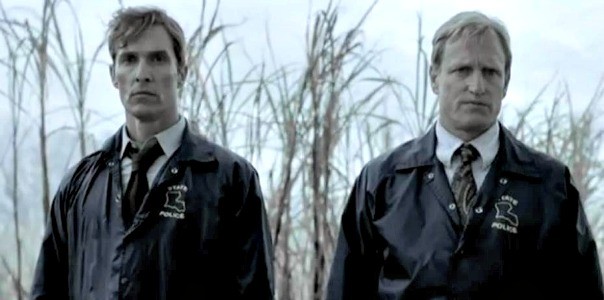
disgraced police detective Rustin “Rust” Cohle (Matthew McConaughey); those same critics warn potential new viewers of True Detective
that the show is merely a standard police procedural–even though that
genre is known to be (to put it charitably) a little light on anything
approaching abstraction generally or philosophy specifically.
True Detective is a show that’s been panned by some major media outlets–The New
Yorker
, most notably–even as
everyone more or less agrees that the acting is great, the
cinematography is great, the writing is great, and the pacing is
sufficient to tie even the most skeptical viewer to their television set
every week.
If all this sounds rather strange–as though True Detective
is getting the sort of treatment reserved for cultural setpieces that
somehow destroy our sense of ourselves, placing us immediately in a
defensive stance–that’s because the whole melodrama surrounding True Detective is indeed incredibly strange. And, too, it has an
undercurrent of nastiness that’s merely underlined by the above
paradoxes. Maybe critics got sick of praising shows produced by HBO;
maybe they resented the growing tendency (see House of Cards)
for Hollywood film stars to take turns on the small screen; maybe they
tire of the arrogant, self-aggrandizing digi-hipster buzz that seems to
surround every new cable series with half a pulse; maybe decades of
egregiously turgid Law & Order spinoffs have soured the media on anything that looks even vaguely like a police procedural.
Here’s
what we know: Watching your television is not an exercise in seeing how
close a program can come to emulating your archetype of the genre you
think you’re watching. Nor is appreciating art merely a game of
deduction in which the starting point is how you think that art should
look, and the endpoint is your grave disappointment at what it actually
turns out to be and (as importantly) want to
be. If a television program features one man so traumatized by the loss
of his two year-old daughter and the subsequent disintegration of his
marriage that he no longer believes in love nor yearns for sex; if it
features another man so self-conflicted about his own soul he ping-pongs
blindly between a loving wife and psychologically immature mistresses
without seeing any of them more clearly than he sees himself; if the
villainous mob at the heart of the program
feeds off the poisonous legacy of “good ol’ boy” Southern cultural
practices like “rural Mardi Gras”; if the milieu of the show’s
protagonists–the seedy criminal underbelly of impoverished coastal
Louisiana–is one in which women are marginalized and most of the chief
actors (that is to say, most of the appalling archetypes dotting the
landscape) are male; if all these things are true, I probably won’t
recommend to friends and family that they watch such a program to find
sterling depictions of complex feminine psyches. But that doesn’t mean I
won’t recommend the show; it simply means that I’ll judge (and
recommend) the program on its own terms, adjudicating its value based
upon the story the program wishes to tell and the fidelity to that
purpose that it shows in telling it. I certainly won’t insist that any
one television program, in a nation with hundreds of them, be all things
to all people.
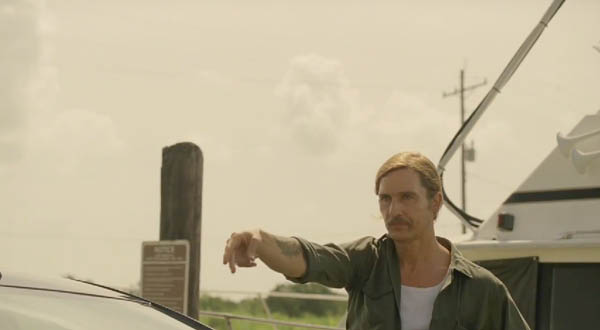
Matthew McConaughey’s Rustin
Cohle is an iconic television figure. Neither a hero nor an anti-hero,
he’s a man whose belief in his own perseverance is so wispy he moves
through every scene like a ghost. If you think you’ve seen Rustin Cohle
on your television screen before, you probably weren’t paying undue
attention to the show’s subtly eloquent dialogue, which
sees McConaughey ruminating on such yawn-inducing, overplayed TV topics
like how hypothetical beings inhabiting the fourth dimension would
perceive the lifespans of two- and three-dimensional beings; whether
consciousness generally and fatherhood and motherhood specifically
are in fact the original, purge-proof sins of our species; whether love
is merely a delusion of sentience subsumed beneath the broader
fallacies of free will and linear time; you know, run-of-the-mill police
procedural shit like that. If Woody Harrelson’s Marty Hart is slightly
more conventional a small-screen figure–a philandering, hard-drinking
alpha male cop who becomes equally enraged at any woman he can’t control
and any man who mistreats a woman–he’s also played to perfection by
Harrelson, in fact so convincingly that when Hart’s wife says that the
foundational tragedy of her husband’s life is that he has no idea who he
is (despite seeming to play entirely to type), we believe her. It’s a
cutting critique of masculinity that those counting, instead, the number
of lines of dialogue doled out to male and female actors in the series
may have missed. In no uncertain terms, True Detective
concludes that
our nation’s founding archetype for the male body and psyche is so
hollow that the destruction it generates is merely terror and aggression
predictably filling an existential vacuum. Critics of the show respond
that it’s a procession of buddy-cop tropes. I don’t have any idea what show they were watching.
It’s true that True Detective
leaves some loose ends, and equally true that in the age of cable
television programs so expensive to produce that one never knows if
they’ll have a second season, that’s par for the course. Still, some
of the loose ends the critics complain about seem paltry by comparison
to, say, the trail of questions left behind by Lost, or Firefly, or even now long-forgotten near-classics like Rome.
Sure, we never find out why Marty’s daughter was drawing men and women
having sex on sketchpads at her elementary school, but who cares,
finally? We never found out the precise mechanism by which that prison
rat killed himself in his cell; so? And it’s unclear whether that
cowardly parish Sheriff in fact goes on to seek revenge against Rust
after the latter has credibly threatened him with execution and
professional ruin if he does, but can’t we just use our imagination to
resolve that trifling canard? And while it’s undoubtedly a much bigger
deal that True Detective
ultimately uncovers the key to only a few
murders on the Bayou, rather than the hundreds it alludes to, for those
taking the show on its own terms Marty’s explanation in the series
finale–that sometimes having good intentions and fortitude means doing
whatever one can, not everything one conceives of–seems not just
plausible but, based upon Hart’s background and motivations, earned.
Likewise, a brilliantly written final monologue by the philosophical
pessimist Cohle (portrayed by critics as “merely” a nihilist, as that’s a
pejorative term most readers will understand) is perfectly consistent with
his complicated personal ethos: one governed by deeply considered views
on consciousness and time, not (as would be the case with the
conventional nihilist) “meaning” and ethics. A key difference between
Cohle and a workaday nihilist is that the latter doesn’t believe in any
of those pesky meta-realities Rust eerily obsesses over–a fact that
makes Rust’s gradual conversion to a sort of spirituality
cleverly unsurprising rather than stupidly epiphanic.
No one will accuse True Detective
of offering many groundbreaking roles for actresses–of the three women
who get the most minutes on-screen, one is a housewife who roughly
conforms to the archetypal spouse locked in a loveless,
infidelity-riddled marriage; one is a courthouse steno who slums with
Marty as she looks for a husband; and one is a former prostitute turned
mentally ill cellphone store employee–but at some point it must be
allowed that there will be programs, albeit thankfully not too many of
them, in which the primary
relationship considered by the script is between two men. I love Cormac
McCarthy’s The Road; I certainly
wouldn’t want every film, or even a notable fraction of them,
to put two males in an existential wrestling match and see who loses and
how. True Detective at least has
the good grace to offer only the slightest relational arc between Rust
and Marty; those who say the series’ first season ends with the two as
lifelong friends are confusing the empathy of co-survivors with genuine
affection. If Rust and Marty seem likely to stay in touch after the
final credits roll, that’s because they have nothing else to do with
themselves and too little direction to orient themselves otherwise. It’s
hardly a ringing endorsement of platonic love between men. Indeed, the
more likely follow-through after the final shot of True Detective
is
that Rust kills himself shortly thereafter, and Marty continues on in
the dreary and directionless life we saw him living when Rust rolled
back into town to close out the Dora Lange case once and
for all. Those who see resolution or reunion in the mere fact that
Marty’s children and ex-wife visit him as he lays half-dead in the
hospital–or that Hart begins sobbing uncontrollably during their visit
(quite obviously tears of abject misery, not joy)–are grasping at
straws. There’s no happy ending for Harrelson’s Marty, nor does the show
allude to one.
Nor, it appears, is there any
happy ending for True Detective. Its detractors have resorted, now, to merely contending that Top of the Lake was a better program and got less attention. Okay; is this somehow proof positive that True Detective is unwatchable or (less grandly) undeserving of praise? Does the fact that The Wire is still far better than either of these two shows mean Top of the Lake is unwatchable too? Someday we’ll find out what was behind the bum rap given to True Detective; or, alternately, we won’t–and be left instead with The New Yorker claiming that one of the best-written programs of the last few years is in fact no more memorable dialogically than, if you can
believe it, Family Matters. Steve Urkel used to go on and on about fourth-dimensional metaphysical overlords, didn’t he?

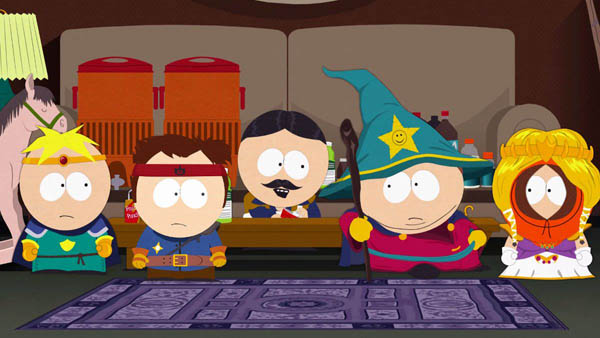
METAMERICANA: SOUTH PARK: THE STICK OF TRUTH Is a Fantasy RPG That’s All Too Real

METAMERICANA: SOUTH PARK: THE STICK OF TRUTH Is a Fantasy RPG That’s All Too Real

null
I
haven’t been an avid videogamer since my mid-twenties, and I’ve never been more
than a casual observer of the South Park television and film franchise,
so I was an unlikely pick to be the guy driving from Madison, Wisconsin to the
Illinois border at 2AM to purchase the new South Park role-playing
videogame, South Park: The Stick of Truth. The reason I made the nearly
hour-long drive from the Wisconsin capital down to Beloit was partly because I
couldn’t sleep, and partly because I’d heard two things about the new South
Park
game that piqued my interest. First, it’s one of the only RPG
videogames licensed from a television or film franchise ever to receive
near-universal critical acclaim in the console era. Second, it is, for all
intents and purposes, a “meta-RPG,” that is, a role-playing game about
role-playing games. Given my recent insomnia and the stated theme of this column
(“art about art”) I just couldn’t resist checking it out. What I found was a
gaming experience equal parts poignant and hilarious, familiar and
unpredictable, self-referential and transgressive—exactly the sort of art we
look for, demand, and deserve in the age of metamodernism.


I’ve
watched maybe thirty South Park
episodes start-to-finish during the seventeen-year run of the television show,
a number which, I’ll concede to the legions of fanatical South Park devotees,
is embarrassingly low. But it’s a show I’ve always admired from afar, and not
merely because I know that, despite being one of the most gleefully offensive
franchises in television and (with the 1999 feature-length film South Park:
Bigger, Longer, and Uncut
) film history, it’s also one of the most
decorated artifacts of the Age of Television. Time Magazine deemed
it one of the 100 best TV shows of all-time; Rolling Stone called it the
funniest show of this century’s first decade; Entertainment Weekly rates
it a Top 25 television program over the last quarter-century; it received a
Peabody Award in 2006; and it’s been nominated for ten Emmy Awards (winning
four times). For all the protests and boycotts it’s provoked, it somehow
manages to win over, in time, even its fiercest critics—or most of them. It
does this by revealing its long game to be an astutely political rather than
merely asinine one. I admire South Park not only for its persistent
intelligence, but also its dogged cultural relevance. Both Gen X and Gen Y
Americans—and soon enough, the elementary school kids of Gen Z—understand what
it’s like to be simultaneously mystified and victimized by the adults of the
generation preceding; the corrosiveness of our intergenerational inheritance is
a timeless theme that South Park
addresses fearlessly and, beneath a veneer of flippancy, with surprising
subtlety.

South
Park
has gotten the
videogame treatment five times in the past, and in all cases (to hear
professional videogame critics tell it) forgettably: South Park (1998)
was said to be “one of those games that is bound to come up when you start
thinking about the worst game you’ve ever played” by industry leader GameSpot; South
Park: Chef’s Luv Shack
(1999) received an aggregate score of 50% (out of
100%) from ratings tallier GameRankings; South Park Rally (2000) fared
even poorer than its predecessor, at 47%; after nine years spent regrouping,
the franchise returned to consoles in 2009 for South Park: Let’s Go Tower
Defense Play
, which failed to achieve critical acclaim but nevertheless boasted
the series’ best showing to date (7.5 out of 10 from GameSpot, which noted,
with only muted sarcasm, that it was at that point “easily the best South
Park
game”); and then 2012 saw a relapse for series creators Trey Parker
and Matt Stone, as South Park: Tenorman’s Revenge again reached
only about the halfway point (52 out of 100) on ratings aggregator Metacritic.

So
why does a television program with so much critical acclaim have such
difficulty succeeding when translated from its native medium to another?
Besides the obvious answer—that licensed videogames are almost always
hastily-arranged cash-grabs that pay zero attention to plot or gameplay—one
possibility is that the allure of South Park is altogether more
complicated than videogame designers have ever considered.

South
Park
, which takes
place largely in the titular (fictional) town in Colorado, is first
and foremost an epic about how American children are forced to inhabit social,
cultural, and political spheres governed by adults who are idiots at best and
cretins at worst. The franchise traces the ways different children respond to
this passive, systemic, large-scale form of child abuse. Some kids, such as
series star Cartman, adopt the worst behaviors of their elders, and do so
effectively enough that many of those they’re emulating give them carte blanche
for their bad behavior; others, like Stan and Kyle, are savvy enough to realize
the impossibility of finding role models, but also pragmatic enough to realize
that navigating the madness of the adult world means from time to time
indulging madness oneself; and still others, like mute latchkey-kid Kenny,
become a sad amalgamation of the two preceding types—suffused with the
callousness of their culture but unable to accede to it entirely because they
are, after all, benignly naive and instinctively optimistic children. To watch
these kids weather the storm of American culture and its many subcultures—now indulging
racist biases because they’ve seen them performed so often and so
energetically; now getting in trouble because the depth of local adults’
depravity is beyond their understanding—is alternately hilarious and
heartbreaking. If I don’t watch the show more often, it’s because I find the
world it depicts a depressing one. And, unfortunately, one I all too often
recognize as my own.

Living
in rural Massachusetts in the 1980s, I had the same sort of middle-class
upbringing I suspect Parker and Stone did: one in which a kid has a lot of
leisure time, enjoys a Gen X sort of relationship with his parents (one marked
by distance rather than, as with Gen Y, an eerie sort of friendship), and is
therefore mostly left to fend for himself in understanding how the world works
and why. Like many kids who grew up in the mid-1980s, I was calling classmates
“faggots” for many years before I had any idea what the word meant; was a
little shy (which is not to say hostile) around any child who seemed different,
whether that child was handicapped or black or a girl or somehow physically
notable (due to height, weight, facial features, or otherwise); and, generally
speaking, learned the conventional biases of my culture via the osmosis of
television and film. It’s remarkable how odiously bias-entrenching much
eighties television and film seems in retrospect, and unfortunately eighties
children bore the brunt of it with only minimal guidance from their
elders. 

When
I see the basically good-hearted kids of South Park, Colorado—Eric Cartman, the
nominal villain, excepted—struggling to understand the cultural mores and
presuppositions they’re exposed to daily, it makes me uncomfortable because I
know that the humor of the kids in South Park is really just that: the
humor of eighties-style elementary school children who don’t know any better
than to reflexively mimic how speech-impaired children speak, or to exoticize
Asian-Americans, or to discount by 50% or more the masculinity of anyone they
identify as gay. I don’t at all mean to excuse these kids (or my child self)
any past misconduct; I merely know what it’s like to be a thirty-something
progressive looking back at his life as a South Park-age kid in the
1980s and feeling ashamed for how natural such misconduct felt at the time. South
Park
is not, to me, a comedy program that fetishizes the most radical brand
of adult humor, it’s a program that dramatizes—sometimes realistically,
sometimes via absurdist metaphor—a very banal and common juvenile
experience. 

In
South Park: The Stick of Truth, the children revolt, which is probably
why I like it so much. The game’s frenetic plot follows the children of South
Park as they turn their occasional LARPing (“Live-Action Role Playing”) into a
perpetual form of escapism, with a gang of “Humans” led by Cartman vying with a
tribe of “Elves” led by Kyle to gain possession of the vaunted “Stick of Truth”
(just a stick, really). The game successfully turns an entire universe of
confusing mundanity into rosters of weapons (e.g., a basketball, a Super Ball,
a broken bottle, a hammer), equipment (e.g., medical scrubs, a marching band
uniform, SWAT gear), and various costumes (e.g., hundreds of makeup kits,
eyewear, wigs, and gloves), all ordered by their supposed effectiveness as
offensive or defensive military equipment. The designations are entirely
imaginary, of course. For instance, the South Parkers refer to Twitter as “a
carrier raven,” their backyards as castles and keeps, and their styles of
dress, personal ethics, and self-mythologies as “classes” consistent with those
found in the Dungeons & Dragons universe (e.g., Mage, Thief, Paladin,
Ranger, and Bard; the game’s one addition is the “Jew” class, inspired by Kyle’s
religion and Cartman’s unsettlingly entrenched anti-Semitism). Because the
whole affair is ripped straight from J.R.R. Tolkien (Lord of the Rings)
and Gary Gygax (creator of Dungeons & Dragons), playing South Park: The
Stick of Truth
is the equivalent of being a role-playing kid who’s role-playing
a role-playing game. But as with so much meta-art, these several levels of
remove from the “real” thing feel as or more real than the “originals,” in part
because being several times removed from anything “real” is more or less the
human condition in 2014.

But
South Park: The Stick of Truth removes its player still further from its
source material, because the game is as much an homage to—and a satire of—the
entire “role-playing” enterprise as it is a gamer’s translation of the
endeavor. Certain set pieces of 1990s video-gaming
(particularly RPG gaming) are here put under the microscope for criticism or
admiration: for instance, the hero of the game (a newcomer to South Park
variously called “The New Kid,” “Douchebag,” “Sir Douchebag,” or “Commander
Douchebag”) is one of RPG gaming’s much-maligned “silent protagonists,” a fact
repeatedly remarked upon and derided during the seventeen-hour run-time of The
Stick of Truth
. The game’s battle sequences are turn-based, a style of play
so long ago abandoned by top videogame developers that it becomes a running
in-game joke here, as your fighting partners will sarcastically remark upon
your slowness if you take any time whatsoever planning your next move in
battle. Even Jamie Dunlap’s score—which is actually very, very good—is merely a
tongue-in-cheek medley of vaguely Tolkienesque sonic doodles. 

Certain
moments in the game are so pricelessly “meta” that I’d be hard-pressed to think
of any game this side of Final Fantasy VII so willing to acknowledge its
own artifice; and in terms of explicit rather than implicit acknowledgment of
artifice, I’m not sure we’ve even seen anything on this scale. At one point
Cartman tells the game’s hero not to speak to Mrs. Cartman (his mother) because
“she’s not part of the game”—leaving unsaid whether the “game” he’s speaking of
is the South Parkers’ LARPing or South Park: The Stick of Truth. In the
same way, a group of toughs at one point informs both The New Kid and the
videogamer playing him that fighting them “at this point in the game is really
just a waste of time.” Who are they speaking to, really, and does it matter?
One of the beautiful ironies of this type of art is that each layer of reality
shares sufficient commonalities with the others that what applies conspicuously
to one level usually applies as much or more to all the others. The more
furious the layering of realities, the more bewildering and also hilarious the
gameplay of The Stick of Truth. At
one point, Mr. Mackey, South Park Elementary’s guidance counselor and detention
overseer, warns the South Parkers against breaking one of their number out of
detention by referencing every layer of reality in the game: the source
material for the kids’ LARPing; the “game” they’ve created to LARP in; and the
videogame in which real-world humans role-play the LARPers. From one sentence
to the next you have no idea which layer of reality Mr. Mackey is inhabiting,
and that sort of sublime ambiguity is, at times, spectacular.

Of
course, South Park wouldn’t be the cultural phenomenon it is if it
merely satirized fringe practices like LARPing and tabletop role-playing games,
or even if it merely commented implicitly on the ignorance and fecklessness of
American adults. The show—and this most recent videogame based on the franchise—is
much more pointedly political than this, and much more maniacally traumatizing
psychologically. Recurring sociopolitical themes in The Stick of Truth
include mistrust of centralized government, derision for political rhetoric,
antagonism toward overdetermined sociocultural discourses, and a frank
appraisal of the way individual citizens shirk their responsibilities to one
another and (even more poignantly) themselves. Of course, all of these
commentaries are packaged in the most visually and aurally noxious plot-points
and cut-scenes imaginable—for instance, a “boss battle” in which the recently
miniaturized hero fights on the very bed his parents are having wild sex upon.
Not only are the hero’s mother’s breasts visible throughout the fight, but dodging
the hero’s father’s testicles is actually part of the in-game challenge.
Failure to do so leads to instant death.

Parker
and Stone likely became such infamous provocateurs because they know that in a
culture incapable of genuine shock, the only way to grab and hold anyone’s
attention is to cross what few boundaries of taste remain. South Park: The
Stick of Truth
certainly does that, offering players everything from a
sodomy minigame aboard an alien spaceship to an abortion minigame in which you’re
asked to perform an “abortion” on a man in drag; from the playing of Nazi
propaganda sound-clips over many routine battles (owing to a “Nazi zombie”
plotline) to a quest in which you beat up homeless people at the request of
South Park’s Mayor (her reasoning: only by violently driving the homeless from
South Park can the town’s callous indifference to their existence be obscured).
Throughout, one finds religious, national, and ethnic stereotypes so
outrageous they can only credibly be received as satire; one also encounters
characters so unthinkably grotesque they can only serve as Parker and Stone’s
own winking self-satire (for instance, talking feces, giant aborted fetuses
wearing Nazi armbands, and gay leather fetishists who aid the hero by anally
consuming minor enemies). There are also dozens of lesser sight-gags, for
instance one involving the television industry: in the sewers of South Park,
regular “finds” include both feces nuggets and Emmy Awards. There’s also an
easily missed but clearly derisive reference to the Entertainment Software
Rating Board, an entity that understandably issued its sternest parental
warning (“M for Mature”) for The Stick of Truth. All of the above
suggests that the game is fully aware of exactly what it’s doing and why.
Much of it is horrifying—I cringed as frequently as I laughed—but I’d be
hard-pressed to call any of it unintelligent or undirected.

For
me, the most moving moment in The Stick of Truth came in the sewers
below the city, as the New Kid moved from caches filled with human feces, used
syringes, dirty bindles, tufts of pubic hair, and Emmy Awards to protracted
battles with drug-addled homeless men. As disgusting as the visuals of this
“level” of the game are, the music being played throughout it is—oddly—deeply
enchanting. Dunlap’s score is gentle, soothing, and vaguely mysterious. The
point here, and one I might not have gotten until I was twelve hours into the
game, is that the music of South Park: The Stick of Truth isn’t “for”
the gamer, or “for” the world of South Park adults whose reaction to their kids’
LARPing is rarely less than hostile. The music reflects, instead, the layer of
reality Parker and Stone are most invested in as kids who grew up largely in
the eighties (Parker was born in 1969, Stone in 1971) and wished to imagine
their world as something rather more beautiful than the one they saw in school
and on the news. In other words, however disgusting the sewers beneath South
Park may be, they’re still a place of some wonder for the pint-size Rangers,
Bards, and Paladins who traipse through them pretending to be questing nobly.
The game doesn’t talk down to these kids—however coarse they themselves may
sometimes be—but rather ennobles their fantasies by treating them as not just
reasonable but superlative. It was a pleasure to inhabit these kids’ fantasies
for seventeen hours, even if they reminded me not just of how beautiful
childhood can be if we let it, but also of how cruel and uncompromising it can
be when we adults do our damnedest, as we usually do, to make it that way.

Seth Abramson is the author of three collections of poetry, most recently Thievery (University of Akron Press, 2013). He has published work in numerous magazines and anthologies, including Best New Poets, American Poetry Review, Boston Review, New American Writing, Colorado Review, Denver Quarterly, and The Southern Review.
A graduate of Dartmouth College, Harvard Law School, and the Iowa
Writers’ Workshop, he was a public defender from 2001 to 2007 and is
presently a doctoral candidate in English Literature at University of
Wisconsin-Madison. He runs a contemporary poetry review series for
The Huffington Post and has covered graduate creative writing programs for Poets & Writers magazine since 2008.

13 Ways in Which RED RIDING Can Satisfy Your Jones for TRUE DETECTIVE

13 Ways in Which RED RIDING Can Satisfy Your Jones for TRUE DETECTIVE

null

The stars of last night’s finale of True Detective were Errol Childress’
Cary Grant accent, his mentally challenged stepsister, his creepy labyrinth,
and Rust’s epiphany about love in the universe—which sucked up air time at the
expense of about 90% of the case details—details that, for my money, were far
more interesting than Rust’s epiphany.  Will
Rust exact revenge on the Tuttle family? Will Marty and Rust continue to fight crime
together as private dicks? Why was Billy’s mouth sewn shut? If he was dead, why
was he so well-preserved? Will we ever find out why Errol had those burn marks
on his face? What was the song Errol was whistling? While
speculative pairings for Season 2 abound on Twitter
, actor Matthew McConaughey
recently told a reporter, “We won’t be back for season two…Season one was
finite. Eight episodes, that’s the [end of conversation].”

So how are you
going to quench that thirst for a tall glass of hardboiled noir topped with a
side order of pedophile rings, smothered in police corruption until season 2—if
there is one? Try Red Riding, based on David Peace’s books, The Red-Riding Quartet. Set against a
backdrop of the Yorkshire Ripper murders, Red Riding’s narrative
complexity combined with grizzly brutality gave birth to a new subset of hardboiled
crime dubbed “Yorkshire Noir.” Three of Peace’s books were made into episodes
for Britain’s Channel 4, which ran in 2009 and were released theatrically in the states in
2010.

null

True
Detective
stole big from Red Riding. It’s a far more savage depiction of
police corruption and poverty with fewer allusions to the occult and philosophy.
The three episodes run from 1.5-1.75 hours each. With all the rewinding you’ll
do to make sure you caught the dialogue, your total viewing time will be about
the same as True Detective—though Red Riding can’t compete with the time
suck of poking around Reddit for Yellow King theories or Googling “capuchon
Mardi Gras
.” Sorry. Nothing will fill that hole.

Warning:
Spoilers abound below, but with Red Riding’s thick-as-Hasty-pudding accents, it
helps to have a leg up. You can read the books first, watch with subtitles,
precede/follow your viewing with episode synopses, or all of the above—the way
some people do with Game of Thrones. It’s worth it.


1. Three Is A Magic Number

Both True
Detective
and Red Riding jump through three different time periods. In True
Detective
: 1995, 2002, and 2012; in Red Riding: 1976, 1980, and 1983. The time
jumps and fractured narrative throughout True Detective, and in the second
two episodes of Red Riding allow us to witness the evolution of the characters—as
well as their cognitive dissonance. We see the mistakes they’re making as they
make them—and that they’re telling lies as they tell them. We watch Marty give the
court reporter a rim job in the past, while his voice over in the present lectures,
“A man without a family can be a bad thing.” But as Rust will tell you,
linear time’s for squares.

Time jumps give
the storylines more ambiguity and slipperiness. In both, every crucial,
case-breaking detail has been reported to, and ignored by, the cops. Files and
evidence have been lost, hidden, and destroyed. But because we’re time jumping,
if it’s an important detail, we’ll touch on it again and again. Most detective
stories trot out their flashbacks at the end, like Murder She Wrote, which
always made clues found in the linear present glint and yell, “Look at me! I’m
a broken fireplace poker!”

2. Location, Location, Location

Place is as
crucial in both True Detective and Red Riding as any of the stories’ characters.
For True Detective, the hurricane-ravaged bayou landscape of Louisiana
reminds us all that men and their machinations inevitably fall victim to nature’s
insatiable maw. Think of all those long aerial shots of the water slicing the
land to lace. If you stand still long enough, kudzu’s gonna choke you out. 

Red
Riding
takes place in the green-grey drizzle of Yorkshire. Historically, the land’s
awash in blood. One long shot of a doomed little girl wandering home along Yorkshire’s
ancient, narrow streets—flanked by dilapidated shacks that look like Charlie
Bucket’s house in Willie Wonka and the
Chocolate Factory,
from which a rheumy set of eyes peers out a toaster-sized
window—says it all: these angelic little moppets have been fodder for the grinding
stone from time immemorial.

3. Cops Gone Wild

When Rust
says, “I’m police. I can do terrible things to people with impunity,” it
means he’s capable of doing bad
things. When a bunch of cops boisterously toast, “To the North! Where we do
what we bloody want!” we know they are
doing bad things.

4. Smokestacks
In both shows, the gray concrete towers and power lines of factories and plants
loom in the background, reminding us that police and pedophiles aren’t the only
ones killing off the residents. The poor are prey; cops, religious jerkoffs,
and corporations are hunting them for sport. No one’s watching. No one cares. Bludgeoned
on the ground, choked by the air.

5. Thick Regional Accents

null

Certainly, “With
all the dick swagger you roll you can’t spot crazy pussy?” was one of True
Detective’
s shiniest gems, but if Rianne Olivier’s
crab trappin granddad’s “Ehbuhdy dink
dey gone beh sometin
dey nat” made you swoon, Red Riding is for you. These
lads are not only slogging through Yorkshirese, they’re hardcore mumblers and
furtive whisperers to boot. Subtitles help, but David Morrissey (the Governor
for The Walking Dead and Time Lord Jason Lake on Doctor Who) is especially
incomprehensible—yet one of the most compelling characters in the series. You
just gotta sit back and let his deee-licious chocolate-colored corduroy suit
and tan tie do the talking.

6. ‘Staches Make the Men

As do
sideburns, beards, mutton chops, bugger grips, mouth mirkens, and chin
chocolate. In Red Riding and True Detective’s sea of face pubes, it’s the clean-shaven
characters who seem out-of-step with the world and estranged from their own consciences.
As 2010 Rust gets in the Gregg Allman face lace race , his perceptions of the
case and himself grow clearer (“I know who I am. And after all these years,
there’s a victory in that”) whereas clean-cut Marty doesn’t know who he really
is until he cries in his hospital bed. In Red Riding, the squeaky-cleanest
character, Assistant Chief Constable Peter Hunter, is thoroughly despised
by everyone, including the woman he had an affair with and wants to have an
affair with again (she really doesn’t
want to).

7. Animals

In True Detective, bodies are adorned with deer antlers; in Red Riding, severed swan wings are sewn
onto a young victims’ back—and wolves, pigs, and rats figure prominently.

8. Ritualistic Abuse & Murder

null

I was glad the glimpse we saw of the
video tape recording of Marie Fontenot’s murder was mostly blocked by
Marty’s back—and the grainy black and white snippet we could see looked like an
early episode of Dark Shadows. Most of the violence on True Detective was “witnessed” through
the retelling of people’s stories. We weren’t forced to watch violence
happen—except for shooting Reggie LeDoux—and damn, that felt good. We saw the crime scenes and the
survivors—not the act of violence, but the aftermath. While Red Riding
normally excels in the violence department, it turns the camera away in a similar
scene to the one where Marty discovering the kidnapped children in the storage
shed* at Reggie LeDoux’s cook house. Red
Riding
skips the gory visuals on that one, too. The violence perpetuated
against children in Red Riding is seen only in one dimly lit flashback**,
which is as haunting as that scene from The
Shining
with the man in the tuxedo and the person (?) in the bear suit.

9. Transsexual Prostitute Survivors of Ritualistic Abuse & Murder

BJ and Johnny Joanie: the boys who
got away grew up very, very gay (and one of them lives in a storage shed*). Just
once, I’d like to see a show in which the boy who survives ritualistic abuse
grows up to be Dale Earnhardt Jr. or Guy Fieri or someone like that.

10. *Storage Sheds & Garages (pronounced gairijiz)

When you need to lay low. How low?
Like Jim Nabors singing “The Impossible Dream” low.

11. Ludicrously One-Dimensional Female Characters
Red Riding and True Detective are both Bechdel Bombs.
Aside from the trailer park madam, (“
Girls
walk this earth all the time screwing for free. Why is it you add business to
the mix and boys like you can’t stand the
thought? I’ll tell you: It’s ‘cause suddenly you don’t own it, the way you thought you
did.”), the women
characters in True Detective are
fairly brainless: they’re dead, sluts, dead sluts, guileless children, nagging
wives, or old, sick women.

null

When Maggie tries to break out of her
dutifully duped wife role by having an affair with Rust, he gives her a taste
of some Real Man Lovin’—without all that fairy tale frosting on top that
Marty’s been keeping her down with. And how does that Real Man Lovin’ taste to
Maggie? Like licking a Port Authority payphone: totally scary and gross. So she
pulls her little pink panties back on and high tails it home—implying good
women can’t handle real male sexuality: it’s too gross. Eeeeeew! Which reminds
me of that Louis CK bit about men being naturally besieged by disgusting sexual
thoughts:

“Women try to compete. [in a woman’s
voice] ‘Well, I’m a pervert. You don’t know. I have really sick sexual
thoughts.’ No, you have no idea. You
have no idea. See, you get to have those thoughts. I have to have them. You’re a tourist in
sexual perversion. I’m a prisoner there. You’re Jane Fonda on a tank. I’m John
McCain in the hut. It’s a nightmare. I can’t lift my arms.”

The most developed female character in Red Riding is the stunned
mother of one of victims who’s playing both sides of the fence and leaking information
to her daughter’s wealthy killer. She’s a blond, breathy, sad, soft-focus
nitwit. The other is a medium who wails a lot. I like her, but she does indeed
wail a lot.

Is it possible to create a similar police
corruption/pedophile ring premise with a female protagonist? Sure. Jane Campion
did it in Top of the Lake, along with bringing other very unique female characters to the story (Holly Hunter plays a
character I’ve never seen anywhere) and lots of unexpected twists. It’s another
great show to alleviate True
Detective
withdraw, but Top of the Lake becomes much more about its
cop protagonist (Elisabeth Moss)—and her intimate relationships—than the
criminals she’s chasing. And it lacks the estrangement of noir.

True
Detective
and Red Riding are pure noir—which the
Oxford Dictionary defines as fiction characterized by cynicism, fatalism, and
moral ambiguity. It’s a genre in which women, historically, have been double-D wooden
window dressing. There’s such a complete absence of actualized female
characters in both
True
Detective

and Red Riding—in the midst of
such intelligent writing—it’s beyond oversight. It’s a kind of willful
blindness: because Marty (and most of the other men on the show) can’t see
women as three-dimensional characters, let’s not have any. But then again, how
many evolved women would be caught dead in the storyline of
True
Detective
or
Red Riding? There’s a reason why smart
women do not attend dog fights.
True
Detective
might have a season
2, and a chance to redeem itself. I
could easily see the cast of American Horror Story: Coven eatin’ them Tuttle
boys alive. Throw Patricia Arquette in there, and cue a Cajun rendition of the theme
from Cops.

12. Mentally Challenged Men with Physically-challenged Testicles

If you think women get the short end of the stick in True Detective and Red Riding, try being a mentally
challenged man.
True
Detective
’s
Burt with his bowl cut and Red Riding’s
Michael Mishkin with his finger twisting twitch share 1) a childlike inability
to withstand the violence of poverty, and 2) nonfunctional testicles. They’ve
been unburdened with all that scary sexuality simmering under Cole’s surface
and right on top of Marty’s. I
n True
Detective
Burt has been maimed by criminals, whereas
in Red Riding, Michael’s disfigurement is congenital, but that doesn’t
mean he hasn’t suffered at the hands of cops.

This is a key difference in the shows: when Marty’s beating
the snot out of the skate punks, you can kind
of
understand why. They did
double-team his daughter, after all. But in
Red Riding, the violence is incomprehensible. No one beats Yorkshire cops
at beating the shit out of people; they’re sadists, and the greatest source of the
city’s pain—if not at their own hands, then by omission, by allowing
others—through their wealth or influence—to inflict pain on the little people.
As Sonchai, the Buddhist cop in Bangkok 8,
tells us, cops are merely a few incarnations away from being criminals.
Red Riding’s got a lot
more bad cops on the payroll. Even the good ones are shits.

13. Kings & Crowns
Red Riding
’s labyrinth can’t hold a
candle to the Yellow King’s, but we learn that the same kind of games have been
played there for many years. **“Mr.
Piggott is king today. You be nice to Mr. Piggott.”

Jennifer
L. Knox 
is
the author of three books of poems,
The Mystery of the Hidden Driveway, Drunk by
Noon, and A Gringo Like Me—all available from Bloof
Books—and
Holliday, a chapbook of
poems written in the voice of Doc Holliday. Her writing has appeared in 
The
New Yorker, The New York Times, and four
times in the Best American Poetry series. She is at work on
her first novel.

Wes Anderson’s THE GRAND BUDAPEST HOTEL: A Vivid Self-Portrait

Wes Anderson’s THE GRAND BUDAPEST HOTEL: A Vivid Self-Portrait

null

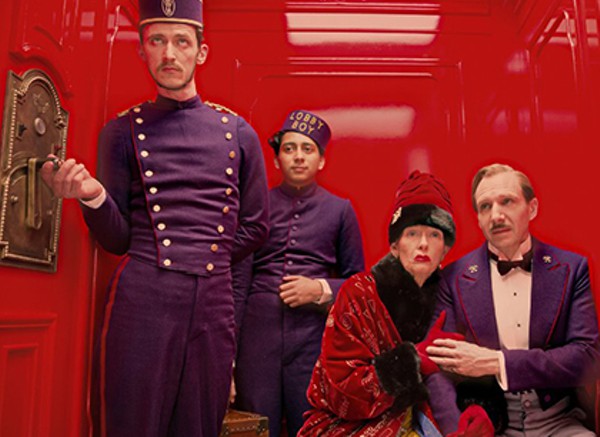
Last week, as I watched director
Wes Anderson take the stage at Lincoln Center to introduce the premiere of The Grand Budapest Hotel, I was struck
by the unusual deep-purple color of his suit. I almost wrote this off as an
inconsequential choice by the famously quirky director. But once the film began
rolling, I realized that Anderson’s colorful attire was actually his subtle
synchronization with the film’s leading character, Monsieur Gustave H. This
character dons the same shade of plum throughout the entire film, and soon I
couldn’t help but see that the similarities between the two went far beyond
their purple garb. The fascinating parallels between Anderson and his leading
man make this film his most soulful and self-reflective work to date.

Anderson’s exploration of this
delightful character gives us a rare glimpse into how the director views his
own world. Gustave (luminously played
by Ralph Fiennes) is the owner of the titular hotel, and his mission is not
unlike Anderson’s as he strives to preserve the particular charms of a world
that is slipping away. Both the director and his fictive concierge create
intricate but impossible worlds in The
Grand Budapest Hotel
. Set in the fictional Eastern European state of Zubrowka,
this pink wedding cake of a hotel is at its peak of grandeur. Gustave directs
the Grand Budapest so that it runs like clockwork, working to maintain its
splendor before it fades and falls with the oncoming war.

With idiosyncratic fervor, Gustave—like Anderson—tries to preserve his whimsical tastes despite the realities
around him. We watch Gustave speed through the halls, fastidious in his duties,
upholding comically high standards. One can imagine a similar eccentricity in
Anderson’s creative work, requiring exquisite attention to detail and
everything just so. Indeed, actors from
Anderson’s veteran cast have described the director’s meticulous production
methods as genius, beginning with his own detailed sketches, animations, and even
a suggested reading list for the cast.

It is hard not to see Anderson as a
sort of innkeeper himself, directing life on and off the set with the same
spirit and extravagant standards as Monsieur Gustave H. In a recent interview, cast
member Jeff Goldblum explained how Anderson’s visionary style pervades the
entire production experience. The director, Goldblum said, “wants to make the
shooting an art project of itself.” He described how the entire cast lived
together in the same hotel during shooting and sat down each night for group
dinners, elaborately arranged by Anderson. This custom aligns so perfectly with
the ethos of The Grand Budapest Hotel,
and seems to be a striking union of character and creator for Anderson.

There is a similarity between the two,
as both Gustave and Anderson hold tightly to their peculiar visions of the
world. For Gustave, this vision is the strange splendor of the Budapest in the
face of an oncoming war. And for Anderson, it is the intricate styling of his
own filmmaking, which stands alone in cinema today. Critics often accuse
Anderson of prioritizing his stylized design over substance, but this film is a
sweet exception to this charge. Visually, The
Grand Budapest Hotel
is as fantastical and charming as ever. But the story
also reaches new depths, with Anderson articulating themes that are richer and
more complex than his earlier works.

Some of that added complexity comes
from the darker and more realistic forces at work in The Grand Budapest Hotel. In past works such as Rushmore and Moonrise Kingdom, the opposing powers take the form of adult
authorities. These professors, parents, and scout leaders may clash with the
protagonists, but they are hardly villainous. This latest film, however, deals
with war, brutality, and a fictional “ZZ” unit that unsubtly recalls Nazi
Germany’s SS. The violence is harsher and the darkness comes closer than usual
for Anderson.

The effect of these forces’ encroachment
on the playful world of the Budapest is a richer story—still the fanciful
world of Wes Anderson, but one that occasionally snaps the characters back into
a meaningful reality. In the same vein, the character of Gustave is not simply
a caricature. He too comes to life with moments of unfeigned grace. We learn
that Gustave is more genuine and deeply relatable than the shiny purple tuxedo
would initially let on.  

One of these endearing traits is
his habit of reciting romantic poetry at length. This meaningful quirk turns
out to be representative of Gustave’s character and, more significantly, of
Anderson’s entire method. As it happens, Gustave consistently chooses the wrong
moment to pause for poetry. He begins forty-stanza poem before dinner, a
dramatic ode while escaping a maximum-security prison, never able to finish his
verses. It is a comical pattern throughout the film, and a fitting one: art
interrupted by a more urgent reality. Anderson portrays exactly this—a world
where there is less and less time for romance, beauty, and whimsy. In spite of
this reality, one man—be it Gustave or Anderson himself—works tirelessly to
uphold the old elegance.

We cannot know how much of himself
Anderson projected onto his leading man, but the resulting film is a triumph.
Anderson is true to his own narrative techniques, and the purple threads that
tie him to Gustave only enrich this: he delves deeper yet into style and
substance, putting a little more of himself into his film.

Kayleigh Butera is
a writer from Philadephia, PA. She is a recent graduate of Brown University,
where she studied American Studies and French language. She worked as the
programming coordinator of Brown’s Ivy Film Festival, the world’s largest
student-run film fest. Kayleigh is currently living in Brooklyn. She can be reached at
kayleigh.butera@gmail.com.

What Jared Leto Brought to His Role in DALLAS BUYERS CLUB

What Jared Leto Brought to His Role in DALLAS BUYERS CLUB

null

In a red carpet interview on Oscar night, Jared Leto mentioned that, prior to his winning
role in Dallas Buyers Club, he hadn’t been in a
movie in six years. He
started his cinematic exodus after Chapter 27 (January 2007), the
Mark David Chapman biopic for which he put 67 pounds on his lithe frame, an act
of near-superhuman binge eating that gave him gout, skyrocketed his cholesterol
so high that his alarmed doctors wanted to put him on Lipitor, and confined him
to a wheelchair during the last days of the shoot. Old acquaintances he
encountered during the shoot regarded him with pity, the looks on their faces
telegraphing loud and clear that, in their eyes, he’d finally let himself go.
It took him a year to “get back to a place that felt semi-normal,” as
he recalled in one print interview, and you can almost hear the shudder in his
voice as he declares  “I’d never do
it again.”

In the almost two decades Leto’s been making movies, his roles
have unavoidably been about the celebration and desecration of his unearthly
prettiness. Jordan Catalano, the crush “so beautiful it hurts to look at
you” in the TV show My So-Called Life (1994-95) got off scot-free
compared to the disfigurement and debasement that befell his other characters,
like the necrotizing heroin addict in Requiem For A Dream (2000) or
“Angel Face,” the pugilist who gets his face pummeled into hamburger
in Fight Club (1999), an act of brutality the nihilistic narrator shrugs
off by saying “I felt like destroying something beautiful.” Leto’s androgynous
pulchritude—and precedent of cinematic self-destruction—made him an obvious
choice to play
Rayon, the glamorous trans woman, drug addict
and AIDS patient who helps the
equally ill Ron Woodroof (Matthew McConaughey) run a guerrilla treatment clinic
in 1980s Dallas.

But no matter
how lovely his sapphire eyes look framed by false eyelashes—and despite
accusations of “transmisogyny” from activists angered by the casting
of a man as a trans woman—Leto didn’t win his Oscar for Successful Wearing Of A Dress. Consider the harrowing scene where
Rayon, gaunt and naked and
terminally ill, begs her ghoulish reflection “God, when I meet you, I’ll be pretty if it’s the last thing I do.” Critics have dismissed this clinging to beauty as a
caricature of trans women, portraying them as petty and narcissistic (Steve
Friess of Time Magazine warns that
“sad-sack, clothes-obsessed” Rayon will be seen as cringingly stereotypical
decades from now, in the same way Hattie McDaniel’s bravura performance in Gone
With The Wind
(1939) is similarly tainted), but I see it differently.
“Beauty” here is shorthand for “value,” for “power,”
for “dignity,” for all the other vaporous externals that we grasp
tightly and futilely in the face of death, and Rayon’s pain in this indelible
scene transcends all other externals like “race,” “class,”
or “gender” that also don’t outlive our bones.

As tartly satirized in Tropic Thunder (2008) with the adage
“You never go full retard,” Oscars for acting can be cynically considered
to be handed out for parlor tricks and impersonations—deaf, blind, autistic,
spastic, retarded, insane—as long as the actor is recognizable inside the role.
Gaining weight within reason for verisimilitude (as DeNiro did for Raging
Bull
[1980] or Charlize Theron did for Monster [2003]), is
appreciated, but it gets nowhere near the monomaniacal applause reserved for
losing weight. Christian Bale, Matt Damon, Leto’s co-star McConaughey, and, it
can be tacitly assumed, almost every actress currently working in Hollywood,
get accolades for the self-control and devotion to craft evinced by their
gauntness.

But fat is the worst thing you can be in Hollywood. And it can’t
be completely unconnected that Leto’s shocking fall from Botticelli pinup into
everyman loser for Chapter 27 has nothing to do with being box office
poison for six years hence. (It’s not like Leto had nothing to do in the
meantime—he toured with his band 30 Seconds To Mars during those off years—but
I can’t imagine any actor getting through half a decade of unemployment without
becoming a little nervous.)

Only an actor who’s experienced the ego whiplash of being valued
and devalued for your looks (as specifically connected to your weight), can
competently play a woman. And only an actor who understands how survival, not
just popularity, is on the line with those good looks can play a trans woman.
Leto may have lost, not gained, weight, to play Rayon, but the power of his
performance in Dallas Buyer’s Club is still informed by his previous
weight gain experience for Chapter 27. There’s still much more to be
said about the practice of cisgendered actors playing transgendered parts—and
the “parlor trick” novelty of same—but this woman says Leto
understands enough about the female relationship to beauty, weight and power to
take on roles like this with dignity and meaning.

Violet LeVoit is a video producer and editor, film critic, and
media educator whose film writing has appeared in many publications in
the US and UK. She is the author of the short story collection
I Am Genghis Cum (Fungasm Press). She lives in Philadelphia.

METAMERICANA: Paolo Sorrentino’s THE GREAT BEAUTY Is Exactly That

METAMERICANA: Paolo Sorrentino’s THE GREAT BEAUTY Is Exactly That

null

This biweekly column
looks at instances of film, television, drama, and comedy that
are in some way self-referential—”art about art.” Also discussed is metamodernism, a cultural paradigm that uses both fragmentary
and contradictory data to produce new forms of coherence.

The first scene of The Great Beauty
documents an interminably long outdoor rave on a scenic balcony owned
by Italian novelist-turned-journalist Jep Gambardella. It takes some
time for the camera to locate the film’s star, as for many minutes it
rests its gaze instead on a cacophony of delirious partygoers, many of
whom are so enmeshed in riotous frivolity they seem creepily
otherworldly–entirely removed from the space-time continuum the rest of
us live in. As we soon
learn, that’s exactly the point: Gambardella, who decades earlier gave
up a once-promising literary career after his first love inexplicably
abandoned him, has spent most of his life living in Rome amid precisely
this sort of rootless inanity. In one early voiceover, he tells us that
the aim of his life so far has been not merely to be the life of every
party, but to be so central to Rome’s dissolute nightlife that he can,
by word or deed, single-handedly ruin
any party he attends. This destructive instinct presages the thematic
arc of the film, which sees Gambardella vainly seeking meaning in the
meaninglessness of his milieu. It seems a paradox, but the resultant act
of witnessing the film permits is as meaning-laden an existential
adventure as I’ve
had the pleasure to experience in a very long time.

As
the theme of this essay series has thus far been metamodernism in the
arts–that is, the rapid oscillation between (and ultimately the
transcendence of) conventional poles of affect like sincerity and irony,
optimism and cynicism, knowledge and doubt–it’ll seem convenient for
me to say now that The Great Beauty is preoccupied, first and foremost, with exactly this sort of oscillation. But it’s true; Gambardella lives in one of the
world’s most venerable cultures, yet traipses voluntarily through
its dankest ephemera; his amorality mandates that he live in the
present, but his mind turns relentlessly to a tragedy in his past; he
repeatedly encounters objects and scenes of obvious moment, yet he
always slips off, thereafter, into a cesspool of artifice, as if by
rote. All in all, it’s impossible to tell what portion of Gambardella’s
life is real and what portion is fantasy, a state of affairs nearly all
of us can relate to in the Digital Age.
What’s most remarkable about The Great Beauty isn’t the concept behind the work, however, but director Sorrentino’s uncanny visualizations of its particulars. The Great Beauty is
not only one of the most visually arresting films in years,
but also one of its most eclectic: each scene develops a distinct
internal atmosphere through the auteur’s selection of color palette,
stage direction, and (most notably) musical score, giving the moviegoer
everything from a sprightly neo-Surrealist scene of couples dancing at
an outdoor wedding to an almost apocalyptic encounter
between Gambardella, a lost child, and a sewer-grate in a crypt. The
film, in other words, follows in its form the pattern of its hero’s
thoughts: it doesn’t cohere so much as wend through marvels of every
mood and description. The poles of reality and unreality, profundity and
banality, sincerity and artifice alternate so rapidly between
prominence and disappearance that the result is a state of suspended
sublimity. If we define the sublime as anything that inspires awe in us
because of its supernaturally elevated quality, The Great Beauty is exactly that.
Several scenes in The Great Beauty encapsulate this sense that it’s possible to occupy the space between realities—that place where all is neither entirely real nor entirely unreal. In one such scene, the sixty-five year-old Gambardella has
just slept with Ramona, the 42-year-old daughter of an old
friend, and the two have awakened the next morning with plans of taking a
day trip to the ocean. The scene begins with a shot of Ramona’s arm
hanging limply over the side of a bed; the way her arm hangs, one
suspects that the body to which it
attaches is now deceased. But then we hear Gambardella lazily coaxing
Ramona to wake, and we realize that she’s merely sleeping. Yet she
doesn’t stir, so Gambardella calls her name a second time, now with a
note of worry, causing us (once again) to suspect Ramona is dead.
But after several pregnant moments—during which the camera
explores Ramona’s entirely still face and upper body—the
forty-something beauty opens her eyes. We relax; she’s alive. But in the
next scene Ramona’s father is being consoled by a male customer at the
strip-club he manages; “I’m so sorry about your daughter,” says the
customer. So is Ramona dead or alive? We never find out: she’s not seen
or spoken of on-screen again.
A
second such scene is the funeral of a socialite’s son. Prior to the
funeral, Jep and Ramona (still alive) are seen preparing for the event
at a local dress shop. Jep patiently, and not a little conceitedly,
explains to Ramona that there’s an art to acting properly at a funeral.
The art, he says, demands two things above all: That the mourner not
cry, and that he position himself in such a way as to be seen mourning
(but not to seem to want to be seen mourning) by all those in attendance. He finishes his lecture by quoting for Ramona the sort of empty but seemingly meaning-laden platitude one might whisper in the ear of a
bereaved mother. 
Later,
during a silent moment in the church where the funeral is being held,
Jep suddenly stands up among the assembled crowd of mourners. His decision
to
stand at such an inopportune moment suggests that the entire scene is a
fantasy, much like the fugue state Jep experiences when he looks up at
the ceiling of his bedroom to see, instead of white plaster, the very
waters in which he nearly lost his life as a teen. But when the much
older Gambardella begins to walk toward the front of the church, we
change our assumption: all right, we think, he must have been asked to
give a eulogy. But when Jep arrives at the front of the crowd, his
silence, and then his awkward statements about the deceased, are so
surreal that we suspect, once again, that the entire event is imagined.
Yet the way the deceased’s mother arises, walks toward Gambardella, and
kisses him normalizes the moment so quickly that we return, once again,
to an acceptance of “reality.” That Gambardella
then whispers in the woman’s ear exactly the absurd
phrase he’d earlier, half-jokingly, told Ramona one might say to a
bereaved family member; that these ingratiating words are accepted by
their recipient as authentic; that Jep then agrees (with some others) to
carry the casket out the front doors of the church; that Jep weeps
uncontrollably as he’s
carrying the casket—all of these subsequent reversals generate the
same sort of reality-to-unreality whiplash of the moments preceding.
There
are other instances of such ambiguity in the film—for instance, an
unforgettable scene in which a giraffe may or may not be present, made
all the more “meta” by the fact that the scene’s dialogue relates to the
difference between trickery and genuine magic—but hopefully the above
elaborations suffice to make the point.
It is often said, of the very best lyric poetry, that much of it is not
factually true, but nearly all of it is emotionally true.
This notion that there are different breeds of truth, and therefore
different planes of reality that are equally true, is endemic to verse
but less well-known in other circles. Certainly, it takes a mind
uncannily willing to juxtapose Art and Life to see no qualitative
difference between the two. Since the nineteenth century, poets have
called this sort of willingness “negative capability”—a suspension not
of disbelief but of belief, a state in which a man or woman exposed to a
sufficiently complex artwork can permit the ignorance of awe to be an
inspiring rather than debilitating experience. Few can achieve this
state of suspended belief, for much the
same reason that few people have ever been exposed to a moment they
could honestly describe as sublime: It’s frightening not to be anchored
by the poles of thought and emotion we know so well, whether they be
reality and unreality, beauty and ugliness, or hope and despair. 
The great beauty to be found in The Great Beauty
is the acknowledgment that in fact most of our lives are
lived in this middle (in ancient Greek,
“meta”) state, and that much of the pain and doubt we experience is
caused not by inhabiting such a space but by insisting we don’t. We’re
comfortable saying that we know something, or that we don’t; we’re less
comfortable saying that we do not know what we know. We’re comfortable
being able to ascribe simple adjectives to our mood—words like
“optimistic” or “pessimistic”—but feel dangerously unanchored when we
cannot honestly say exactly how or even what we feel, or what that
should or shouldn’t mean to us, or what it does or doesn’t say about who
and what we are.
Metamodernists
(not coincidentally, much like Buddhists) know that the middle space
between certainties is not a place of weakness and self-destruction, but
of the kind of transcendence no other abstracted space can offer. Nor
is ceasing to tell the story of oneself in terms of polar extremes
disempowering; just as Jep begins his second novel after he realizes he
can no more understand his own mortality as understand why his
now-deceased first love abandoned him, one imagines The Great Beauty to be a screenwriter and director’s acceptance of this
same sublime ignorance. If, several days after seeing it, I still don’t
know exactly what I think The Great Beauty has
done to or for me—except to know that seeing it was an experience I’ll
never forget—that’s due not to ambivalence on my part, or to any
infirmity in the film, but to my recognition that the film delivered on
what at first had seemed like an undeliverable promise: to provide a
glimpse of genuine and permanent transcendence.
The final shot of The Great Beauty is
its most
striking; oddly, or perhaps not so oddly, it’s also its most
understated. The camera, placed on the bow of a small riverboat, tracks
what a person sitting in that spot might see—and might choose to look
at—during a continuous, ten-minute slice of life that’s at once almost
entirely silent and almost inconceivably profound. What Paolo Sorrentino
shows us here is how dramatically his film has changed its viewer;
having experienced first-hand Gambardella’s transformation from amoral
playboy to spiritually awakened artist, we’re now able to calmly see the
world the way it was meant to be seen. My girlfriend and I sat
transfixed as the closing credits rolled over this final shot, and I suspect many reading this essay will do the same if and when they see The Great Beauty.
The sublimity
of unknowing as a pathway to internal quiet and a form of transcendence
may sound like New Age nonsense, but as I’m neither a religious person
nor a devout spiritualist of any kind, I certainly hope it isn’t. What I
know for certain is that the 142 minutes I sat watching The Great Beauty were the most Real—capital-r “Real”—moments I’ve enjoyed in a movie theater. And that’s good enough for me.

Seth Abramson is the author of three collections of poetry, most recently Thievery (University of Akron Press, 2013). He has published work in numerous magazines and anthologies, including Best New Poets, American Poetry Review, Boston Review, New American Writing, Colorado Review, Denver Quarterly, and The Southern Review.
A graduate of Dartmouth College, Harvard Law School, and the Iowa
Writers’ Workshop, he was a public defender from 2001 to 2007 and is
presently a doctoral candidate in English Literature at University of
Wisconsin-Madison. He runs a contemporary poetry review series for
The Huffington Post and has covered graduate creative writing programs for Poets & Writers magazine since 2008.

ARIELLE BERNSTEIN: Childhood from ADAPTATION to MAD MEN to MOONRISE KINGDOM

ARIELLE BERNSTEIN: Childhood from ADAPTATION to MAD MEN to MOONRISE KINGDOM

nullFor adults, childhood is
perceived as a time of full potential. At the end of the film Adaptation, Susan Orlean, awash in a druggy
love affair with her subject, John Laroche, calls out that what she
wants most is to start over, before things got all messed up. “I want to be a
baby again,” she whimpers, “I want to be new.”

It’s a seductive fantasy,
one less about childhood itself than about our adult ideas of what childhood
represents. In a 2005 Pitchfork review of Neutral Milk Hotel’s album, “In the
Aeroplane Over the Sea,” Mark Richardson commended Neutral Milk Hotel
for capturing how “dark surrealism is the language of childhood”: the newly
developing body, newly awakened stretches of feeling, the inherent strangeness
of sex. Childhood is the time when everything in us cracks open, when we see
the world as it really is for the very first time.

Directors like Wes Anderson,
Noah Baumbach and Spike Jonze often obsessively highlight the combination of
tenderness and terror that comes from being a small, new person in the world.
In The Royal Tenenbaums, the child versions of Chaz,
Richie and Margot are wide-eyed and solemn, wiser than their parents and wiser
still than the grown-ups they end up becoming. In The Squid and the Whale,
the kind of childish acting out that Walt and Frank demonstrate seems like
merely gentle thrashing in response to a grown up world that is not necessarily
beautiful or true. In Where The Wild Things Are, Max’s
wildly yearning heart is consistently coming up against giant monsters
manifesting adult suffering. And in Moonrise Kingdom Sam
and Suzy’s love for each other is steadfast and true, a kind of love that the
adults surrounding them have a terribly hard time replicating in terms of
either intensity or purity of heart.

If childhood is presented as a
time of great potential, it is also presented as a time of incredible loss. Female
children in particular are poised to lose something—their innocence, their
virginity, their baby-faced youth. To my mind, the most touching moments in
Mad Men occur when Sally makes tentative
steps towards adulthood. Betty’s icy maternal speeches highlight how
restrictive the adult world ultimately is, how full of suffering by comparison.
After Sally kisses a boy for the first time, Betty warns her, “The first kiss
is very special.” “But I already did it,” Sally tells her matter-of-factly.
“It’s over.”

It’s unclear whether Sally
feels the kind of sadness an adult viewer experiences when hearing those words.
Children learn that first times are important primarily because adults tell
them they are. Our sense of nostalgia for our childhood comes less from the
knowledge that our experiences of the world were more fulfilling when we were
young than from the acknowledgment that these moments were the only chance we
ever had to experience something new for the first time.

*******

Recently I assigned a
personal narrative assignment to my college writing students, most of who are
between 18 and 20. They all wrote about things that 18 to 20 year olds normally
do—first kisses, first deaths, first loves. I was surprised at how many wrote
about nostalgia for their childhoods, since for me, 18 is far enough away to
feel like a piece of my childhood. It’s far enough away that the pain I felt
during the time period doesn’t feel all that painful anymore, and the joys I
felt feel stronger. I don’t remember the eating disorder. I can laugh at the
heartache. But the concerts, the parties, the music, the classes, the first
moments of falling in love: everything is swaddled in nostalgic hues.

I turned 30 this year,
and my therapist, who is probably my mother’s age,
just smiled at me every time I mentioned how afraid I was to hit this year. I
know that my older friends and teachers probably view me with the same sort of
mild amusement I feel when my students tell me similar fears about turning 20.
“I feel so old,” one tells me. “I haven’t figured anything out yet.” “You have
plenty of time,” I reply.

Of course we only have as
much time as we think we do. The inevitable aging process is exacerbated by a
kind of media that is constantly trying to sell us a version of ourselves we
can never entirely attain. My students want to be older and more respected, to be
seen as adults with real feelings
and ideas. They long to be respected and heard, to prove they are actually people, walking through the world.
I felt that way forever too, but somewhere around your late twenties you get a
memo that tells you that you will never be as sexy or wonderful or perfect or
free as when you were young.

When Betty tells Sally that
every kiss she is going to experience from here on out is a shadow of her first
kiss, poor Sally is afraid she already let it slip away. Consumer culture, of
course, is not just about capturing that shadow, but also actively creating it.
This is happiness, we are
told.
This is freedom. This is love. We bought it since the
inception of television and we buy it even more today. Activists don’t even try
to tell us to turn off our televisions and to unplug from the Internet. Today we
know what other generations didn’t- that the media world is the real world and, just like in childhood,
our very identity still hinges on someone more powerful than we are, telling us
how we ought to think and feel.

“What I came to understand
is that change is not a choice,” Susan Orlean says in Adaptation, shortly after seeing the elusive
ghost orchid in person and realizing the quest was more exciting than finding
the actual plant itself. “It’s just a flower,” she tells John Laroche flatly.
Our greatest fear is always that the things we love are merely illusions,
smaller and less important than we imagine them to be. Every time I’ve felt
anything that mattered I thought I would never feel anything that strongly ever
again. But I did. I did and I did and I did. And each time wasn’t some shadow
of something I felt before. Each time something new woke inside me, something I
hadn’t experienced yet and something I wouldn’t ever experience ever again.

We are built for
transformation, even though we have a culture that doesn’t encourage us to live
that way, a social media-infused landscape where identity is seen as something
fixed, where our very identity is a brand.

In Moonrise Kingdom, when Sam and Suzy run away
together, Sam asks Suzy what she wants to be when she grows up. “I don’t know,”
Suzy replies. “I want to go on adventures, I think. Not get stuck in one place.”
Escape is, of course, the heart of any love story, because when we fall in love
we live the best parts of childhood, with every atom in us open and alive.

Arielle Bernstein is
a writer living in Washington, DC. She teaches writing at American
University and also freelances. Her work has been published in
The
Millions, The Rumpus, St. Petersburg Review and The Ilanot Review. She
has been listed four times as a finalist in
Glimmer Train short story
contests
. She is currently writing her first book.

On Harold Ramis, 1944-2014

On Harold Ramis, 1944-2014

null

I’ll miss Harold Ramis’s presence in the world because no
one in my generation is getting any younger. Before you dismiss that sentence
as a tautology, I should explain. My generation can be roughly defined as those
born in or near 1970, growing up watching (read: worshiping) Saturday Night Live, SCTV, and other shows like them, and then finding
that comedies such as Caddyshack, Animal
House,
and Ghostbusters are part
of their culture, their lives, and their minds, regardless of what supposed
intelligence they may, as viewers, presumably bring to the table—and then,
beyond that, finding that they are quite grateful to have Groundhog Day as part of their culture, and then, going even
farther, finding that they loved all of those films, and can’t conceive of replacements
for them, and can’t, as adults, readily explain why. But there is, in fact, a
reason: these movies, with which Harold Ramis was inextricably associated, in
either a large or small degree, stood for a set of comedic values which are no
longer with us.

What values? Well, these films had, as their calling card
and as a force which animated them, a sense of utter abandonment. To crassness.
To vulgarity. To spontaneity. To irreverence. Anything as openly vulgar and as
indulgent of objectification as Animal
House
made these days would either not be noticed or would be placed under
a microscope so intense as to render its integrity as a whole utterly
unrecognizable. No one would dream of making a film as over-the-top as Ghostbusters, with its marshmallow man walking through Manhattan, today—unless it were attached to a franchise, of some sort.
The makers of these films weren’t trying to market anything: they simply wanted
to create an absurd situation and see where it led, to open things up as wide
as they possibly could. Ramis is an indelible part of their success because, as
the most gawky character in the room, he reminded us most strongly of
ourselves, sitting in the dark, living vicariously through others’ adventures
either ghostbusting or being slimed.

And, above and beyond that, these films were successful
executions of outrageous ideas, a harder task to accomplish than one might
think. Groundhog Day is a perfect
example. The story Ramis tells with this movie, that of daily reincarnation, is
a sophisticated one, but he presented it to us with the open-hearted brio of an
everyman filmmaker. The actors he chose, as well, from Murray to MacDowell to
even Elliot or Tobolowsky, are actors it’s hard, in a sense, to dislike—none of
them carried, at the time of filming, any special baggage, any notably
distasteful films in their history, that would have distracted from the
miraculousness of the story—they are wholly participating in the prolonged joke
of this movie, this project, the one they’re in right at that moment. And the
mood Ramis maintained throughout was consistently light—a lightness that
results in a subtlety one doesn’t find that often, an ease of laughter that
recalls much earlier films, even silent films. Is there mean-spirited humor in Groundhog Day? Sure, but it’s comedic
mean-spiritedness. No one’s bones, hearts, or lives are ever at risk of being broken,
though it might look that way: philosophical exercise rendered as comedy.

The cultural influences that produced the sort of comedy
Ramis participated in, wrote, and ultimately directed were very different from
those driving today’s comedies. The cultural legacy Ramis and his
contemporaries had was that of the 1960s and 1970s, eras heralded for their
freedoms and excesses but rarely examined as recovery from the social,
economic, and historical traumas of the 1950s and 1940s. The comedic films made
today are made in the shadow of a technological advancement that has rendered
our culture dispersed and distracted to the point of soullessness. Ramis is, in
a sense, a symbol of certain kind of
comedy: a comedy with a beginning, a middle and an end, all equally ridiculous,
all equally enjoyable, and all developed with the intention of fulfilling a
film’s full potential. Those kinds of comedies—comedies with a soul that you
can practically see—simply don’t exist anymore. Rest in peace.

Max Winter is the Editor of Press Play.

In Memory: Sid Caesar and YOUR SHOW OF SHOWS

In Memory: Sid Caesar and YOUR SHOW OF SHOWS

null

“Your Show of Shows” was a 90-minute, comedy/variety program
that ran on NBC from 1950 to 1954 and featured Isaac Sidney Caesar—Sid, to
you and me—as its star. Caesar was an intimidating, strong-shouldered force
who could also be a face-contorting wiseass. He often barreled through sketches
with a bull-in-a-china-shop ferociousness. Working with invaluable co-stars and
comic supporting actors Imogene Coca and Howard Morris as well as an alpha team of
writers including future comedy legends Mel Brooks, Neil Simon and fellow
sketch player Carl Reiner (Larry Gelbart and a young, nebbishy fellow named
Woody Allen would later write for Caesar on the truncated “Caesar’s Hour”),
Caesar was the aggressively clownish captain of a usually madcap operation.

               
One of
my favorite sketches from “Shows” was a sketch I actually discovered when I was
nine. It was a parody of that old docu-series “This Is Your Life” called “This
Is Your Story.” Reiner played a host who approaches Caesar, sitting in the
audience as a man named Al, and tells him that’s it’s his life that the show
will be chronicling on this evening. At first, he passes out from shock. Then,
he tries to escape from Reiner’s grip when he attempts to get him onstage. Once
he escapes, he tries to make a run for the exit, only to be chased and tackled
by ushers and ultimately carried onto the stage.
It gets
only more hysterical from there. Morris shows up as his “Uncle Goopy,”
blubbering into Caesar’s arms as they both wail and refuse to let each other go
for several minutes. More family members appear and follow suit, all falling
over each other. Then, a beautiful blonde shows up. Who is she? Caesar doesn’t
know, but he’s gonna smother her with kisses anyway. (She’s supposed to do the
show next week.) Finally, Caesar’s old bandmates the New Jersey Drum and Bugle
Call start marching and blaring all around the stage, as an emotionally wrecked
Caesar is in the middle of it all. It’s still eleven minutes of the most
chaotic sketch comedy I’ve ever witnessed.

While
I’m too young to have seen Caesar in his “Shows” prime, watching old Kinescope clips of “Shows” and other programs of its ilk throughout the years reminds
me how television back then was, at times, entertainingly anarchic. It’s not
anarchic in the sense that these shows came up with their
material on the spot. (“Shows” producer Max Liebman was notorious for
reprimanding those who dared stray from the script and ad-libbed—“you would
have been drummed out of the corps,” Coca once said.) But there was this
feeling of unbridled unpredictability, as these shows constantly threw stuff
out there to see what stuck.

“Shows”
did that with aggression, mostly because the writers were all backstage stampeding
over each other in order to get their jokes and skits on the air. In his 1975
Playboy interview, Mel Brooks compared the writers’ room to “rats in a cage,”
filled with desperate, competitive jesters who lived only to appease the king.
“Everybody hated everybody,” Brooks said. “The pitch sessions were lethal. In
that room, you had to fight to stay alive.”
The
desperation also seeped its way on-screen, mostly through Caesar. In the same
Playboy interview, Brooks noted that his boss “had this terrific anger in him;
he was angry at the world.” Audiences at home could sense it too. Even when he
was being his most lovable and/or ridiculous, the fear that he might just blow
a gasket and go off always lingered. In the book of essays “Prime Times:
Writers on Their Favorite TV Shows,” the late novelist Barry Hannah recalled
his younger years watching “Shows” and seeing Caesar—“the clown so hard-put
in a gray flannel suit,” Hannah called him – put in serious work just to get a
laugh:
“I
recall Caesar sweating, cross-eyed, sputtering. He was a damned fool over and
over again, in any role—a pirate, a businessman, an emperor in the East with
a way big-assed sword. He was just not getting the hang of it.”
Nevertheless,
Hannah took a shine to Caesar, as he and Coca (whom Hannah praises for being
“perfect, drab and scrawny and simply overcome”) mugged and contorted for our
viewing pleasure. “The black and white of that show seemed so grainy and raw,”
Hannah wrote, “Caesar and Coca appeared to be wrestling with the medium
itself.”    
Decades
later, that insanity would be the inspiration behind the movie “My Favorite
Year,” where Peter O’Toole played a swashbuckling, alcoholic movie star who
inflicts madness on an already disorganized variety show (Joseph Bologna played
the Caesar stand-in as a blustery softie) and the play “Laughter on the 23rd
Floor” (written by former caged rat Neil Simon), whose original Broadway run
had Nathan Lane as a pill-popping TV star often going for the throats,
literally, of his neurotic writing staff.
Caesar’s
recent passing at the age of 91 only reminds us he’s the last of the damned
fools—Allen, Berle, Gleason, Kovacs—who became TV’s earliest innovators. These
go-for-broke funnymen made figuring out what would entertain TV audiences for
generations to come a weekly chore—televised trial by fire. “Shows,” a weekly
revue that was as manic and uproarious as it was smart and clever, quietly
invented the sketch-comedy show, leading the way for “Saturday Night Live” and
all its offspring.
However,
even after all these years, “Shows” and those variety shows of yesteryear still
exhibit a loose energy that “SNL” (and even most of television today) is often
too stiff and rigid to indulge in. Everything seems too prepared these days.
But as prepared as those shows might have been back in the day, there was still a
feeling of anything-goes anticipation. As these programs were broadcast live
from coast-to-coast, everybody involved, from the people watching the show to
the people putting on the show, were going on a ride. And there was Sid,
insuring us that the ride would be fun—and a little bit dangerous.

Craig D. Lindsey used to be somebody. Now, he’s a freelancer. You can read all his latest articles over at his blog. He also does a podcast called Muhf***as I Know.

By the way, if Helen Mirren or Christina Hendricks is reading this, get at me, ladies!