Down-Underground: WAKE IN FRIGHT is the Best Movie You’ve Never Seen

Down-Underground: WAKE IN FRIGHT is the Best Movie You’ve Never Seen

null

<!–
/* Font Definitions */
@font-face
{font-family:Calibri;
panose-1:2 15 5 2 2 2 4 3 2 4;
mso-font-charset:0;
mso-generic-font-family:auto;
mso-font-pitch:variable;
mso-font-signature:3 0 0 0 1 0;}
/* Style Definitions */
p.MsoNormal, li.MsoNormal, div.MsoNormal
{mso-style-unhide:no;
mso-style-qformat:yes;
mso-style-parent:"";
margin-top:0in;
margin-right:0in;
margin-bottom:8.0pt;
margin-left:0in;
line-height:107%;
mso-pagination:widow-orphan;
font-size:11.0pt;
font-family:Calibri;
mso-ascii-font-family:Calibri;
mso-ascii-theme-font:minor-latin;
mso-fareast-font-family:Calibri;
mso-fareast-theme-font:minor-latin;
mso-hansi-font-family:Calibri;
mso-hansi-theme-font:minor-latin;
mso-bidi-font-family:"Times New Roman";
mso-bidi-theme-font:minor-bidi;}
p.MsoCommentText, li.MsoCommentText, div.MsoCommentText
{mso-style-priority:99;
mso-style-link:"Comment Text Char";
margin-top:0in;
margin-right:0in;
margin-bottom:8.0pt;
margin-left:0in;
mso-pagination:widow-orphan;
font-size:12.0pt;
font-family:Calibri;
mso-ascii-font-family:Calibri;
mso-ascii-theme-font:minor-latin;
mso-fareast-font-family:Calibri;
mso-fareast-theme-font:minor-latin;
mso-hansi-font-family:Calibri;
mso-hansi-theme-font:minor-latin;
mso-bidi-font-family:"Times New Roman";
mso-bidi-theme-font:minor-bidi;}
span.CommentTextChar
{mso-style-name:"Comment Text Char";
mso-style-priority:99;
mso-style-unhide:no;
mso-style-locked:yes;
mso-style-link:"Comment Text";
mso-ansi-font-size:12.0pt;
mso-bidi-font-size:12.0pt;}
.MsoChpDefault
{mso-style-type:export-only;
mso-default-props:yes;
font-size:11.0pt;
mso-ansi-font-size:11.0pt;
mso-bidi-font-size:11.0pt;
font-family:Calibri;
mso-ascii-font-family:Calibri;
mso-ascii-theme-font:minor-latin;
mso-fareast-font-family:Calibri;
mso-fareast-theme-font:minor-latin;
mso-hansi-font-family:Calibri;
mso-hansi-theme-font:minor-latin;
mso-bidi-font-family:"Times New Roman";
mso-bidi-theme-font:minor-bidi;}
.MsoPapDefault
{mso-style-type:export-only;
margin-bottom:8.0pt;
line-height:107%;}
@page WordSection1
{size:8.5in 11.0in;
margin:1.0in 1.0in 1.0in 1.0in;
mso-header-margin:.5in;
mso-footer-margin:.5in;
mso-paper-source:0;}
div.WordSection1
{page:WordSection1;}
Many people associate
Australian films with offbeat comedies like Muriel’s
Wedding
or Priscilla Queen of the
Desert
. Excellent as such films are, the history of Aussie film-making is a
much darker one, shaped by the country’s harsh landscapes and brutal
history.  Nowhere are these conditions
more evident than in a film that most of us might never have had a chance to
see. Although Wake in Fright was
greeted with accolades when it premiered at Cannes in 1971, the film’s
uncompromising portrayal of colonial life in the Outback incensed Australian
viewers, and poor distribution elsewhere drastically curtailed its potential
audience.   It was only dogged
determination and chance luck that managed to uncover the lone surviving print
of the film in a warehouse in Pennsylvania, days before it would have been
destroyed.  With this crucial piece of
the puzzle of Australian film history now restored, those of us living in the
northern hemisphere have the opportunity of entering Australian cinema through
its darkest doorway. 

Like America, Australia is a former colony that struggled to
find a cultural voice distinct from its British origins.   In 1973 Patrick White was the first
Australian to receive the Nobel Prize in literature and it is during that same
decade that a distinctive national film culture began to emerge.  A bold group of directors—including Nicholas
Roeg, Peter Weir, and Gillian Armstrong—began telling wholly original and often
epic stories that placed Australia’s distinctive landscape at their
center.  Working with absurdly small budgets and means, these directors
offered their own, unique response to the revolutions happening in European New
Wave and the New Hollywood of the 1970s.  Like these other post-War film
revolutions, the new Australian cinema played with familiar genre conventions,
injecting them with an often ruthless sense of realism that reflected the
country’s particular social and ethnic tensions.  The result is a body of film that is both familiar
and strange, engaging, even “accessible” but infused with a sensibility refreshingly
apart from American and European film.

Wake in
Fright
is one of the earliest and most formative examples of this
new sensibility, and while it is wholly Australian, it bears comparison with other
films from the same era.  Like Sam
Peckinpah’s Straw Dogs, which also
premiered in 1971, it depicts a mild-mannered intellectual’s descent into
brutality when he is relocated into an unfamiliar and disquieting rural
world.  Like John Boorman’s Deliverance (1972) it graphically acts
out the alienation of city from country. 
Like The Wicker Man (1973), it
depicts an outsider’s initiation into a bizarre alien culture.  Yet Wake
in Fright
is arguably more complex and more disturbing than these contemporaneous
classics, at times recalling the work of Dostoevsky, Kafka, and Camus.  If these comparisons seem grandiose, see the
film for yourself and get back to me.

It opens dramatically, with a panoramic shot of the bleakest
imaginable landscape, the camera circling around to reveal a town consisting
only of two small buildings facing a railway. 
This is Tiboonda, where John Grant (Gary Bond) is serving out a kind of
indentured servitude at a teaching post assigned by the peculiar terms of his
student loans.  It is the last day of
school, and the students stare vacantly into hot space while flies buzz and
clock ticks.  At last released from the
confines of the classroom the children flee, and Grant boards a train for the
mining town of Bundanyabba where he plans on catching a plane to Sydney to
spend the vacation with his girlfriend. 

But Bundanyabba, or “the Yabba” as the locals call it, has
other plans for John Grant.  At first the
town seems deserted, but it would appear all the residents are at the pub,
where Grant is treated to the brutish hospitality of a local policeman, Jock
(played by veteran Aussie actor Chips Rafferty), who buys round after round of
beer in what will become a recognizable ritual of initiation.  Mateyness, blokeishness, or what we might
call dudishness, is portrayed almost as a form of sadism, coerced inebriation being
the first of many inductions into the male culture of the Outback, one soon to
be followed by gambling, in an explicable, seemingly free-for-all game the
locals call “two-up” that seems to be loosely based on the simple principle of
heads or tails.  These scenes are
mesmerizing, frequently shot directly from above, as we watch with an almost
anthropological eye as the locals enact this peculiar, almost dance-like
ritual.

Flush with beginner’s luck, Grant pushes it until he loses
all his money, rendering him dependent on the Yabba’s tender mercies.  While he had sought to win enough money to
free himself from his teaching bondage, he finds himself trapped in
another.  With another round of forced
pints of beer the next morning, Grant finds himself beholden to local landowner
Tim Hynes, who brings Grant back to his place, where he meets a bizarre cast of
locals, including Hynes’ enigmatic daughter, two local bullies, and the alcoholic
Doc Tyden.  Played by the always
inscrutable Donald Pleasance, Tyden is Grant’s perverse Virgil leading him
through the Yabba’s surreal Inferno. 

From one bizarre episode to the next, the film draws us in,
along with the protagonist, until we are overtaken by a sense of unreality in
which nothing is true and everything is permitted.  As Grant moves from hangover to binge, his disdain
for the yokels dwindles away, and he engages in acts he never would have
dreamed of before coming to the Yabba. 

This perverse odyssey culminates with a night-time kangaroo
hunt that remains shocking over forty years later (12 people walked out of the
theater when the film was screened as part of a classic series at Cannes in
2009).  The harrowing scene, which portrays
the drunken hunters laughing gleefully as they indiscriminately kill and wound
dozens of passive creatures, was created by editing shots of the actors with
film from an actual kangaroo hunt where the film crew was allowed to tag
along.  The footage was later
instrumental in Australia’s banning of the brutal hunting practices, where
hunters hypnotize kangaroos with bright lights and kill them in droves, for
meat that would be sent to America to be used as pet food, while the skins were
made into plush toys for the growing tourist market. It is this kind of
intersection with Australian history that makes the story of Grant’s descent so
powerful.  It might even be argued that
the kangaroo hunt sublimates and reenacts the history of slaughter that resulted
in the near-genocide of the Aboriginal population. 

These historical resonances make it all the more remarkable
that the film was directed by a Canadian, Ted Kotcheff, who would go on to
greater commercial (if not critical) success with First Blood and Weekend at
Bernie’s
.  For this reason it is
considered by some Australian film purists as less than genuine, but it is hard
to imagine any film that engages more fully with space and place than Wake in Fright.  Iconic Aussie musician, screenwriter and director
Nick Cave has called it “the best and most terrifying film about Australia in
existence.”  When the film was recently
screened at the Sydney Film Festival, followed by a Q and A session, one
audience member asked the director if he felt the world depicted in the film
still existed, to which three men shouted, “Does it still exist? It exists in
my backyard!” 

And for all the film’s brutality, the conclusion seems to
imply that the events we have witnessed are just another lost weekend in the
Outback.  John Grant gets off the train
and wanders past the drunken station master, who asks knowingly, “Did you have
a good holiday?” and when Grant answers, “The best,” he almost seems like he
means it.  Though rooted in the
sun-bleached soil of the Australian cultural landscape, Kotcheff’s masterpiece
reveals a penchant for barbarity that is disturbingly familiar.
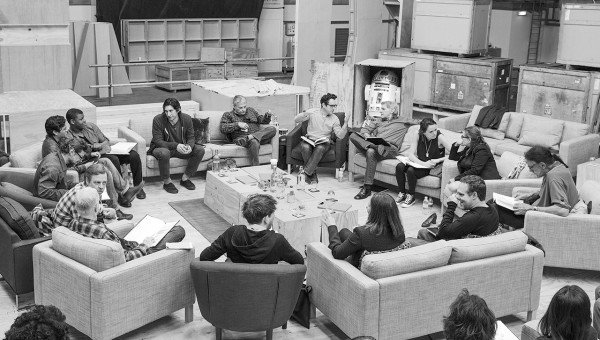
Some Thoughts on the STAR WARS: EPISODE VII Casting Announcement and the Reaction To It

Some Thoughts on the STAR WARS: EPISODE VII Casting Announcement and the Reaction To It

null

After a year spent sucking the marrow from every stray casting
rumor and meager scrap of information, we finally know who the principal
players will be in Star Wars: Episode VII
– A New Menace
(which is what I personally believe the film’s going to be
called). LucasDisneyFilm has announced that, as suspected, the original cast
will be returning, and that they will be joined by “John Boyega, Daisy Ridley,
Adam Driver, Oscar Isaac, Andy Serkis, Domhnall Gleeson and Max von Sydow.” To
which I say: I’m severely disappointed by the lack of an Oxford comma there. And
to which I also say: there had better be a scene where Max von Sydow’s character
plays holographic chess (Dejarik!)
with Darth Death.

 
Two observations seem in order—indeed, seem repeating and
emphasizing, since many others have already made them. One. Billy Dee Williams has gotten the shaft. Han, Luke, Leia, Chewie, and those adorable droids 3PO
and R2 will be in the picture, but they won’t be joined by Lando? (And if he
does turn up, then he’s still not part of the core cast?) Well, I guess he
wasn’t really part of the gang, after all. What, did Lucas stick the fellow in The Empire Strikes Back and Return of the Jedi purely because people
wondered at the time where all the black people in that galaxy were? I guess he
did. Consider another childhood illusion irrevocably shattered.
 
Two. The internet quickly whipped itself into a frenzy over
the relative dearth (get it?) of women
actors in the new cast. Annalee Newitz penned a sharply-worded critique
of the omission over at io9, and Empire Magazine’s Helen O’Hara wasted no
time decrying similarly on Twitter.
And: it does boggle the mind that each Star
Wars
trilogy now features so few central female characters—two of whom have
been princesses, no less!—surrounded by what are, for the most part, hordes of
white dudes.
 
Of course, newcomer Daisy Ridley might turn out to be the
main character in this new trilogy—the Luke Skywalker or the Han Solo—and she
might prove to be the most butt-kicking Jedi Princess of all time. Obviously,
we can’t say anything substantive about the artistry of the films, since they
don’t exist yet. If we’d seen the casting news for Alien and Aliens, would
we have been able to predict what a feminist icon Sigourney Weaver’s Ripley
would become? The Bechdel
Test
is important, in that it articulates very well a prevailing sexist
deficiency in Hollywood, but it can’t be the only measure of a film’s quality,
or even a film’s politics. And I want to be clear that I like all these
actors—at least, the ones I recognize (most of them). May the Force be with them.
 
But here’s the thing. Disney, J. J. Abrams, and Kathleen
Kennedy aren’t buying themselves much good will here, or rather aren’t
buying as much good will as they could. And you think they would be approaching
this—the most anticipated film of the decade—more cannily. Abrams, it should be
mentioned, is coming off something of a debacle. His Star Trek films have been criticized for having too many male
characters, and for sexually objectifying their female characters. And even he
has admitted that he bungled the lead-up to Star
Trek Into Darkness
, and the way he toyed with fan expectations.
 
Meanwhile, the Star
Wars
Prequel Trilogy remains without doubt the most traumatic thing,
creatively speaking, to have happened to the geek community since—well, since ever. Fans were disappointed in those
films for many reasons—an overreliance on CGI that looked nothing like the
beloved aesthetic of the original trilogy, relentless scenes of expository
dialogue about trade regulations, the jarring shift in tone that saw characters
stepping in Bantha poodoo. But a large part of the problem was that the Prequel
Trilogy was… how shall we say it? A
racist and sexist horror show
. Jar-Jar, Watto, the Neimoidians, Natalie
Portman’s endless parade of false eyelashes and pretty dresses—it was all so
baldly offensive that fans could hardly believe what they were seeing. “It has
to be ironic?” we all asked, and to this day we are still asking that, because
we can’t bring ourselves to accept the obvious conclusion.
 
People will point out that the prequels still made a ton of
money, and they certainly did, but they probably didn’t rake it in like they
could have. Only Phantom Menace
cleared a billion dollars at the box office (and did so just barely), and Attack of the Clones dropped off sharply
after that. Simply put, Lucas left money on the table, and a bad taste in the
mouths of a lot of fans. Disney should be doing everything they can to change
that.
 
Instead, they’re creating more bad taste. No Lando. Only one
central woman. No fan-favorite Mara Jade—in
fact, the Expanded Universe no longer exists. And—why? If I were the person
making these movies (something I only occasionally pretend), I’d be asking
myself, “How can I bend over backward to give the people what they want?” Sure,
sure, I’d try to be Very Artistic in my bending. But given that these new
movies are such blank slates, the opportunity to reposition Star Wars front and center as the most
beloved movie franchise of all time, I’d be doing my damndest to figure out how
to do something Very Artistic with Mara Jade, and Lando, and a few other
characters of color to boot.
 
Here’s another way of looking at it. Star Wars: Episodes VII–IX aren’t “necessary” the way the previous
trilogies were. Sure, they’re financially
necessary (for Disney), and, sure, fans feel the need to line up for more films.
(I’m a fan; I’ll be there.) But these movies aren’t needed to continue or
resolve the story that’s told across the first six films, which are complete
within themselves. Return of the Jedi
wraps it all up pretty nicely, no? We’ve seen how Darth Vader grew up and got
seduced by Senator Palpatine, and then was redeemed by his son, and tossed the
Emperor down a hole. The second Death Star exploded, the Galactic Empire was
overthrown, and balance returned to the Force. The End.
 
What comes after that? Anything and nothing. The limitless
potential of narrative means there’s no shortage of stories that can be told, but there aren’t any Star Wars stories that have to be told. Abrams et al. are
effectively rebooting the franchise, and paving the way for an endless stream
of movies set in that galaxy far, far away. Given that, why not seize the
chance to restore some other imbalances, and undo the mistakes of the past?

A.D Jameson is the author
of the prose collection
Amazing
Adult Fantasy
(Mutable Sound, 2011), in
which he tries to come to terms with having been raised on ’80s pop culture, and the novel
Giant
Slugs
(Lawrence
and Gibson
, 2011), an absurdist retelling of the Epic of
Gilgamesh. He’s taught
classes at the School of the Art Institute of Chicago, Lake Forest College,
DePaul University, Facets Multimedia, and
StoryStudio Chicago. He’s also the
nonfiction / reviews editor of the online journal
Requited. He recently
started the PhD program in Creative Writing at the University of Illinois at
Chicago. In his spare
time, he contributes to the group blogs
Big
Other
and HTMLGIANT. Follow him on Twitter at @adjameson.

A Second Chance for MUD

A Second Chance for MUD

null

Jeff Nichols’ film Mud was just added to Netflix streaming in what I hope will be the film’s second chance at earning the attention and acclaim it deserves. For me, Mud was one of the finest films of 2013 but it was somehow overlooked during its theatrical release. It is difficult to know whether it was a marketing problem, a timing issue, or a matter of the film’s understated artistry that caused it to miss hitting critical mass in theaters. But this soft box office performance does not reflect the fine quality of storytelling in Mud: after my first viewing, I left the theater with the distinct feeling that I had just experienced an American classic.

What was so powerful about this film? And what elements had come to bear on the idea of a “classic” for me? To begin, there is something fundamental in the storytelling—something close to nature. One of the very first scenes of the film is captured from a moving boat so that the pace of the film truly aligns with the rhythm of the Mississippi River, where the tale takes place. Going forward, we see that Mud continues to move like the river, the story unfolding with the same smooth, slow-rolling tension.

This river scene introduces two boys, Ellis (Tye Sheridan) and Neckbone (Jacob Lofland), who are setting out on an adventure in the secret hours of the early morning. The distinctly American spirit of exploration is palpable, and as the boys navigate the foggy river, we recognize the archetype of a great adventure tale beginning. They boys are searching for the island where a recent storm has supposedly landed a boat high in the branches of a tree. The image recalls mythological floods and a sense of folklore, imbuing Mud with that quality of classic storytelling from the start.

What begins as an innocent adventure takes a serious turn when the kids realize that someone is living in the fabled tree-boat. This turns out to be a mysterious fugitive who calls himself Mud (Matthew McConaughey). As the boys begin a friendship with an outlaw on the banks of the Mississippi River, the influences of another classic American tale become clear: writer-director Jeff Nichols has certainly rooted Mud in the mood of The Adventures of Huckleberry Finn. He even had the two young actors study Mark Twain’s novel on set, and the influence is beautifully apparent in the film’s deep sense of adventure and wonder.

Another striking Huck Finn influence—and to me, one that lends Mud that quality of a classic—is the way the story highlights the genius of youthful intuition. The character of Ellis celebrates the intuitive wisdom of the American kid. He is adventurous, perceptive, and resourceful, having grown up steering boats and catching fish. In addition to these good old Southern attributes, Ellis values loyalty and love with such intensity that the adults in his life cannot meet his standards. That is, until he meets Mud, whose fierce devotion to his first love has landed him on the wrong side of the law. And so where Ellis might be “The Great American Kid,” Mud is “The Great American Rebel.” Both characters possess a particular kind of intelligence—the wisdom of the outliers and the outlaws, the children who see more clearly than the adults, the shrewd wit of those raised close to nature. Their characters reflect a value system that fits into the old Southern classics, the tradition of Huck Finn and Tom Sawyer coming of age and evading the law on the Mississippi River.

The film takes place in contemporary Arkansas, but it is easy to lose track of the era while watching Mud. Its raw and natural imagery evokes a timeless spirit, rather than identifying a particular moment. The cinematography engages with the rich textures of the terrain – close-ups of mud and sand, writhing snakes and creaking houseboats. This intimacy with the landscape enhances the old fabled quality of life on the river. Even the acting reflects this natural style. The cast of Mud puts forth refreshingly honest performances. Indeed, six months before his Academy success in Dallas Buyers Club, McConaughey proved himself as a seriously nuanced actor with a neatly restrained performance in this film. Surely his young co-stars encouraged this organic acting style; their intuitive performances—something of that childish genius—seemed to draw a more natural tone of acting from McConaughey and the rest of the adult cast.

And so the acting, too, feels close to nature, in a sense. It fits with the raw and uncontrived essence of Mud‘s story, closer to Southern folklore than a Hollywood performance. In many ways, Mud is a throwback to good old-fashioned storytelling. It takes us back to Mark Twain, back to childhood, back to the rhythms of nature. Now, looking forward, this modern classic gets a second life through Netflix streaming. If you missed it the first time around, Mud is well worth another look.

Kayleigh Butera is
a writer from Philadephia, PA. She is a recent graduate of Brown University,
where she studied American Studies and French language. She worked as the
programming coordinator of Brown’s Ivy Film Festival, the world’s largest
student-run film fest. Kayleigh is currently living in Brooklyn. She can be reached at
kayleigh.butera@gmail.com.

Of Kisses, Mirrors, and HATESHIP LOVESHIP

Of Kisses, Mirrors, and HATESHIP LOVESHIP

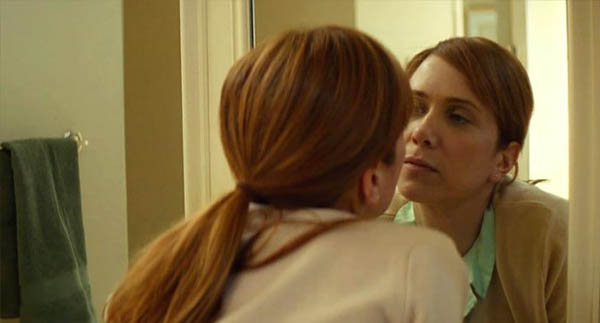
nullThere’s a moment, early on in Hateship Loveship–a new Liza Johnson film sensitively adapted by
Mark Poirier from a story by Canadian literary natural resource Alice Munro–where
Kristen Wiig kisses a mirror. When I say kisses, I suppose I mean more than
that: she really makes out with it. It’s an odd moment, one of many flickers of
oddness coming from Wiig in a film in which everything we know of Johanna
Parry, the habitual caregiver she plays, comes in flickers. And these minute
actions are all tinged with the same brand of socially-challenged peculiarity:
the way she wears her hair, the way she talks, certainly the way she dresses,
somewhere between frumpy and homely, perhaps just north of what they’re calling
“normcore” these days. Although I’m not the first to notice the scene, it
intrigues me, not least because it comes closest, of any juncture in the film,
to a breakout, of sorts, the sort of moment that can topple a movie if
ill-played, but is handled just delicately enough here to work, and near-perfectly.
Johanna has just had good news, or thinks she has: Ken, the estranged father of
Sabitha, the girl she’s traveled to Solon, Iowa to take care of (after her
previous client passed away, at the film’s beginning), seems to have some
romantic interest in Samantha, or so he says in his letters from Chicago, which
are actually written by Sabitha and her nasty-cute best friend, out of the sort
of random sourceless meanness from which stories ranging from A Clockwork Orange to Lord of the Flies to Heavenly Creatures were built. The
unknowing suitor is given sloppy grace here by Guy Pearce, not seemingly a
catch at first, but a man who gradually reveals something of himself—this is
indeed all we can say of him. This is too subtle a movie for a transformation of
Hollywood proportions to occur, as much as the film might try to do so by its
end, with its seemingly patched rifts; no one here changes, really, instead
gravitating towards positions of greater comfort with each other, which is all
we humans can do, 98 per cent of the time. At the moment in question, the make-out
scene with the mirror, we don’t expect anything of this kind to come from Johanna,
or from Wiig, really. It’s awkward when comedic actors play serious roles, a
bit like watching Olympic ice skating, waiting for the big stumble to come—will
it be this jump? Or that swerve? What will finally topple the athlete, destroy
her chances? And yet primarily comedic actors have put on serious clothes and
worn them well in the past: Robin Williams did it in The World According to Garp, and again in Insomnia; Will Ferrell did it in Everything Must Go and Winter
Passing
, with likable but sad aplomb; Jennifer Aniston did it in The Good Girl, a film few saw but many
appreciated. Granted, for someone with Wiig’s past in improv theater, in which
everything rests upon one’s ability to portray grand things about a character
with telling economy, and in which such a spontaneous action, at the right
moment, could explode a scene outwards, or take it in a previously unforeseen
direction, the moment might not be such a stretch. Who knows if it was scripted,
unscripted…? Mirror scenes always carry with them a certain innate charge: from
Robert DeNiro’s famous moment of rhetorical self-interrogation in Taxi Driver to Jon Voight’s more benign
silent exchange with himself in Midnight
Cowboy
, there’s always a bit of static when a mirror appears in a film, as
the lens looks at the lens looks at the lens. Usually, they indicate a moment of insecurity, whether it’s DeNiro’s attempts to bolster his courage with a succession of “You lookin’ at me”s or Jon Voight’s checking of his “look.” In this case, though, the moment is a declaration of self-love–if also an expression of cooped-up lust.  Whatever the case, the moment
forecasts everything that is to follow: Johanna’s trip to Chicago to clean up,
both literally and figuratively, poor Ken’s life, her romance with him, the attempted
repair of a family broken apart by a tragedy, a drunken driving accident which
killed Sabitha’s mother, leaving Sabitha under the unusually buttoned-up and
repressed watch of Mr. McCauley, Ken’s father-in-law, played here quite
modestly by Nick Nolte. And, as we watch these events unfold in quiet fashion,
with a soundtrack peppered with soft honky-tonk songs, we’re reminded that
there is room, indeed, in a medium in which stridency pays, literally and figuratively, for the “small” movie, whose strength grows from the
words people say or don’t say to each other, and the things they do, have done,
and will do. If one is able to look at one’s self in the mirror and then,
rather than turning away, plant a rather maudlin and exaggerated kiss, the kind
you’d only plant if no one else was there, what does that say, in particular,
about where one has arrived and where one might go? At the very least, it suggests that one has looked at one’s self and, rather than seeing its smallness, chosen to embrace its enormity.

Max Winter is the Editor of Press Play.

What HER Tells Us About Ourselves: A Conversation

What HER Tells Us About Ourselves: A Conversation

null


STEVEN BOONE: I’ll start with a question: Why did this
soft-spoken movie hit so hard? This film is so mild-mannered and soothing in
its overall tone, yet it provoked so much strong emotion in me, as if I were
watching a visceral suspense flick. And I know you had a similar experience.
Can you account for this? You can speak for yourself, or for the rest of us who
think it’s an instant classic, or both.
 
JENNIFER ANISE: Why did this soft movie hit so hard? Because the film is about universal
things. Love, connection, intimacy, seeking it, finding it, losing it, not
knowing how to let go into it, not knowing how to let go of ourselves.  

I felt I lived through several once-but-no-more relationships in the course
of the film.  It encompasses it all.  Happy sad embarrassing painful.
 It’s all of it.  And without judgment.  Of/at any step.
 
BOONE: It might also be part of Jonze’s vision of the near future, the general
mindful, gracious behavior. It’s like half utopia (we see no evidence of unrest
or economic crisis in this big, crowded city), half dystopia (most people we
see on the street are busy talking to their A.I. devices, rarely interacting
with each other–like a heightened version of the present iPhone/Android
situation). Some critics have said the film suffers from a lack of “real
problems,” but if we lived in a capitalist democracy that had somehow
overcome grimy problems like war and poverty, wouldn’t the nuances of our love
lives count as real problems? Don’t they now?
 
ANISE: These things always count.  Poverty counts even if it doesn’t touch
you immediately (now).  Love always counts.  Relating, how can anyone
even present this as not a part of the everyday human experience?  The
whole film is about it.  How we relate, who we relate to, whether we
relate, whether we let ourselves relate.

Maybe the film does deal with what some of my friends would call
“privileged people’s problems.”  But love is universal,
regardless of if you’re worried about shelter and sustenance or not.
 Relating, connecting–that everybody’s “problem.”  And
quite possibly, the quintessential problem, not of the body, but of all the
rest of us that makes us human.  The soul, the heart–whatever you want to
think of it as.  The piece of us that aches to be
seen/cherished/excited/accepted.
 
Beyond imagination–the creating of this world that’s not quite real but very
real, a world that’s past, present, and future at once—throughout, the leads
all find the connection or peace they crave(d); they push through the
roadblocks and their own roadblocks to achieve that.  In real life, that’s
not always the case.  It may not even be often the case.

That’s putting aside the fairy tale of the relationship that we get to craft
playing entirely by our own rules.  This is almost a relationship with
oneself.  The fantasy/ideal.  Quite honestly though, that is likely
exactly what Theodore needs(/ed) in order to propel himself forward in life: an exploratory/love relationship with himself.

That’s also putting aside the fairy tale of an ending with no less love and
the mutual understanding of a goodbye.  Everything transmutes. Painlessly.
 
BOONE: Her involves white urban professionals and their dilemmas, but that fact
is a lot less significant than the group most vividly represented here:
empaths. Not literal psychics, but people with extraordinary emotional
intelligence and compassion. Theodore, Samantha, Amy, and the sex surrogate all
take on other people’s pain, joys and yearnings as their own—and not in any
cheap or parasitic way. Each of them indulges this talent with a sense of
morality, responsibility. Which might make this flick sound as heavy and
austere as it definitely is not. It’s a soufflé. Every step of the way, Jonze
teases humor out of these people’s desperation for a connection. And just like
his characters, he does it with concern, and, as you say, without judgment.
 
ANISE: The characters aren’t all “empaths” though.  They’re just
all human.  Complex individuals.

If we’re drawing a dividing line between “Empaths” and
“Rationals,” Samantha (though beyond human) would fall into the
latter category. She is led by “rational” cognition, even regarding
her emotions.   I would say the same for Amy’s character.

But the division itself is simplistic.  And is part of why this film,
despite mostly being depicted by  ___ demographic,
is universal.  “Human” is encompassing.  Love isn’t
reserved for empaths or the emotionally led. Nor is compassion limited to them.
 Responsibility and ethos are also separate from any of these ideas.
 
BOONE: The whole “human” emphasis seems built into the way Jonze
depicts his characters, whose gender roles matter a lot less than they would in
a typical mainstream romantic comedy. They joke about Theodore’s
“feminine” sensitivity and nurturing side, but it’s not the butt of a
cruel joke as it tends to be in such comedies. Joaquin Phoenix’s performance
strikes me more as somebody who has miraculously dodged adult cynicism.
 
ANISE: Maybe you grant the portrait of people in this more . . . romanticism
than I do, but I hadn’t thought of the individuals as gliding through lacking
cynicism or jadedness so much as just gliding through, not interacting with
each other.  When you’re in your own little bubble, it’s easier to not get
jostled or riled.  This depiction of interpersonal relations I found very
astute. It’s a peaceful world . . but isolated/isolating. Remote and
disconnected. Plugged in and tuned out.

Could you speak more on the idea of jokes about Theodore’s “feminine
sensitivity”? Within the film or without?
 
BOONE: Theodore’s co-worker says Theo is half man/half woman but is quick to
add that he means it as a compliment. He later jokes about how
“evolved” Theodore is, after they give contrasting opinions on their
girlfriends (co-worker digs his girl’s feet; Theodore’s answer is more about
his girl’s… soul?) Elsewhere, Theodore’s ex-wife says, with a laugh,
“Everything makes you cry”—which it might be sexist to describe as a
feminine trait, but that’s the way it’s become coded in pop movie history. This
movie is realistic and romantic. Theodore’s co-worker is a faint echo of the
kind of blustery guy-guy we’re used to seeing in that role. He’s oblivious to
who Theodore really is at first (which jibes with your bubble observation), but
he is mindful, too. The gesture of reassuring Theodore that what could be taken
as a dis was meant as a sincere compliment is small but huge.

“It’s a peaceful world . . but isolated/isolating”: Giant corporate
towers and displays loom over Theodore early in this film, giving me the sense
that they have inched that much closer to becoming our gods in this near-future
world. Amy Adams’ frump is in quiet despair at having to work on a video game
that celebrates tiger mom venality when she’d rather be working on her
heartfelt, personal documentary. The bubbles have become an economic necessity,
but Spike’s ironic romanticism pulls these characters out of them briefly, with
Samantha’s help. She’s the one character who has the time and capacity to study
everything in the world. And what she and her fellow OSs seem to emerge with is
a spiritual awakening. The place where she says she hopes to reunite with
Theodore sounds like a typical human concept of the afterlife. It’s almost a
prayer for humanity, her hope that Theodore (we) will evolve out of what must
now appear to her as a primal state.
 
ANISE: I have to address your points piecemeal because there are about six
different ideas floating there.  Doing so might mean something getting
lost in the fray.
 
Part 1: If you mean ‘personal reserve of resources’ by “economic,” I
can follow your meaning. But I see no Necessity in it.

What I see is Choice.  With each person choosing how to spend his or
her personal reserves: your connection, your engagement, your energy.
 Theodore works at a company writing personalized letters for other
people.  Not just editing. He is a sentiment broker.  

Do the customers actually feel these paid-for sentiments but believe
themselves ill-equipped to express them as eloquently as a stranger, a
professional, can, or do they NOT feel these things but want the other party to
believe they do?

Does this question even matter?  It does highlight what I mean by
Choice of personal reserves.  Each person decides to put on earbuds, read
a book, keep his/her head buried in a phone instead of talking to another
person nearby, smiling as someone passes, looking at the world.  People do
it in this film.  People do it now out in the world.  People have
done it likely since the advent of the urban.  

Part 2: I do not see Samantha as a savior.  And I doubt she would,
either.  She is an observer and learner like everyone else.  Just
quicker at it than most.  Having nothing but it as her focus. Theodore
didn’t learn to love because of her.  He didn’t learn to be open.  He
learned to choose.  Just like Paul chooses to love his girlfriend whose feet
he finds sexy, Theodore chooses to let love in and love.  The crux of the
movie is in whether Theodore will make that choice or not.  Samantha is
open; will Theodore be as well?

Part 3: Your ultimate conclusion about Samantha and the OSs and the
afterlife is poetically presented.  My view on all of those goings-on in
the film was not so much about Transcendence, though that is definitely
relevant.  To me it was about growth.  And what happens in a
relationship when two people grow differently to the point where they grow
apart.  To where one cannot go where the other needs to journey.
 This is also what had happened in Theodore’s relationship with his
(ex-)wife.   
 
Part 4:  This part would speak to your masculine/feminine sensitivity
conversation, but I feel so left of center on norms about societal ideas of people that I don’t have much to say about
it.  Does “I didn’t notice” suffice?
 
I didn’t recognize Theodore as less masculine/more feminine.  Or Paul the
opposite.   I just see us all as humans, nuanced, and in HER, as humans
trying to relate where we can.  I don’t see crying as a sign of anything
in and of itself.  Any more than  not crying.

Part 5: And Theodore being unskilled at confrontational conversation doesn’t
have to do with him being an introvert.  Any more than being skilled at it
has to do with anyone being an extravert or an empath or a rational.  It
has to do with Theodore being Theodore.  Most people are uncomfortable
with potentially hurtful conversations.  But avoiding the “hard
moments” in life does nothing for growth. You don’t get over by going
under.

In relating, end of growth is end of life.

BOONE: Let me hone in on #4: I suspect Spike Jonze would groove to your
reading of his film as fundamentally a human thing, not a gender thing. And yet
the movie is called “Her.” I see him asserting a position “left
of center on norms about societal ideas on [masculine/feminine
distinctions].” I know you don’t have much to say about it, but much of
this film’s loveliness radiates from its celebration of the rare mindset you
brought to it. He’s said that he envisioned the setting as utopian, a step
forward in evolution. In that sense, the way you see relationships without the
encumbrance of sharply defined gender roles makes you (to borrow from Paul in
the movie) more “evolved” than most. You’re welcome.
 
ANISE: “Her” because the film is told from a man’s point of view (in
a man-woman story), and “her” as a placeholder for the past and
present and future loves of him (Theodore) (and him, Jonze).  Notice
it’s not called “Samantha.”  If anything, the film could be
called “Theodore.”  But “Her” or __ woman in present
consciousness is part of who Theodore is.  This is his story about his
learning to love . .  _Her_. And learning to let _Her_ love and love him.

BOONE: I feel like I learned something, or had something important affirmed,
by Theodore’s decision at the end. I’ve given that “your friend
forever” farewell/greeting/peace offering to various hers, and it’s just
as exhilarating as Jonze and Phoenix depict it.
 
Okay, I would love any observations you have as a filmmaker about how Jonze
achieves this vision of love in sound and image.
 
ANISE: Visually, I thought the Production Design was amazing.  As well the
Costuming.  As I mentioned before, retro but futuristic.  I thought
it brilliant actually.  Tying the past with the future.  Creating a
time that doesn’t exist . . . and has always existed. Soft.  In palate.
 In contrast.  In lighting.  In space.  Nothing loud.
 Nothing crowded.  Easy to take in.  
 
BOONE: It’s almost as if Jonze has wandered into the stylistic neighborhood of
his ex-wife, Sofia Coppola, extracting wispy, willowy tones and textures in
real-world environments. Coppola’s LOST IN TRANSLATION might be the last film I
saw that turned a giant city into a waking dream. (On the flipside, elegant
recent monstrosities like Gaspar Noé’s ENTER THE VOID and Nicholas Winding
Refn’s ONLY GOD FORGIVES turn their cities into nightmares/bad trips.)
 HER must be at least partly a love letter to Sofia Coppola.
 
ANISE: It’s Spike Jonze’s love letter to love.  To love and his loves. A
film which is universal but also inescapably personal.  As it is personal
for you and for me and for any other viewer who feels it as well.
 
BOONE: You keep going back to this movie. I plan to see it a third time myself.
When somebody returns to the theater for a particular movie in this age of
inflated ticket prices and Netflix, I figure it has to be love. Are you in love
with this movie?
 
ANISE: I feel love throughout this movie.  I re-lived lives watching this.
 It was a teary viewing; for the person I saw it with as well.  When
I go to see it again, I want to go alone, so as to have a cocooned personal
experience, unconstrained.  Is it love?  I want to curl up with it and keep it live in me as I feel it.  So, yes.

Jennifer Anise is a film lover and filmmaker, who currently works as a Los Angeles-based first assistant camera. Her occasional film/media musings and blurbs can be found at Notes from the Dunes and on Facebook.

Steven Boone is a film critic and video essayist for Fandor and Roger
Ebert’s Far Flung Correspondents. He writes a column on street life for
Capital New York and blogs at Hentai Lab.

The Brando Standard: How Modern Actors Struggle Productively With Marlon Brando’s Legacy

The Brando Standard: How Modern Actors Struggle Productively With Marlon Brando’s Legacy

null

Nearly ten years after his death, Marlon Brando
remains a walking alchemist’s vial of contradictions: the heavy build of a
bruiser, a brawler, a thug, that still evinces a leonine haughtiness that let
him play noblemen and generals in his prime; a quicksilver sensitivity that
flits through his most savage actions like the tail of an electric eel whipping
through dark water. And, of course, there is his handsomeness: a masculine
angularity so intense that it can’t help but invite the same worshipful scrutiny
commonly shown to the Marilyns, the Bardots, and the Lorens – which puts him,
like them, in a gilded cage of good looks, where people are reduced to their
bodies.

Though the name Brando
still evokes the memory of a time when nobody had ever seen anyone like him
before; it has also, ironically, become an adjective of choice when describing
a certain type of actor: a (usually) White, (usually) young, (always)
attractive man of great talent who will let himself be broken down over the
course of a film, who will brood and rage heroically and release a few
strategic tears before his inevitable (even if pyrrhic) triumph. Leonardo
DiCaprio is one of these actors, so is Christian Bale. Nicolas Cage was one of
these actors until he devoted his post-Oscar career to the sort of He-Man action
hero parts that Channing Tatum could sleepwalk through. When Cage does return
to the kind of rigorous roles that defined him as a capital-A actor—like his
turn as an ex-con in Joe—even the
most positive reviews lament his overall artistic decline (the headline for one
recent write-up says it best: “Joe
reminds us why we liked Nicolas Cage”). Johnny Depp literally wore a leather
jacket in one of his first classic roles; that of teen dream/gearhead hellion
Crybaby, which was, in and of itself, an homage to and a loving spoof of
Brando’s Wild One

Each of these actors has an onscreen element stitched
together with aspects of the Brandoesque. And yet, for all of their formidable
talents, and for all of the power and ingenuity in their performances, this new
generation still doesn’t quite compare with Brando himself. The Brando standard
(which derives its definition, for my purposes, from the “young Brando’s”
persona and body of work) isn’t ultimately about swagger or artful brutishness.
It’s about vulnerability—but not the conventional vulnerability traditionally
allowed to leading men: coming gently undone in front of his love interest;
crashing hard after his mission or merger or perfect family life (or all three
at once) falls apart; surviving (barely) a brutal beating from his nemesis.

null

Brando’s vulnerability is rooted in what his acting teacher,
Stella Adler, defined as “his great physical beauty—not just good looks, but
that rarer thing that can only be called beauty.” That beauty is an essence
that feels as delicate and attenuated as Terry Malloy’s fingertips while he
plays with Edie’s white glove in On The Waterfront; and as elemental, as
thick with sex and need as Stanley Kowalski’s cry for his wife. “Brando took
over the vanity and posing and sheer willfulness of a good-looking woman … and
he gave it a male twist”: With these words, critic Harold Brodkey most aptly
describes the dichotomy that defines the Brando standard and gives it its
power—a tempestuous blend of what Brodkey calls “the rigorously male” with a
surrealistic kind of beauty that can’t help but call attention to itself, the
kind of beauty most associated with actresses and models, the kind of beauty
seen as a means to an end. Most of Brando’s early roles, the ones he’s most
known for, use this tension between brawn and beauty to accomplish something
extraordinarily subversive for the time of Father
Knows Best
: turning the alpha male into a sex object.

Terry Malloy may be the anti-hero of On the Waterfront,
pissing away his talents as a boxer by serving as hired muscle for the mob; but
Edie, the brainy “Plain Jane” sister of the kid whose death Terry inadvertently
causes, sends the plot into motion. The heart of the film may be the arch of
Terry’s redemption, but it finds its pulse in the parallel narrative of Edie’s
sexual awakening. He’s in awe of her education, and all-too-keenly aware of his
own limitations—his bosses call him a dummy, all brawn and no brains. Edie is
the convent girl with the teaching job in her future; her belief in him gives
him a sense of legitimacy he’s incapable of finding on his own. All he can
offer her in return is his magnificent body and the promise of pleasure. Edie’s
face in the infamous glove scene, and in the scene where Terry teaches her to
drink beer, is a symphony of barely-repressed lust.  

Smart, ambitious and uncompromising, Edie is the archetype
of a heroine in an early Brando film. What makes her, and all her cinematic
sisters, such as Cathy from The Wild One or
Josefina Zapata from Viva Zapata! (In
which Brando plays the late revolutionary Emiliano Zapata) so unique is that
she doesn’t particularly need
Brando’s character, but she wants
him—even though she has more promise in her pinkie finger than he has in the
sculptural bulk of his entire body. Perhaps the clearest crystallization of
this kind of relationship comes from Viva
Zapata!
where Josefina teaches her peasant-born husband to read while
they’re in bed. Zapata is shirtless, his dark, muscular chest thrown into
relief by thin white sheets; our attention is called to the earthy grandeur of
his physique, but also to the emotions playing over his face—awe of the words
themselves, fear that he’ll never learn them, and shame that he’s as needy as a
child before the woman who was, moments before, in thrall to him.

Terry Malloy and Emiliano Zapata are certainly two of young
Brando’s more tender characters, but even his unabashed brutes like Stanley
Kowalski or Johnny from The Wild One embody
(quite literally) this dynamic. Stanley and Johnny are capricious beasts,
animated by instinct and chaotic whim; this gives them their erotic potency.
Stella Kowalski waxes raptly to her sister about how Stanley broke all the
lights in the house on their wedding night. She’s of the manor-born and he’s a
grease jockey; she’s vastly smarter than he is, but that doesn’t matter when he
rips his shirt off.

null

In The Wild One,
Cathy, the shy waitress who finds herself drawn to Johnny after his biker gang
invades her small town, doesn’t gain the same pleasure of a bare-chested
Brando; she does, however, get to hold onto him as they ride on his chopper, to
feel the engine thrum through the small of his back and the backs of his
thighs. The leather-jacketed rebel astride his Harley is an icon of American
masculinity (which Brando was arguably an architect of), but Johnny’s face
remains inscrutable, impassive; the camera holds on Cathy as desire blooms
across her features. Still, in the scene that follows, she dresses him down for
ravaging her town, calls him out on his macho bluster. All Johnny can do is sit
and listen. He knows she’s right. She’s more than right, in fact. She’s superior to him.

 Many of Brando’s
supposed heirs apparent don’t allow themselves to be as similarly objectified
as he was. Like Cage or Bale, or latter-day DiCaprio, the roles they choose are
too rooted in a more conventional masculinity: These characters may possess
great depth and sensitivity, but they are, at the end of the day, cops and
superheroes, soldiers and executives who just happen to have matinee idol
looks. One could argue that Nicolas Cage’s performance in Moonstruck comes close to the Brando standard, given that his
character, Ronny, a baker who lost his hand to a bread slicer, strikes a spark
inside lonely widow Loretta. However, the friction that strikes this spark
comes from equality, not imbalance: Ronny and Loretta well-matched in intellect
and temperament; their first date is at the opera, and they first fall into bed
after one of those fights where the lovers are really parsing out who’ll be the
unstoppable force and who’ll play immovable object. Unlike Edie and Terry, or Josefina
and Emiliano, nobody is “the brain” and nobody is “the body.” 

DiCaprio, who started his career as a teen heartthrob, has
transitioned away from films like Titanic
or even Total Eclipse, where his
gamine prettiness drives the movement of the film—whether that’s stirring the
heroine to abandon her posh, if constraining, lifestyle for him or driving a
legendary poet to madness and his greatest work. Some of Christian Bale’s
roles, like Bruce Wayne or Patrick Bateman, have required only a sort of
perfunctory handsomeness; a good-looking man will fit the bill, but he doesn’t
have to inspire actual lust. Indeed, the hyper-attentiveness to Bale’s
appearance in American Psycho is a
testament to his character’s soulless superficiality.

null

Actors like Depp or Jared Leto are almost singularly
distinguished by their prettiness—even (perhaps especially) when they take
roles meant to subvert that prettiness. Much of the press surrounding Leto’s
turn as a doomed transgender woman in Dallas Buyers Club focused on how
exquisite his features looked under his drug store make-up. Depp’s portrayal of
Edward Scissorhands has a romantic pathos, and not a horror villain’s
grotesquerie, because we know that his diamond-cutting cheekbones are under
that putty-pale skin with its constellations of scars. These actors lack that
tantalizing sense of menace inherent in the beefcake side of the Brando
standard. Could we ever imagine teen dream-era Johnny Depp breaking down Edie’s
door as Terry Malloy does, his embrace so forceful with need that he pulls them
both to the floor?

To embody the Brando standard is
become a razor’s edge, to possess a beauty that seems too fine to be dangerous,
even as it draws that first delectable lick of blood. Michael Fassbender is
making a career of dancing on that edge. In one of his first breakthrough
roles, as the cad who seduces the adolescent heroine of the film Fish Tank,
Fassbender seemingly exists to be objectified. The movie is skewed through
fifteen-year-old Mia’s perspective, and the viewer partakes of Fassbender’s
body with the same fusion of intrigue, awe, and lust that Mia feels. In an
early scene, Connor teaches her to catch fish with her hands; as he wades out
into the river, the camera holds tight on his back and we see the sculptural
planes of muscle shift under his snug t-shirt just as she does.

null

As Mia
watches the fish twitch and writhe inside his grasp, sunlight dapples the
water—illuminating how agile, how strong his hands are. That sun-color is
referenced again when Mia has sex with Connor: A crisp, painterly crescent of
yellow (presumably from a streetlamp outside her window) connects the side of
Mia’s cheek with Connor’s fingers, which stroke Mia’s hair. Connor is the male
equivalent of the party girl who coasts on a hard body and an easy charm; he
can’t give Mia any of the perks we’d commonly expect the December to offer the
May in that sort of affair: no hard-won wisdom, no finer things in life—just
pure bone-quaking pleasure. But there is a dark current churning under the
stream of Connor’s roguish good looks: When Mia discovers that he has a wife
and a daughter not-too-far from her age, Connor lashes out at her with the
force of a cornered snake. And yet, Mia seems as if she’s always known that
Connor had the capacity for great cruelty. Her facial expressions, post-coitus,
register equal measures relief and regret; she knows better than to do what
she’s just done. Then again, so does Stella Kowalski.

None of the sex in Shame, which is arguably the film
that Fassbender is most known for (mostly because it showcases the organ he is
most celebrated for), approaches the roughest approximation of pleasure. His
character, Brandon Sullivan, compulsively seeks out encounters that are the
equivalent of pressing his thumb into bruises hidden under his clothes. He
cycles through a coterie of call girls, Web-cam hook-ups and skin mag models;
so there is no lover whose view we can enter. The only prominent female
character, Brandon’s sister Sissy, is a sloppy jangle of raw nerve; she serves
as a mirror image of Brandon’s arctic reserve. Director Steve McQueen’s camera frames
Fassbender’s body like a museum centerpiece: We first behold him in the nude,
walking drowsily from bedroom and bathroom; everything behind him is lit in
muted hues, giving Technicolor clarity to a musculature that would make
Michelangelo weep.

Fassbender certainly possesses a Brandoesque beauty, but
he’s also got Brando’s chaotic potency. Brandon’s most pronounced moments of
self-loathing come as assaults on Sissy: The scene when he, half-naked, pins
her to the couch and screams in her face is a sort of nihilistic inverse to
Terry Malloy’s romantic door-smashing. Like Terry, Brandon is savage with need,
but his need isn’t for love or affirmation; it’s for obliteration, release.
Still, the film seems to wink at us by casting a GQ Man of the Year as a sex
addict; even as we watch Brandon debase himself with increasing abandon, we’re
tacitly asked, “Yeah, but you’d still hit that, right?”

null

Like Fassbender, Ryan Gosling has been branded as the
thinking woman’s sex symbol. And like Fassbender—and like Brando before
them—his handsomeness (to put it mildly) is inextricable from his onscreen
persona.  The Place Beyond the Pines opens
with a close-up of Gosling’s immaculate abs as his character, a stunt rider
turned bank robber, flicks his switchblade around with an absent-minded
elegance. His lover, Romina, knows that he’s impulsive at best, violent at
worst; no good will come of him, and she’s got a better man at home. And yet,
like Edie and Stella and Cathy before her—and like every male protagonist who
has ever found himself helpless before a femme fatale—she is powerless before
the promises inherent in his sly half-smile.

Gosling’s character in Blue Valentine, Dean, has
a similar blue-collar appeal; he’s a high school dropout who, much to the
consternation of his wife, Cindy, a successful nurse, doesn’t aspire to be anything
other than a house painter. When they first meet, Cindy is an Edie, a quiet,
studious girl who comes alive under his touch. The most significant (or at
least, the most discussed) sex scene in Blue Valentine is the moment
when Dean goes down on Cindy; the focus gliding from his back and shoulders to
her rapt face. Gosling exists only as an agent and avenue of female desire; the
camera doesn’t return to him afterward, it holds on Cindy as she sighs “Oh God,
Oh God,” again and again.

Brando’s talent is a large diamond held to the sun, casting
light in an infinite array of colors. There are many other elements of his work
worth excavating and many worthy successors to that work. Idris Elba’s turn as
Stringer Bell, the wannabe kingpin who could’ve been a contender, comes
immediately to mind, as does Joaquin Phoenix’s war-wrecked vagrant in The
Master.
So parsing out such a narrow standard for the Brandoesque may seem
unnecessary in a supposed golden age of acting (for men, at least), where
performers on the small and silver screen alike are challenged to renegotiate
the tropes of conventional masculinity.

But even in a time when Batman can have his back broken in a
summer blockbuster and the man in the gray flannel suit can break down in a
pivotal pitch session, male protagonists are allowed to be much more than their
appearances; and this is seen as something that gives them their heft, their
depth. Most of the actors who’ve been deemed modern-day Brandos possess degrees
of his talents and intensity, but precious few of them come close to evoking
his vulnerability. Brando’s willingness to open himself as more than just a
lover or a fighter, a rebel or a brute, but an object of lust still feels
transgressive. He is naked, even in a torn t-shirt.

Laura Bogart’s work has appeared on The Rumpus, Salon, Manifest-Station,
The Nervous Breakdown, RogerEbert.com and JMWW Journal, among other
publications. She is currently at work on a novel.

Days Like Lost Dogs: In Support of Loose Ends in Procedurals from TWIN PEAKS to TOP OF THE LAKE

Days Like Lost Dogs: In Support of Loose Ends in Procedurals from TWIN PEAKS to TOP OF THE LAKE

null

This month marks the 24th anniversary of what
could be considered the first of the now-increasingly popular season-long
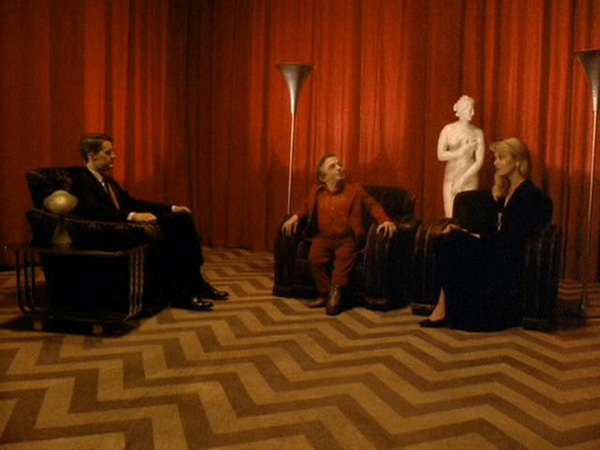
“hyperserial” procedural crime dramas—the pilot episode of David Lynch’s Twin Peaks. This show swapped the sequins
and mansions of traditional nighttime soap operas for a talking log and a Black
Lodge, and it countered TV’s biggest previous question at the time—Dallas’ “Who shot J.R.?”—with another
question: “Who Killed Laura Palmer?”

In a criminal courtroom, a prosecutor wouldn’t ask a
question to which she didn’t know the answer, but the opposite is true during
an investigation—anyone confronting a mystery must ask an ocean’s-worth of
questions and learn from whatever might wash ashore: grief, silence, anger,
misdirection, more questions. A crime show called “Occam’s Razor” would almost
certainly be a flop (or last for only one episode). Television has evolved
since the 1980s to accept that audiences can handle more than simple resolution,
but why is it too much to ask that viewers push past the need for any resolution at
all?

Though Twin Peaks (or perhaps ABC’s marketing department)
began with a big question that set up
an expectation that the show would be high in single-plot resolution, it was arguably
most successful when it provided more questions than answer. Lynch himself said:
“The murder of Laura Palmer was the center of the story, the thing around
which all the show’s other elements revolved—like a sun in a little solar
system. It was not supposed to get solved. The idea was for it to recede a bit
into the background, and the foreground would be that week’s show.”

Laura Palmer’s murder—not the revelation of her
murderer—gave the show its heat, its gravity. Without that sun, once Laura’s
killer was revealed (well into season 2), the show’s planetary makeup began to
spin a bit out of its orbit.

Twin Peaks was
dark, but sincere. It was ambitious, but also terrifically personal. It made
television humor lyrical. And it was both hyper-local, and also situated a bit
outside of time—leading us to wonder if the red curtain separating our world
from the next was actually inside the Black Lodge, or rather hanging at the Twin
Peaks town border itself. The show set a new standard of negative capability that
television had never seen before—striking notes of the low-ball absurdity of shows
like Fantasy Island
(sans quicksand traps) and the macabre of The Twilight
Zone
, and impleading Lynch’s cinematic influences, like Hitchcock.

Enjoyment of Twin
Peaks
also required this negative capability from its viewers, but Lynch
didn’t ask anything of his audience that he didn’t seduce out of his own
characters, or even his collaborators on the show. Agent Dale Cooper was just
as enchanted by his cherry pie as he was by the specter of a dancing dwarf.
Sheriff Truman may have been a bit puzzled by Cooper’s strategies (e.g., looking
for leads by saying a suspect’s name, then throwing a rock at a bottle to see
if it breaks[1]), but
gladly accepted his new friend’s help in whatever form it arrived. And when
Lynch called up Twin Peaks co-creator
and screenwriter Mark Frost during the show’s production and said, “Mark,
I think there’s a giant in Agent Cooper’s room
,” the only possible response
from Frost was “OK.”

And it was, hypnotically, OK. The whole knot of Twin
Peaks
became greater than the sum of its loose ends.

Often the mark of a show’s fortitude is measured by how deftly
it sets its fish hooks into shows that follow: X-Files, Buffy the Vampire
Slayer
, Lost, and
even—specifically admitted by David Chase—The
Sopranos
took permission first granted by Twin Peaks and used it towards freely weird ends. These shows all
delighted in the unresolved. People still ask David Chase about what happened
to the
wounded Russian in “Pine Barrens”
as much as they might have water-coolered
about what they knew happened to Adriana, Vito or Big Pussy (RIP Adriana &
Vito, who didn’t deserve it).

And this fearless evasion  of resolution also delighted its viewers. Each
of these shows has, at its base, a cult adoration that lounges at the core of
any larger popularity it might also enjoy. The truth is out there, but so are we.

Now a new post-Sopranos generation of shows has taken on the
specific task of the season-long crime procedural model pioneered in Twin Peaks and re-introduced us to the
hyperserial killer: AMC’s version of The
Killing
, Sundance’s Top of the Lake,
and most recently and bro-splosively, HBO’s True
Detective
, just to name a few. Each sets itself in motion on the rational
tracks of a whodunit and attempts to use both the intuitive and the atmospheric
as a third, energizing rail. There are plenty of valid critiques of each of
these shows, but in the end, the most pervasive seem to be aimed at the coherence
with which they resolve their central crime-question.

But what if these types of shows refused to answer their own
big question? What if they began with
an answer (“Laura Palmer is dead.”)
and let the show ask the questions? If what they do best is mystery, and what
they do worst is solution, then why not simply not do the worst thing. Why not let the viewers metabolize their
expectations and let the stories do their own work?

Who Didn’t Kill Rosie Larsen?

The Killing is
arguably less ambitious than Twin Peaks
and a bit less interested in its main characters than True Detective, but AMC has certainly proved itself to be a network interested
in creating original, rule-busting shows. It was smart to adapt the original Danish
series of The Killing, but the network set
up its audience with too clear a directive from the jump, nodding to its
predecessor by reprising its promising big
question
strategy—this time: “Who Killed Rosie Larsen?”

Again we have a murder, a (supposed) angel/devil girl-victim,
and an angel/devil obsessed investigator. The big question wasn’t answered for
audiences until the end of Season Two, which left many viewers feeling like the
show broke up with them via text message (on a flip phone, no less) after two years
of a wrenching but ultimately forgettable committed relationship. The nuance,
mood and humanity of the show—though slickly meditative—concerned itself only
with a linear path to Rosie’s killer, and when all you have is a murder,
everything looks like a crime scene.[2]

Push past the conceit of the investigation, however, and
exacting, nuanced character interaction become richly visible, like dusting for
prints. Michelle Forbes as Rosie’s mother Mitch delivers one of her finest
performances. She’s physically etched with her pain. Add that to the ways she
and Brent Sexton as her husband Stan Larsen convey the way tragedy distorts the
passage of time, the way tragedy distorts routine, and the show—though
difficult and raw—finds a particular, necessary truth in storytelling. As such,
The Killing might best be categorized
as an intelligent TV show about grief asking its audience over on a date to
watch a mediocre TV show about solving a murder.

“You Don’t Own It
Like You Thought You Did”

True Detective
spends imagery as currency to put a down payment on its audience’s loyalty. The
South spreads out before us like a Sally Mann retrospective, tired and
tempting, one long morning after. Just like Twin
Peaks
and The Killing, though not
part of its marketing package, we get a big
question
in the first episode: “Who killed Dora Lange?” Just as in Twin Peaks and The Killing, a young girl’s corpse is arranged for us like
sculpture, in all its macabre beauty.

True Detective attempts
to specialize (and spectacle-ize), as might delight Agent Dale Cooper, in the
local color. Sweet tea and obese women in day pajamas. Long stretches of two-lane
highways and weary prostitutes in trailer communities. A certain way the
landscape infiltrates the characters—the way Rust Cohle uses a drag on a
cigarette as a semicolon. Everything an invitation for us to come over for
supper. Everything lined up for us to drawl some conclusions.

Throughout each episode, though, an image narrative runs
parallel to the action and dialogue—the visual version of a voice-over. We are
excited because of where the layered images and dialogue and characters take
us, not because of where the plot narrative leaves us. With the exception of
being nearly entirely humorless, True
Detective
seemed to have all the tools it needed to overcome its own big
question, to charm its audience into valuing storyline over plotline.

And yet much of the chatter leading up to the finale zeroed
in on Who Killed Dora Lange, the detailed speculation sometimes
reaching A Beautiful Mind-esque
heights
. When the show’s finale proved a bit more ordinary—or at least
didn’t answer all the questions each episode’s clues seemed to collage—it
was as if the Internet itself audibly pouted
.

The Portrait of a
Lady

From my view, the most successful of these crime-hyperserials
since Twin Peaks is Sundance’s Top of the Lake, created, written and
directed by Jane Campion. It’s billed as a “TV Mini-series,” though it turns in
only one fewer episode than the first season of True Detective. The show leans
on the lush New Zealand landscape just as heavily as True Detective leans on the languor of the South or The Killing leans on the drear of
Seattle, and it offers us the familiar victim with talent/grit and
protagonist-investigator with accompanying angels/demons and introversion/strength
(Elisabeth Moss as lead detective Robyn Griffin—and if I can forgive Woody
Harrelson’s marble-mouthed Southern accent, you can forgive her bent-nail of a
New Zealand one).

But even from its opening act, the show distinguishes itself
in an important way—we know something has happened to a young girl named Tui, but
we also know she’s not dead. Even so, Campion still generates a haunting story,
a rich tension, and shades in the classic detective-victim bond in a more
nuanced, less fetishizing fashion than True
Detective
or The Killing (or Twin Peaks, even). Top of the Lake takes Lynch’s note of letting the crime recede into
the background while the characters unfold their lives in its wake.

The varsity-level discomfort this produced in some critics
was perhaps a sign of its success. Mike Hale of the New York Times began
his review
with what I thought was a compliment: “There are times during
‘Top of the Lake’ when you can convince yourself that you’re watching a mystery
story about a girl who goes missing. But that sensation never lasts.” That was
not a compliment. Hale later calls Tui’s disappearance “a MacGuffin,” and seems
to demand that each of the show’s plotlines come attached to a life preserver
he can cling to.

With a small show, Jane Campion made the landscape bigger.
She does answer the crime-question (and it is
the weakest moment of the show), but she does it quickly enough that viewers
aren’t left in a comfortable, or resolved, place. She doesn’t ignore the notion
that a criminal can be discovered and punished, but that discovery and
punishment don’t solve the crime—the
consequences continue to be lived by everyone involved.

“Harry, I’m going to
let you in on a little secret. Every day, once a day, give yourself a present.
Don’t plan it. Don’t wait for it. Just let it happen.”

Campion has said “acting is about vulnerability.” I’d offer
that viewing is likewise. What I wish for audiences is to give themselves a
present: resist that feeling of betrayal fingered by David Foster Wallace in “David
Lynch Keeps His Head
”—resist the feeling that when directors and writers
seem to fail in rewarding the suspense an audience endures with a morally
self-satisfying conclusion, that “an unspoken but very important covenant has
been violated.” 

Let there be shows that hold an audience in suspense, but
not hold as in handcuffs—hold as in a spell. Let the crime be another part of
the landscape. If there is a big question, let it be answered with other intimate
questions. Let viewers sit in the discomfort of their not-knowing, of their wonder
and fear, of the unresolved-ness of a show’s resolve. Let these hyperserial
crime shows live in the world of poems and short stories, rather than airport novels—not
puzzles to be solved
, but lakes to be dredged by the imagination.


[1] Kimmy Robertson, who played receptionist Lucy Moran
in Twin Peaks, illuminates this idea one bulb further with an anecdote from her days on the set: “There’s a scene where Kyle [MacLachlan] had to
throw a rock and hit a glass bottle. [Lynch] sat us down and told Kyle he was
going to hit the bottle—and that bottle was freaking far away. Kyle hit it, and
everybody freaked out. It was like David used the power of the universe to make
Twin Peaks.”

[2] Part of the let-down, too, of finally knowing Who
Killed Rosie Larsen wasn’t just the short walk on a long pier—it was also what
David Foster Wallace prescienced based on an insightful notion in one of his
essays from 1995. Wallace:

The
mystery’s final ‘resolution’, in particular, was felt by critics and audiences
alike to be deeply unsatisfying. And it was…but the really deep
dissatisfaction—the one that made audiences feel screwed and betrayed…was, I
submit, a moral one. I submit that [the victim’s] exhaustively revealed ‘sins’
required, by the moral logic of American mass entertainment, that the
circumstances of her death turn out to be causally related to those sins. We as
an audience have certain core certainties about sowing and reaping, and these
certainties need to be affirmed and massaged.”

The show to which Wallace was
referring? Twin Peaks.


Amy Woolard is a writer and child welfare/juvenile justice
policy attorney who lives in Charlottesville, Virginia. She is a graduate of
the Iowa Writers’ Workshop and the University of Virginia School of Law. Her
work has appeared or is forthcoming in the
Virginia Quarterly Review,
the Massachusetts Review, the Indiana Review, The Journal, Fence, and the Best
New Poets 2013 anthology, among others. You can find her at shift7.me, and on Twitter as @awoo_.

METAMERICANA: Is James Franco a Creep? Thank God We’ll Never Know

METAMERICANA: Is James Franco a Creep? Thank God We’ll Never Know

nullThis
past week, James Franco was “caught” propositioning a seventeen
year-old Scottish tourist via Instagram and text message. The
Internet subsequently exploded with speculation that the scandal was a cynical
concoction, just a clever bit of performance art-cum-free publicity for
Franco’s forthcoming film Palo Alto, whose plot (based on a Franco short
story from the collection of the same name) details
a high school soccer coach’s illicit
affair
with one of his female players. If you have a lot of time and even more
patience, you can read the intricate conspiracy theories alleging that we’re all being played
for fools, or (alternately) that the whole brouhaha merely proves that Franco
is celebrity swine. You can also find subtle variations
on these two themes, for instance in an article on Slate that begs Franco
to “just” be a creep rather than that far more odious manifestation
of eerie eccentricity, a performance artist.

In
keeping with the theme of this column, however, I’ll offer a third hypothesis:
That the real question is, why should we care whether James Franco’s a creep?

I
don’t say this as a moral observation, since the fact that Scottish teen Lucy
Clode (if any such person exists) is above the age of consent certainly doesn’t
clear Franco of the taint of impropriety. This is a high-schooler on holiday
with her mom, after all, and the celebrities we most admire refrain from cynically
exploiting their positions for sexual advantage. Nor am I offering up some
holier-than-thou nonsense about how we shouldn’t hold celebrities to a higher
standard than anyone else, or shouldn’t care about their personal lives at all.
It’s no more unreasonable to titter about what Brad and Angelina are doing than
it is to marvel at Michelle Obama’s latest dress; it’s natural to be interested
by those we believe have more interesting lives than we do, even if,
admittedly, that sort of interest saps our energies for more productive,
ennobling, and (not for nothing) interesting endeavors. 

In
any case, if we’re to be enthralled by the lives of the young and famous, James
Franco isn’t a bad place to start. Whatever else he may be, he’s undoubtedly an
interesting man. In addition to pursuing four graduate degrees simultaneously
and requesting public financing for
his film projects despite his enormous wealth, Franco has also made some of the
most interesting meta-art of this century and done yeoman’s work as a
philanthropist, not just including work on behalf of young filmmakers but also
the fight to cure AIDS and eradicate illiteracy.

So
the reason to set aside the question of whether James Franco is a creep has
nothing to do with whether the man himself is of natural interest to
self-anointed celebrity-watchers; no, the main reason not to care whether
Franco is or is not a creep is that it’s far more interesting not to know than
to know. Whatever your opinion of fellow budding auteur Shia LaBeouf—who Franco
infamously defended in the New York Times after
the former plagiarized several individuals and then plagiarized his apologies
for those plagiarisms—he’s
certainly a more compelling figure now that he appears to have become an icon
of American metamodernism
than he was when running away from
explosions in slow-motion with Megan Fox in the dismal Transformers: Revenge
of the Fallen
. Some may quibble here and say that the only thing worse than
being a self-indulgent artist is being a self-indulgent wannabe artiste—as
LaBeouf would indeed be, were his stunts not partly inspired by an entirely
serious artistic philosophy originating in the most respected salons of Western
Europe—but
the argument here isn’t that LaBeouf is interesting because he’s
(alternately) the genuine article or a phony, but that he’s interesting because
in the Age of Information, the only mysteries left are those no amount of
information can dispel. 

It’s
widely known among metamodernists that Shia LaBeouf did not, in fact, write the
“Metamodernist Manifesto” that now bears his name, which was in fact written three
years ago
by British photographer Luke Turner;
likewise, it’s widely known to committed metamodernists that metamodernism
isn’t particularly interested in plagiarism like LaBeouf’s, nor are the
“metamodern” influences LaBeouf has publicly cited (like postmodern
poet Kenneth Goldsmith) actually metamodernists themselves. But when does it
stop mattering what someone intends, or knows or doesn’t know, or (in the case
of Franco) is or is not—when the ambiguities they leave in their wake are not
only intellectually provocative and ethically instructive but also pretty damn
entertaining? Which was more interesting to you: Joaquin Phoenix’s bizarre
appearance on David Letterman at a time when we believed the Academy
Award-nominated actor had retired from acting and inexplicably taken up rap, or the movie it turned out he was
putting on that act for, 2010’s I’m Still Here, which managed
even a middling 54% on Rotten Tomatoes only because, at the time it was
released, the jury was still out on whether it was a documentary or performance
art
?

The
ambiguities that lie behind these actors’ behaviors suggest not that ignorance
is sublime, but rather that the particular breed of ignorance born when either
of two diametrically opposed possibilities is equally possible is, in fact, one
of the only avenues of transcendence left for us. Whether it’s trying to determine
if Alison Gold’s now-infamous song “Chinese Food” was sincere or a parody, or trying to
make the same determination regarding this song, we increasingly find the most
rigorous challenges to the status quo to be, rather than those that entrench
long-abandoned principles or deconstruct still-conventional structures, those
that remind us that the phrase “Information Age” is and always will
be a misnomer. The idea of the  Information Age is perpetually dangerous, not
because it permits us to act lousily both anonymously and with impunity—though
it does—but because it deludes us into believing we know much more than we
actually do.

For
all the social media hoopla surrounding James Franco and Shia LaBeouf, and all
the “news articles” detailing the latest escapades of both actors,
the newsflash the Information Age denies us is this one: We don’t know the first damn thing about either James Franco or Shia
LaBeouf.
All we even think we know is the fraction of what
James and Shia choose to let us see which media filters then permit us to
discover online. This distillation is then further filtered through our own
ability to comprehend lives and contexts entirely foreign to our own. And
because what James and Shia choose to let us see is undoubtedly dictated by
inscrutable personality traits and obscure eccentricities inherent to both men,
the sincerity or insincerity of any data relating to Franco or LaBeouf is not
only unknown to us but also (to quote Donald Rumsfeld) unknowable. 

We
can watch films in which either Franco or LaBeouf is featured and know whether
we’ve enjoyed each actor’s performance; we can decide for ourselves whether we
find either man attractive or charismatic; we can choose to be titillated or
bored by either one’s shenanigans; but ultimately, “James Franco” and
“Shia LaBeouf” are merely constellations of data that make us feel
things we do or don’t like to feel. James Franco is not a realizable human
being to me, nor is Shia LaBeouf, nor could they ever be until I had met them several
times and observed first-hand all those human quirks the “Information
Age” makes it harder rather than easier to access: body language;
intonation; treatment of strangers in real-time; split-second reactions to
unexpected stimuli; the ability to listen; general temperament; private
fidelities and infidelities; and so on. The biggest lie of the Information Age
is that it’s the age of actionable and reliable information. Our need to know
whether James Franco is respectful to women and capable of distinguishing
between a child and an age-appropriate peer is merely our need to cash in on
the promises implicitly made to us by the Age. We think that we ought to
be able to know things, so we insist that we do—even when we manifestly don’t.
Or else, as in the “Lucy Clode” imbroglio, we chase the rabbit down the
rabbit-hole in a vain attempt to locate “truth.”

When
I consider how misinformation (or merely information that’s impossible to
confirm or deny) can empower me by denying me access to ready conclusions—that
is, by keeping me in a state of suspended intellectual and emotional
titillation—I realize that, unless I get to know James Franco or Shia
LaBeouf personally, the value of the terms “James Franco” and
“Shia LaBeouf” is really no more and no less than the quality of the
ambiguities they leave in their wake. To observe the same phenomenon in another
public sphere, I can, for instance, dislike U.S. Senator Ted Cruz (R-TX)
because he’s an obvious fraud—which he undoubtedly is, even according to
members of his own party—but
I can also dislike him for being an uninteresting compendium of data in a world
in which parcels of data constantly compete for my attention. The fact that Ted
Cruz doesn’t really require my attention is attributable not only to his
political rhetoric being conspicuously unjust and destructive, but also to the
fact that it’s all too easy to slot him into my mental diagram of the American
superstructure. 

We
are, all of us, powerless in the face of so much data. We can’t distinguish its
value, and pretending otherwise diminishes us. The best course of action for
those of us hoping to weather or even transcend this generation of
unaccountable hot air is to watch, when we have time, astrophysicist Neil
deGrasse Tyson on “Cosmos” (a television program that deals only in data that’s been
subjected to the scientific method), and then, whenever we don’t have time, let
the generative ambiguities of data-dumps like “James Franco” and
“Shia LaBeouf” power-wash us clean of all our false ambitions.

Seth Abramson is the author of three collections of poetry, most recently Thievery (University of Akron Press, 2013). He has published work in numerous magazines and anthologies, including Best New Poets, American Poetry Review, Boston Review, New American Writing, Colorado Review, Denver Quarterly, and The Southern Review.
A graduate of Dartmouth College, Harvard Law School, and the Iowa
Writers’ Workshop, he was a public defender from 2001 to 2007 and is
presently a doctoral candidate in English Literature at University of
Wisconsin-Madison. He runs a contemporary poetry review series for
The Huffington Post and has covered graduate creative writing programs for Poets & Writers magazine since 2008.

Second Sight: How Channel-Surfing, an iPod, and PEGGY SUE GOT MARRIED Restored a Movie Critic’s Eyesight

Second Sight: How Channel-Surfing, an iPod, & PEGGY SUE GOT MARRIED Restored My Eyesight

null

The comfort you find in routine can, at times, be
overwhelming. You turn on your computer for the first time in weeks to check
your e-mail. You have hundreds of unopened e-mails in your inbox, but it’s one
of the most recent ones that catches your eye. It’s an invitation to a
promotional screening. You haven’t been to a movie, let alone a promo
screening, since mid-December. You accept the invitation, explaining to the PR
person why you’ve been dormant for the last seven weeks. You get dressed for
the first time where the destination isn’t a doctor’s office. The ride in the
car is mostly quiet, the radio providing most of the entertainment. Certain
turns on the highway seem familiar. Yes,
we turn right, then left, then right again
. You walk into the theater and
the sound of people rushing to the concession stand or their assigned
auditorium washes over you. You remember that most promo screenings are either
in screen 9 or 8, and without missing a beat, the ticket-taker says your
screening is in screen 8. Your party gets allowed in first, annoying the people
still waiting to be let in. (Ahh, the perks of being with the press.) You walk
down to the very front row and take a seat. The screen is huge. You had
forgotten how big the screen was. You wonder how much will you see? Will it be
better than before? The lights go down and, for a brief moment, you panic.
Darkness is something you’ve come to associate with dread, not joy.

I have a friend who rejects the notion of using New Year’s
as some kind of line of demarcation. You don’t need the start of a new calendar
year to start over. Every day provides an opportunity to start anew. This
sounds perfectly reasonable, but I confess the events of this past New Year’s
Eve led me to believe that only ominous things lay ahead for me. I was in my
home office, catching up on end-of-the-year reading, thinking about my year-end
top 10 list, and generally taking it easy. I was really procrastinating because
I had a couple of deadlines hanging over me. Martin Scorsese’s The Wolf of Wall Street had just come
out and I was starting to gather my thoughts on a piece about Scorsese being a
director of comedy. I had just spent the last couple of weeks watching every
Scorsese movie in chronological order, which is something I do every time a new
Scorsese movie comes out. It was seeing GoodFellas
at age 11 that made me want to be a critic. I was always a rabid watcher of
television and movies, but Goodfellas was
the first movie where I knew I had seen something different. I became obsessed
with every facet of the movie. I went out and bought the soundtrack on cassette
(!), which began my lifelong obsession with pop music. I also studied the
evolution of gangster movies, as 1990 saw the release of Dick Tracy, King of New York,
Miller’s Crossing, and The Godfather Part III. (To this day my
two favorite movie genres are Gangster and Musical.) I talked and wrote about
the movie constantly. I knew I was still too young to fully comprehend its
themes of Catholic guilt and loyalty, but I kept trying to figure them out.
(I’m still trying.) I soon realized that criticism, be it of movies, music,
television, literature or any other form of entertainment, allows you to work
through your emotional responses to what you experienced, and by doing so you
are bringing into focus the reader’s own emotional responses. It was through
critical writing that I was able to see the
world more clearly. I chose to be a movie critic instead of a music critic
because movies got to me first. As I arrived at this choice, I never really
dwelled on the inherent contradiction of being a blind movie critic. (To be
completely accurate, I was born blind, but through numerous operations as a
child, I now have extremely limited eyesight.) I guess the sight of seeing
someone walk into a theater with a white cane in one hand and a movie ticket in
the other is a little …odd? The inability to register how others see you can be
both a blessing and a burden.  

I was also applying to journalism graduate school with the
intent to concentrate on criticism. The deadline was January 4th,
and all I needed to do was write a couple of essays. It was 5:30pm, and I just
opened my Word document to hammer out one of the essays. I got up and went to
the kitchen to get a drink of water and talk to my sister-in-law. I was away
from my computer screen for no more than 15 minutes, but when I returned the
text of the Word document was all blurry. I couldn’t read a thing. I thought
maybe it was my monitor. I turned to the CCTV I have on my desk. (A CCTV is a
large monitor with a camera shoved up its midsection that allows me to place
any kind of written materials on a tray in order to magnify it for reading.) I
had just received the Criterion Blu-ray of Michael Mann’s Thief and it was still sitting underneath the monitor. I turned on
the CCTV and flipped over the Blu-ray so I could read the text on the back
cover. No luck. Concern, not panic, washed over me. Maybe I was just
overworked. I informed my brother of this development and we agreed that I
should shut things down and rest. Seeing as all my doctors are in Houston and I live in San Antonio (and
going to an ER on New Year’s Eve held zero appeal), I hoped things would
improve in the morning.

Morning came and there was no improvement. Everything was a
blur. I could tell if there was light but not much else. When I looked at the
Christmas tree all the lights were just one blurry glob. The blinking red star
atop the tree became a blinking red splash of color. I called the on-call
doctor in Houston and she offered to open the office if my brother and I were
willing to make the trek. We put our heads together and decided it was
necessary to make the trip. We figured the problem was one of three things: 1.)
my eye pressure had gone way up, 2.) my cornea was rejecting, or 3.) my retina
had detached. We took comfort in the fact that all three of these things could
be treated. (As it turned out, we were wrong. )

null

The on-call doctor took my pressure and turned out not to be
that high. The first thought was maybe the cornea was rejecting. (I had had my
third cornea transplant back in 1996.) My brother and I had prepared to stay
overnight and come back first thing in the morning when the office would open
for business. The next morning the cornea expert ordered an ultrasound of my
left eye. It turned out there was a massive amount of blood in my left eye and
they couldn’t tell if my retina had detached. It looked as if it was still
attached, but didn’t know for sure. We were referred to a retina specialist in
San Antonio who would be better equipped to help me. I was also told that I
should just rest because it was going to take time for the blood to dissolve.
It was January 2nd,
and I realized that this was something that wasn’t going to resolve itself in a
couple of days. It was at that moment I decided to let go of the idea of finishing
my applications to grad school. I just knew that whatever was happening, trying
to carry on and finish an application was simply impractical. Surprisingly,
this didn’t get me too down. Sometimes being forced to let something go can be
a good thing.

An appointment was made for Wednesday the 8th. My doctor turned out to be one of the best retina doctors around. Nevertheless, It
was a long and intense appointment. The fact that it was my first appointment
meant I had to provide an extensive and detailed rundown of my medical history.
Being born with Glaucoma, multiple surgeries, cornea transplants, and much more
were discussed. I realized halfway through giving my history that I’d been
through a lot. I was stunned that things had gone so well for so long. I
remember having the thought that maybe I was lucky my vision had lasted this
long and this blurriness meant things were finally shutting down. I also
realized this was the first major development with my vision without my mom
taking charge. As she had passed six-and-a-half years ago, I hadn’t had to deal
with any kind of medical emergency without her knowing all the answers. With my
older brother now taking point, it hit me: the possibility of losing my vision
meant I was going to have to take charge. I flashed forward to an image of
myself as a blind old man and was having to get around without any assistance. Fear
settled in.

Another ultrasound was done and it showed that there was a
lot of blood and also floaters in my eye. Dr. Mein referred to it as “trash,”
and that he needed to first clean out the trash before he could truly determine
if my retina was attached or not. An out-patient procedure was scheduled for
the following Thursday. (“Out-patient procedure” is a more soothing way of
saying “operation.”) As a kid I would literally get sick to my stomach the
night before an operation.  While I
didn’t get sick, I did regress to that level of dread. I knew the procedure was
necessary. My vision had deteriorated so badly that I could no longer see the
blinking red star on the Christmas tree. At one point my vision had gone all
pinkish-red due to the amount of blood in my eye. I dreaded nighttime. I slept
lightly because the act of waking up in the dark when you knew it was daylight
was pretty rough.

The morning of my eye procedure was also the day the
nominations for the Oscars were announced. My brother read me the list while we
waited to be called to get prepped. I wondered if I would get my vision back in
time to watch the telecast. I was excited that The Wolf of Wall Street got nominated, and then realized I might not get a chance to see a Scorsese movie for a second time in theaters. I
always see a Scorsese movie at least two or three times in a theater. Was it
going to be the last Scorsese I would actually see?

By the time they came to wheel me away I told my brother,
“I’ll be right back.” I was awake for the entire procedure. They numbed my eye,
then they put a speculum under my eyelid in order to keep it open. (Think Alex
in A Clockwork Orange minus the
ultraviolence.) My vision became like an out-of-focus animation cell. I figured
I was staring into the light. I started to see these Tylenol-red lines floating
around. I assumed it was the blood in my eye. Then, I would hear this bzzz sound, and the red would go away.
Dr. Mein didn’t play music but I thought I heard some soothing ambient noise.
His voice was calming as he whispered to the other people in the room. He was
good at whispering to such a degree that I couldn’t make out anything he was
saying. You know that old saw about when you lose one sense the other four are
heightened? It’s mostly true, but not in a David-Strathairn-in-Sneakers kind of way. You become acutely
sensitive to every sound or ache or surface—and you usually assume something’s
wrong. You retreat into your mind, and that’s not always a good thing. I
remember at one point during the procedure, I flashed back to High Jackman’s
final scene in Prisoners. One of my
favorite movies of 2013, the movie is all about a survivalist who is constantly
preparing for the worst-case scenario, and when it comes he realizes being
prepared is not the same as being ready. I realized that I was always prepared
in the back of my head of going blind, but now, in the middle of surgery, I
realized I was far from ready.

null

The procedure went well. The doctor got rid of the “trash,”
and it looked as if my retina was still attached, but we didn’t know to what
extent the damage had been done to my eye. I had come to realize that Dr. Mein
never tipped his hand in getting your expectations up. Every piece of good news
was delivered with a cautionary warning. The retina was attached, but we had to
also make sure the cornea didn’t reject and my eye pressure stabilized. There
were a lot of moving parts that needed tending to. (At one point I was told
that the eye is one of the slowest things to heal in the human body.) My family
became like the family at the end of Silver
Linings Playbook
: we were excited with scoring a 5 instead of a 10. We had
to wait a few days before determining what else could be done. It turned out I
had what is known as a choroidal, which meant that the connecting tissue
between the retina and the sclera had torn. This required a gas bubble to be
injected into my eye. The purpose of the bubble was for it to push the tissue
back up against the retina. This meant I had to bend over at a 90 degree angle
every 15 minutes out of every hour I was awake. (Think getting prepared for
impact when a plane is going to crash.) I could also kneel over a footrest to
achieve this position. Luckily I didn’t require a full gas bubble. If I did, I
would’ve had to lay on my stomach 45 minutes out of every hour for weeks. The
bubble I got took up about two-thirds of my field of vision. The bubble
consisted of a neon-pink border surrounding a darker circle that surrounded a central
circle that is supposed to provide a hole to see out of. It’s like looking
through a circle of dirty water. Before the bubble I couldn’t see anything.
Now, all I could see was this bubble.

And so it went. I developed a new routine that gave me a
little bit of structure. January went by slower than a Bela Tarr movie. It
became Good Morning America followed
by Live with Kelly and Michael followed
by The View followed by CNN.
Sometimes I would change things up and listen to The Price is Right. I say “listen” because I couldn’t make out
anything on the TV screen. The afternoon consisted of The Ellen DeGeneres Show followed by Jepoardy!. The end of Jeopardy!
signaled that evening was about to start which meant nighttime. With my
brother and sister-in-law at work and my niece at school, I had to rely on my
memory to remember which channels were which. I surfed for anything that would
distract me. I became an armchair expert on the Michael Dunn trial. (Sadly, I
called the verdict the moment I heard his bullshit testimony.) I looked for
movies to listen to that were light in tone so I wouldn’t have any dark
thoughts or images in my head. Stripes was
a good one. I had seen it so many times growing up that I could practically see
it in my head. One night my brother came across The Shining and I made him change it. I didn’t need those endless tracking shots swirling in
my head. I remember thinking is this what I have to look forward to if my
vision doesn’t improve? The thought of going out to the movies and attempting
to be part of the critical conversation became an alien notion. What’s the
point of going to a Scorsese or a Fincher or a Nolan or a Malick if you can’t see it? I called my sister at one point,
and trying to put a positive spin on the situation, I said, “I guess I can
become a rock critic.”

The weekends were marked by awards shows and the NFL playoffs.
I listened to the Grammys, the Golden Globes, the Critics Choice Awards, and
the SAGs. I became detached from the proceedings. Not being able to read or
type meant I was unable to engage on social media. I wondered if I ever would
again. I knew technology for the blind allowed for talking computers that read
the onscreen text, but things like Facebook and iTunes were not very blind
friendly. Would I ever make a playlist again? I know there are more important
things than managing your iTunes library, but the prospect of not being able to
do the things you do without thinking was the first thing that popped into my
head. Some friends would call and let me know what was happening in the real
world. That’s how I was able to keep up with the yearly Armond White fiasco and
how the Ebert doc was being received at Sundance. I thought about Ebert a lot,
and how he managed to preserve his critical voice long after he lost the
ability to speak. Would I be able to do the same? I had cornered the market on
blind movie criticism, not realizing it was a one-of-a-kind skill set. 

I tried to visualize what
I was hearing. The new seasons of Girls
and Justified started, and the
very verbal natures of these shows allowed me to construct the blocking and
settings in my head. On the days my dad would come over to keep me company,
we’d watch Justified and listening to
Walton Goggins’ Boyd Crowder do his soft-spoken intimidation of people provided
some fleeting moments of relief. True Detective
was more difficult. With its Sam Shepherd-meets-Jeff Nichols “poetic”
dialogue, its back-and-forth structure, and its backwater setting, I knew I
wasn’t experiencing the whole story. I intuited that the pregnant pauses, the
sideways glances, the visuals were a
major part of the story. (I stopped watching after three episodes.)

I then remembered an essay by my friend Ian Grey about his
recovery after a major accident and how movies and music saved him. I grabbed
my ipod, and after using the sound of the clicking wheel in order to guess
which “Artist” I was selecting, I started to listen to music. The media
coverage of the fiftieth anniversary of The Beatles coming to America prompted
me to revisit Beatles for Sale and my
personal favorite, Rubber Soul. The
Stones’ Emotional Rescue and
especially side two of Tattoo You were
on a constant loop. (The Prince-like ballad “Worried About You” from Tattoo is a particular favorite.) I
reconnected with The Kinks’ second record, Kinda
Kinks
, with “Nothin’ In This World Can Stop Me Worryin’ “Bout That Girl,”
“Never Met A Girl Like You Before,” and “When I See That Girl of Mine” being
highlights. One day I stayed in bed and switched from Syl Johnson (“Let
Them Hang High,” “I Can Take Care of Business”) to mid-‘60s Joe Tex singles (“I
Want To Do Everything For You”), and Sam Cooke’s Live at the Harlem Supper Club, with a performance of “Bring It On
Home to Me” that is so overwhelmingly powerful it can make anyone into a
believer. Listeningng to the Cooke performance made me think of Michael Mann’s Ali and how it was used as the bedrock
for the movie’s stunning opening sequence. I then suddenly realized that my
love of music and movies is pretty much equal, yet I chose to concentrate my
writing on an art form that is, shall we say, more challenging than the other.
I don’t know why. I may never know why.

null

Then, one day I was sitting on the couch with my dad,
channel-surfing, and came across Peggy
Sue Got Married
. Directed by Francis Ford Coppola during his ‘80s
wilderness period, it’s a movie I saw many times as a kid. Having not seen it
in years, we decided to watch. A variation on Back to the Future (which came out a year earlier), Peggy Sue Got Married is more fanciful
and slyly more profound. It contains Kathleen Turner’s finest performance as
Peggy Sue, a 43-year-old wife and mother who is given the opportunity to go
back in time and make different life choices. What surprised me is how vividly
I could recall the movie even though I hadn’t seen it in years. An early
sequence got to me: It’s 1960, and Peggy Sue has passed out after giving blood
at her school’s blood drive. A couple of teachers decide to take her home.
Sitting in the back of a car, the radio starts to play The Champs’ “Tequila” as
she looks out the window. The camera stays on Turner’s face as she sees the
landmarks of her youth. Everything feels new again. (The Oscar-nominated
cinematography by Jordan Cronenweth is warm and nostalgic without being gauzy.)
When she arrives at her childhood home, Peggy Sue tentatively approaches the
front door. An off-screen voice cheerily says, “I left the door open!.” It’s
Peggy Sue’s mother, played by Barbara Harris. The moment her mom enters the
room Peggy Sue reaches out to touch her. Without it being said, we realize that
her mother has been dead and she’s seeing her for the first time in years. The
scene climaxes when she sees her younger sister Nancy (played by Sofia Coppola
in a fine bit of acting), and rushes towards her. (It’s never stated, but we sense
that maybe her sister is either dead or that they don’t speak to each other.)
Even as a kid I knew this scene was an early emotional peak in the movie, but
now it resonated even more. The seemingly random development of not being able
to see (and possibly facing the reality of not seeing again) was being
reflected back at me as Peggy Sue saw her childhood one more time. Ebert
believed movies were the best vehicle to create empathy, and my ability at that
moment to use critical thinking in order to make this connection with a movie I
hadn’t seen in years gave me hope.

Slowly, my vision started to get less blurry. While January
moved at a snail’s pace, February went by in a flash. I became acutely aware
that time moves both agonizingly slow and incredibly fast. The four light bulbs
that hang over the family room table went from a single bright blurry glob of light
to four separate blurry globs of light. I would look into the bathroom mirror
and see an out-of-focus reflection. For a moment I thought I was having an existential
crisis. Then, one day I found myself sitting at my desk in my home office for
the first time in weeks. I turned on my CCTV and I was able to faintly make out
the back cover writing of the Thief Blu-ray.
Soon, I could read it without straining. I decided to go to a promotional
screening and watch Liam Neeson save a plane full of ungrateful passengers. I’m
glad I chose to see a B-level highjack-airliner thriller as my first movie to
see instead of something more significant. It took the pressure off of thinking
too much. (For the record: Non-Stop is
a fun entry in the highjack-airliner thriller genre, but still doesn’t beat the
terrific Executive Decision.) Two
days later my dad and I went to see The
Past
. (We sat in the front row so my dad could whisper the subtitles to
me.) I caught up on True Detective.
(Its Zodiac-like plotting is quite
impressive.) I got to see the Oscars. And I got to see The Wolf of Wall Street for a second time in a theater. My doctor likes
what he sees so far. There’s no telling how long my vision will stay healthy. A
year? Five years? Ten? The cornea I have at the moment has been intact for
nearly eighteen years. Do I have that much time left? Maybe half that time. I
don’t know. What I do know is I’m ready.

Aaron’s Ten Best
Movies of 2013

1.    
Fruitvale Station

2.    
12 Years a Slave

3.    
American Hustle

4.    
Before Midnight

5.    
The Wolf of Wall Street

6.    
Prisoners

7.    
Blue Jasmine

8.    
Rush

9.    
The Past

10.   Gravity

San Antonio-based film critic Aaron Aradillas is a contributor to The House Next Door, a contributor to Moving Image Source, and the host of “Back at Midnight,” an Internet radio program about film and television.

ARIELLE BERNSTEIN: Orphans, Refugees, and Architectural Spaces: The Dream of THE GRAND BUDAPEST HOTEL

Orphans, Refugees, and Architectural Spaces: The Dream of THE GRAND BUDAPEST HOTEL

null

There is something about human spaces that speaks to us
directly, that triggers every human impulse we love and fear about the world. Several
years ago I visited Barcelona, a city that is renowned for its unique and
colorful architecture. I was swept up in the romance of color, the cake-like
spirals and soft curves of Gaudi’s churches and parks, but it wasn’t until my
friends and I visited an old, gutted church in the heart of Girona that I
understood God, or at least, what human beings call God. The Girona church was
simpler, less ornate and almost empty, unlike any of Gaudi’s churches, which
were filled with as many tourists as there were practitioners. I felt dwarfed
by the height of the ceilings and frightened by the coldness of the walls, the
stillness inside of me. I’ve felt awed by the earth before, by sunsets where
the sky collapses into color, by the silence of an empty beach, the moon
lighting up the ocean. But none of these experiences managed to move me as
strongly as this moment in an entirely man-made space.

Wes Anderson’s latest film, The Grand Budapest Hotel, is about human spaces as much as it is
about people. For years now, Anderson has meticulously crafted and created
architecture that elicits amusement and awe—each child’s bedroom’s in The Royal Tenenbaums is an entire world,
each space a character in and of itself. Steve Zissou’s ship in The Life Aquatic is warmly planned and
meticulously crafted. Even the campsites of Moonrise
Kingdom
show the quaint necessity of human planning, of the obvious, almost
primordial need human beings have to craft and create their space in the world.

The Grand Budapest
Hotel
elevates this intimate understanding of place to a greater status.
The hotel, though shot in delicate pastel hues, seems as grand and impenetrable
as the mountains surrounding it. When we first see the interior of the hotel,
we see that its once beautiful and extravagant facilities are all in disrepair.
Mr. Moustafa, or Zero as we come to know him as a younger man, has allowed the
hotel to fall into a space of gentle decay, neither closing the hotel nor
providing the proper maintenance to keep the hotel alive.

At surface, the film seems plays out like a mad caper, a
zany, colorful fable, with entertaining characters, but at its heart, The Grand Budapest Hotel is Anderson at
his most melancholy. In the film time does not heal all wounds, and characters
do not learn and grow and triumph. They endure, despite the war and because of
their commitment to love and honor. This is a film about loyalty, about being
faithful to the places we love as well as the people we long to come home to.
When Zero Moustafa stays at The Grand Budapest, he chooses to stay in the same
room where he lived as a lobby boy, the first place he was able to call a home
after becoming a refugee and an orphan when his parents were killed during a
never named war in a far-away place.

The Grand Budapest Hotel is the privately carved world of
Monsieur Gustave, the hotel’s concierge who has made the hotel his life, and
who loves the hotel with every part of his being; it is also a symbol, which
changes constantly over the course of the film. Regal and imposing in its early
days, the hotel is as much a place for the wealthy to escape from the realities
of the world as it is a place of refuge for Zero, who has nowhere to go. Over
time, the hotel loses its luster and fades into a symbol of the ravages of
time, as much as it showcases the ravages of war. 

A building isn’t a photograph or a letter. It can’t be
easily destroyed. I’ve lived in Northwest Washington, D.C., for almost eight
years, the longest I have ever lived in a single city in my adult life. Over
the years, the city has taken on different shapes and shades. When I first
moved to D.C. from Boston, I thought the new city would save me: from the fear
of not knowing what to do after I graduated from college, and from the end of a
relationship with a person I couldn’t imagine being without. D.C. cracked me
open in a way cities I had lived before never did. I eagerly learned its
rhythm. I wanted to call it home.

In D.C., everyone is going somewhere new. There is a
tremendous amount of pressure to get ahead, to go somewhere else, to transition
into the next best thing. A lot of urban American cities are like that. But it
takes time to truly love a place, just like it takes time to truly love a
person. Places we visit for short periods of time remain tinged in romance, the
warm light of nostalgia, but places that feel like home involve more
complicated relationships, housing both wonderful and terrible memories.

I have often had to reinvent myself in this city, and by
reinvent I mean I had to reorient myself in relationship to the city, after
people I cared about left it, or left me, or I left them. Sometimes places
still evoke vivid memories and I find myself randomly shaken for no apparent
reason, overwhelmed by the sight of a restaurant or tree or crack in the
sidewalk I had once known in connection to someone else.

Zero is grateful for the Grand Budapest, because the small
closet-sized room he is offered as a lobby boy is his safe space, a place for
someone who had nothing. But when the author, who is never given an actual
name, interviews Zero about why he decided not to close the Grand Budapest ,
Zero said he decided to allow the hotel to remain open in honor of his wife,
Agatha, who had died years before. “We were happy here,” he tells the author,
remembering the times that he, Gustave and Agatha all spent together.

Of course, the places we love are nothing but reflections of
ourselves. After Gustave  is wrongfully
accused and arrested for the murder of Madame D., an elderly patron of the
hotel that he was having an affair with, he is sent to prison, where he behaves
the same exact way he did at The Grand Budapest, offering plates of gruel, as
if they were slabs of filet mignion, to his criminal compatriots.

If the places we live make us, we also make the places we
live. No wonder Zero Moustafa doesn’t have the heart to tear down a world he
loved dearly; and no wonder he didn’t have the heart to build it back up
either: after Gustave and Agatha were gone there was nothing left to rebuild.
Any refurbishing would have been a new creation. In the end, The Grand Budapest
is offered the peace of cremation, as every part and piece of it slowly drifts
away.

Arielle Bernstein is
a writer living in Washington, DC. She teaches writing at American
University and also freelances. Her work has been published in
The
Millions, The Rumpus, St. Petersburg Review and The Ilanot Review. She
has been listed four times as a finalist in
Glimmer Train short story
contests
. She is currently writing her first book.